 Add to Chrome
 Add to Firefox
 Add to Edge
Neural Tracking of Sustained Attention, Attention Switching, and Natural Conversation in Audiovisual Environments using Mobile EEG
Jan 21, 2026
Everyday communication is dynamic and multisensory, often involving shifting attention, overlapping speech and visual cues. Yet, most neural attention tracking studies are still limited to highly controlled lab settings, using clean, often audio-only stimuli and requiring sustained attention to a single talker. This work addresses that gap by introducing a novel dataset from 24 normal-hearing participants. We used a mobile electroencephalography (EEG) system (44 scalp electrodes and 20 cEEGrid electrodes) in an audiovisual (AV) paradigm with three conditions: sustained attention to a single talker in a two-talker environment, attention switching between two talkers, and unscripted two-talker conversations with a competing single talker. Analysis included temporal response functions (TRFs) modeling, optimal lag analysis, selective attention classification with decision windows ranging from 1.1s to 35s, and comparisons of TRFs for attention to AV conversations versus side audio-only talkers. Key findings show significant differences in the attention-related P2-peak between attended and ignored speech across conditions for scalp EEG. No significant change in performance between switching and sustained attention suggests robustness for attention switches. Optimal lag analysis revealed narrower peak for conversation compared to single-talker AV stimuli, reflecting the additional complexity of multi-talker processing. Classification of selective attention was consistently above chance (55-70% accuracy) for scalp EEG, while cEEGrid data yielded lower correlations, highlighting the need for further methodological improvements. These results demonstrate that mobile EEG can reliably track selective attention in dynamic, multisensory listening scenarios and provide guidance for designing future AV paradigms and real-world attention tracking applications.

The Accuracy Cost of Weakness: A Theoretical Analysis of Fixed-Segment Weak Labeling for Events in Time
Feb 13, 2025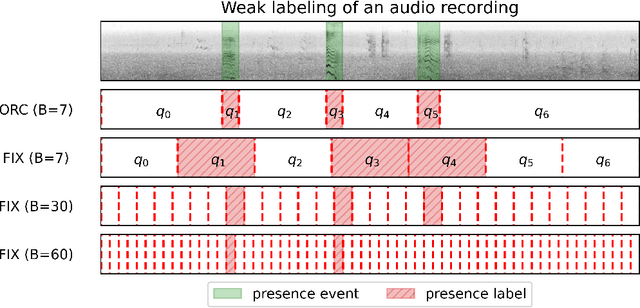

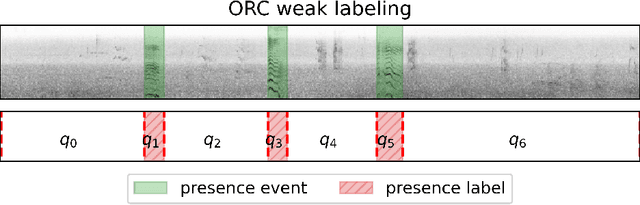
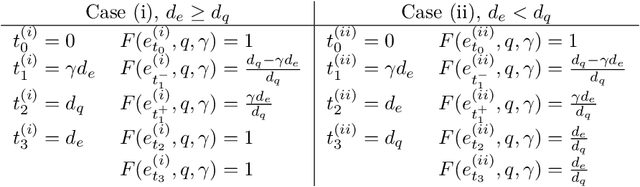
Accurate labels are critical for deriving robust machine learning models. Labels are used to train supervised learning models and to evaluate most machine learning paradigms. In this paper, we model the accuracy and cost of a common weak labeling process where annotators assign presence or absence labels to fixed-length data segments for a given event class. The annotator labels a segment as "present" if it sufficiently covers an event from that class, e.g., a birdsong sound event in audio data. We analyze how the segment length affects the label accuracy and the required number of annotations, and compare this fixed-length labeling approach with an oracle method that uses the true event activations to construct the segments. Furthermore, we quantify the gap between these methods and verify that in most realistic scenarios the oracle method is better than the fixed-length labeling method in both accuracy and cost. Our findings provide a theoretical justification for adaptive weak labeling strategies that mimic the oracle process, and a foundation for optimizing weak labeling processes in sequence labeling tasks.
From Weak to Strong Sound Event Labels using Adaptive Change-Point Detection and Active Learning
Mar 13, 2024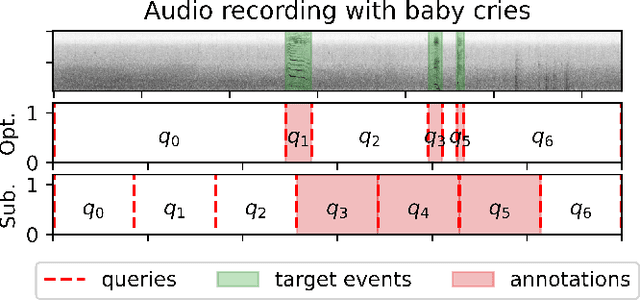

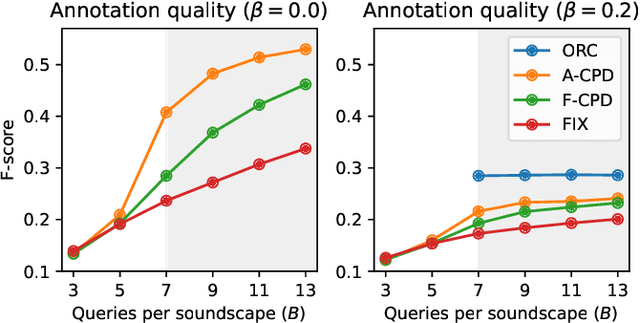
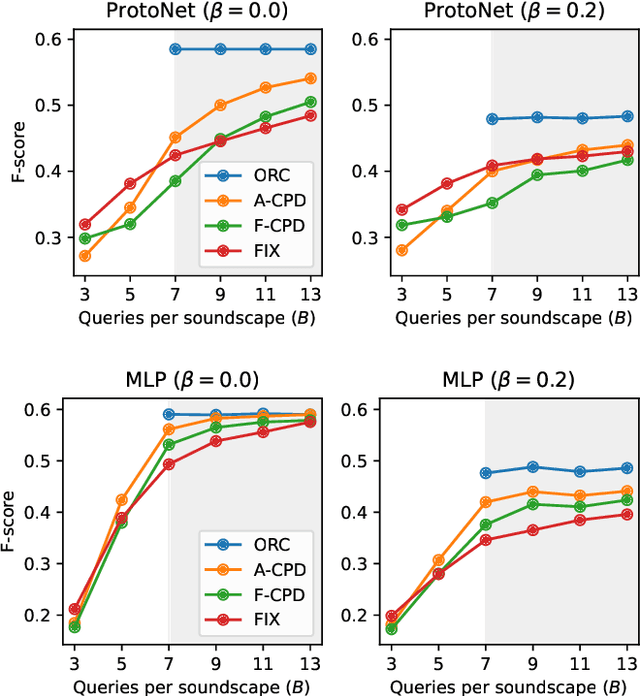
In this work we propose an audio recording segmentation method based on an adaptive change point detection (A-CPD) for machine guided weak label annotation of audio recording segments. The goal is to maximize the amount of information gained about the temporal activation's of the target sounds. For each unlabeled audio recording, we use a prediction model to derive a probability curve used to guide annotation. The prediction model is initially pre-trained on available annotated sound event data with classes that are disjoint from the classes in the unlabeled dataset. The prediction model then gradually adapts to the annotations provided by the annotator in an active learning loop. The queries used to guide the weak label annotator towards strong labels are derived using change point detection on these probabilities. We show that it is possible to derive strong labels of high quality even with a limited annotation budget, and show favorable results for A-CPD when compared to two baseline query strategies.