 Add to Chrome
 Add to Firefox
 Add to Edge
From Democracies to Autocracies: How AI Systems Enable Authoritarianism by Design
Jun 15, 2026
AI-enabled authoritarianism is not confined to autocracies. In this paper, we provide greater transparency by investigating and mapping the lifecycles of six AI systems deployed in different political regimes, ranging from the US to China. By drawing on an extensive range of sources (academic publications, investigative research reports, third-party evaluations, media interviews, government procurement notices), we conduct a systematic, qualitative comparison across systems to identify the critical technical and operational features that enable authoritarianism within their respective political contexts. We find that enabling features include the centralization and co-optation of administrative data for law enforcement and political punishment, regulatory gaps that fail to deter misuse, weak user compliance that nullifies human oversight mechanisms, and the encoding of protected group traits that identify members of vulnerable populations. We find that these features are present across systems deployed in autocratic and democratic regimes, albeit in varying configurations. We also find that both centralized and fragmented AI systems can contribute to authoritarianism by exploiting governance gaps: centralized systems directed by executive authorities, particularly within security and military institutions, are often not subjected to formal oversight mechanisms, while fragmented systems diffuse accountability between stakeholders, paving the way for entrenchment. These findings reveal that AI-enabled authoritarianism is distributed, resulting from design and operational choices made by developers, administrators, and users alike. We conclude with recommendations for developers and policymakers to mitigate these risks.

Sustainable Artificial Intelligence through Continual Learning
Nov 17, 2021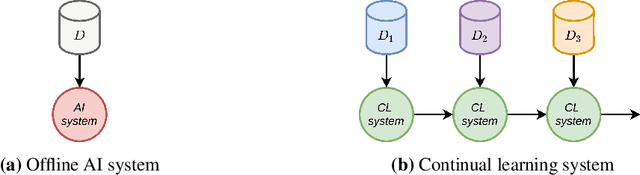
The increasing attention on Artificial Intelligence (AI) regulation has led to the definition of a set of ethical principles grouped into the Sustainable AI framework. In this article, we identify Continual Learning, an active area of AI research, as a promising approach towards the design of systems compliant with the Sustainable AI principles. While Sustainable AI outlines general desiderata for ethical applications, Continual Learning provides means to put such desiderata into practice.
Intelligent Drone Swarm for Search and Rescue Operations at Sea
Nov 13, 2018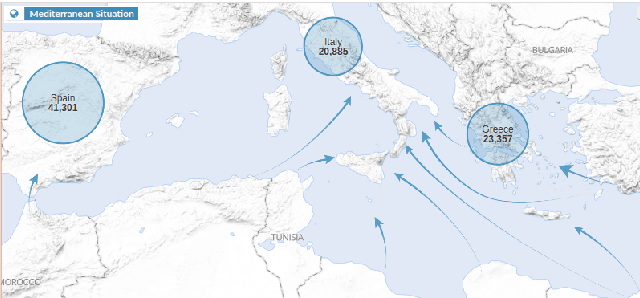
In recent years, a rising numbers of people arrived in the European Union, traveling across the Mediterranean Sea or overland through Southeast Europe in what has been later named as the European migrant crisis. In the last 5 years, more than 16 thousands people have lost their lives in the Mediterranean sea during the crossing. The United Nations Secretary General Strategy on New Technologies is supporting the use of Artificial Intelligence (AI) and Robotics to accelerate the achievement of the 2030 Sustainable Development Agenda, which includes safe and regular migration processes among the others. In the same spirit, the central idea of this project aims at using AI technology for Search And Rescue (SAR) operations at sea. In particular, we propose an autonomous fleet of self-organizing intelligent drones that would enable the coverage of a broader area, speeding-up the search processes and finally increasing the efficiency and effectiveness of migrants rescue operations.