 Add to Chrome
 Add to Firefox
 Add to Edge
Dynamic Resource Allocation for Ensemble Determinization MCTS
Jul 14, 2026
Simulation-based algorithms are especially suited for high-uncertainty environments such as adversarial board games with significant elements of randomness and hidden information. In particular, several Monte Carlo Tree Search (MCTS) variants are commonly used in such domains. In this paper, we propose a series of enhancements for Ensemble Determinization MCTS, introducing two axes for dynamic resource allocation. First, Dynamic Number of Determinizations, increases or decreases the number of currently used determinization trees depending on the behavior of so-far search. Second, Dynamic Simulation Allocation, splits the simulation budget nonuniformly across the determinization trees, using simulation-to-simulation decisions to choose the tree with potentially the best knowledge gain. As benchmark domains, we used three popular tabletop games: Jaipur, Lost Cities, and Splendor. Testing our proposed enhancements in iteration- and time-based settings showed that particular configurations yield a statistically significant increase in the algorithm's strength.

Magic-Informed Quantum Architecture Search
May 05, 2026Nonstabilizerness, commonly referred to as magic, is a fundamental resource underpinning quantum advantage. In this paper, we propose a magic-informed quantum architecture search (QAS) technique that enables control over a quantum resource within the general framework of circuit design. Inspired by the AlphaGo approach, we tackle the problem with a Monte Carlo Tree Search technique equipped with a Graph Neural Network (GNN) that estimates the magic of candidate quantum circuits. The GNN model induces a magic-based bias that steers the search toward either high- or low-magic regimes, depending on the target objective. We benchmark the proposed magic-informed QAS technique on both the structured ground-state energy problem and on the more general quantum state approximation problem, spanning different sizes and target magic levels. Experimental results show that the proposed technique effectively influences the magic across the search tree and notably also on the resulting final circuit, even in regimes where the GNN operates on out-of-distribution instances. Although introducing a problem-agnostic magic bias could, in principle, constrain the search dynamics, we observe consistent improvements in solution quality across all problems tested.
StratFormer: Adaptive Opponent Modeling and Exploitation in Imperfect-Information Games
Apr 28, 2026We present StratFormer, a transformer-based meta-agent that learns to simultaneously model and exploit opponents in imperfect-information games through a two-phase curriculum. The first phase trains an opponent modeling head to identify behavioral patterns from action histories while the agent plays a game-theoretic optimal (GTO) policy. The second phase progressively shifts the policy toward best-response (BR) exploitation, guided by a per-opponent regularization schedule tied to exploitability. Our architecture introduces dual-turn tokens -- feature vectors constructed at both agent and opponent decision points -- coupled with bucket-rate features that encode opponent tendencies across five strategic contexts. On Leduc Hold'em, a small poker variant with six cards and two betting rounds, we test against six opponent archetypes at two strength levels each, with exploitability ranging from 0.15 to 1.26 Big Blinds (BB) per hand. StratFormer achieves an average exploitation gain of +0.106 BB per hand over GTO, with peak gains of +0.821 against highly exploitable opponents, while maintaining near-equilibrium safety.
Asymmetric regularization mechanism for GAN training with Variational Inequalities
Jan 20, 2026We formulate the training of generative adversarial networks (GANs) as a Nash equilibrium seeking problem. To stabilize the training process and find a Nash equilibrium, we propose an asymmetric regularization mechanism based on the classic Tikhonov step and on a novel zero-centered gradient penalty. Under smoothness and a local identifiability condition induced by a Gauss-Newton Gramian, we obtain explicit Lipschitz and (strong)-monotonicity constants for the regularized operator. These constants ensure last-iterate linear convergence of a single-call Extrapolation-from-the-Past (EFTP) method. Empirical simulations on an academic example show that, even when strong monotonicity cannot be achieved, the asymmetric regularization is enough to converge to an equilibrium and stabilize the trajectory.
Variational Quantum Algorithms for Particle Track Reconstruction
Nov 14, 2025Quantum Computing is a rapidly developing field with the potential to tackle the increasing computational challenges faced in high-energy physics. In this work, we explore the potential and limitations of variational quantum algorithms in solving the particle track reconstruction problem. We present an analysis of two distinct formulations for identifying straight-line tracks in a multilayer detection system, inspired by the LHCb vertex detector. The first approach is formulated as a ground-state energy problem, while the second approach is formulated as a system of linear equations. This work addresses one of the main challenges when dealing with variational quantum algorithms on general problems, namely designing an expressive and efficient quantum ansatz working on tracking events with fixed detector geometry. For this purpose, we employed a quantum architecture search method based on Monte Carlo Tree Search to design the quantum circuits for different problem sizes. We provide experimental results to test our approach on both formulations for different problem sizes in terms of performance and computational cost.
Towards Explaining Monte-Carlo Tree Search by Using Its Enhancements
Jun 16, 2025Typically, research on Explainable Artificial Intelligence (XAI) focuses on black-box models within the context of a general policy in a known, specific domain. This paper advocates for the need for knowledge-agnostic explainability applied to the subfield of XAI called Explainable Search, which focuses on explaining the choices made by intelligent search techniques. It proposes Monte-Carlo Tree Search (MCTS) enhancements as a solution to obtaining additional data and providing higher-quality explanations while remaining knowledge-free, and analyzes the most popular enhancements in terms of the specific types of explainability they introduce. So far, no other research has considered the explainability of MCTS enhancements. We present a proof-of-concept that demonstrates the advantages of utilizing enhancements.
Generalized Proof-Number Monte-Carlo Tree Search
Jun 16, 2025This paper presents Generalized Proof-Number Monte-Carlo Tree Search: a generalization of recently proposed combinations of Proof-Number Search (PNS) with Monte-Carlo Tree Search (MCTS), which use (dis)proof numbers to bias UCB1-based Selection strategies towards parts of the search that are expected to be easily (dis)proven. We propose three core modifications of prior combinations of PNS with MCTS. First, we track proof numbers per player. This reduces code complexity in the sense that we no longer need disproof numbers, and generalizes the technique to be applicable to games with more than two players. Second, we propose and extensively evaluate different methods of using proof numbers to bias the selection strategy, achieving strong performance with strategies that are simpler to implement and compute. Third, we merge our technique with Score Bounded MCTS, enabling the algorithm to prove and leverage upper and lower bounds on scores - as opposed to only proving wins or not-wins. Experiments demonstrate substantial performance increases, reaching the range of 80% for 8 out of the 11 tested board games.
Quantum Circuit Design using a Progressive Widening Monte Carlo Tree Search
Feb 06, 2025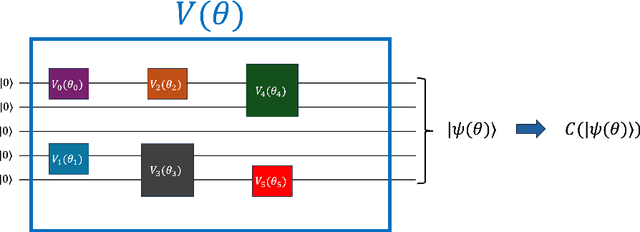
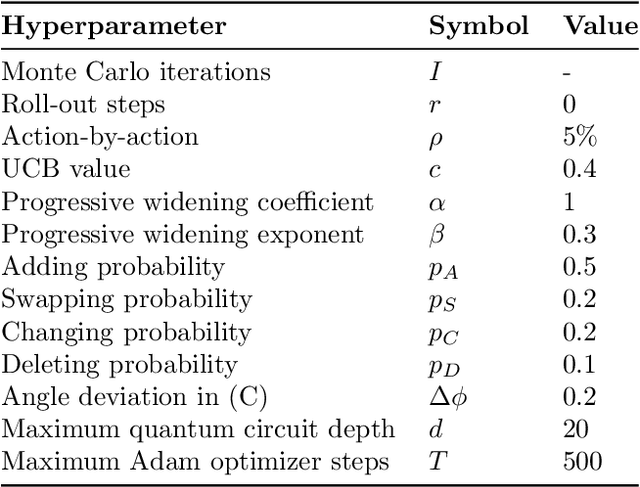
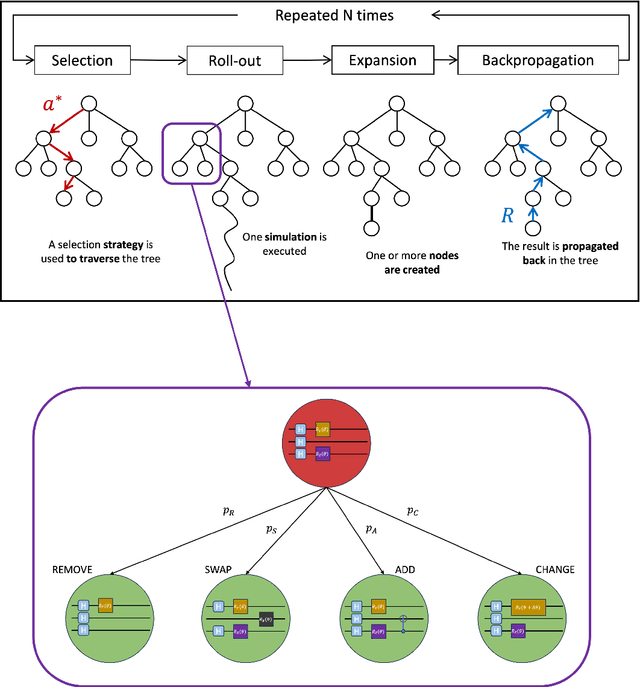
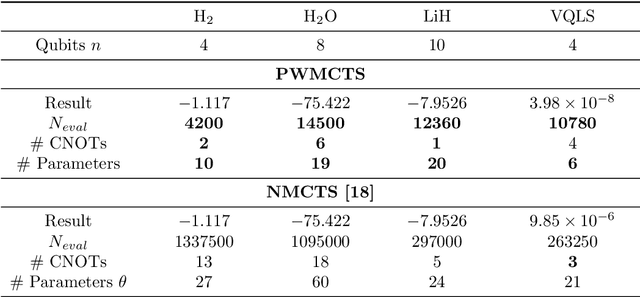
The performance of Variational Quantum Algorithms (VQAs) strongly depends on the choice of the parameterized quantum circuit to optimize. One of the biggest challenges in VQAs is designing quantum circuits tailored to the particular problem and to the quantum hardware. This article proposes a gradient-free Monte Carlo Tree Search (MCTS) technique to automate the process of quantum circuit design. It introduces a novel formulation of the action space based on a sampling scheme and a progressive widening technique to explore the space dynamically. When testing our MCTS approach on the domain of random quantum circuits, MCTS approximates unstructured circuits under different values of stabilizer R\'enyi entropy. It turns out that MCTS manages to approximate the benchmark quantum states independently from their degree of nonstabilizerness. Next, our technique exhibits robustness across various application domains, including quantum chemistry and systems of linear equations. Compared to previous MCTS research, our technique reduces the number of quantum circuit evaluations by a factor of 10 to 100 while achieving equal or better results. In addition, the resulting quantum circuits have up to three times fewer CNOT gates.
Environment Descriptions for Usability and Generalisation in Reinforcement Learning
Dec 22, 2024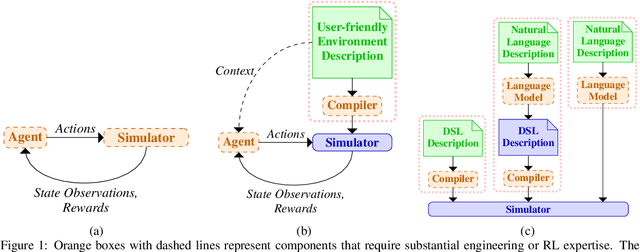
The majority of current reinforcement learning (RL) research involves training and deploying agents in environments that are implemented by engineers in general-purpose programming languages and more advanced frameworks such as CUDA or JAX. This makes the application of RL to novel problems of interest inaccessible to small organisations or private individuals with insufficient engineering expertise. This position paper argues that, to enable more widespread adoption of RL, it is important for the research community to shift focus towards methodologies where environments are described in user-friendly domain-specific or natural languages. Aside from improving the usability of RL, such language-based environment descriptions may also provide valuable context and boost the ability of trained agents to generalise to unseen environments within the set of all environments that can be described in any language of choice.
Anytime Sequential Halving in Monte-Carlo Tree Search
Nov 11, 2024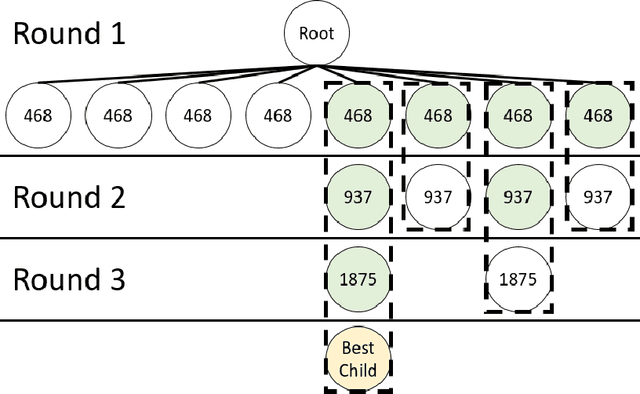

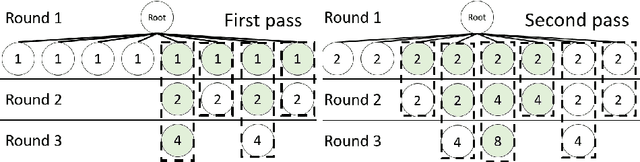

Monte-Carlo Tree Search (MCTS) typically uses multi-armed bandit (MAB) strategies designed to minimize cumulative regret, such as UCB1, as its selection strategy. However, in the root node of the search tree, it is more sensible to minimize simple regret. Previous work has proposed using Sequential Halving as selection strategy in the root node, as, in theory, it performs better with respect to simple regret. However, Sequential Halving requires a budget of iterations to be predetermined, which is often impractical. This paper proposes an anytime version of the algorithm, which can be halted at any arbitrary time and still return a satisfactory result, while being designed such that it approximates the behavior of Sequential Halving. Empirical results in synthetic MAB problems and ten different board games demonstrate that the algorithm's performance is competitive with Sequential Halving and UCB1 (and their analogues in MCTS).