 Add to Chrome
 Add to Firefox
 Add to Edge
Magic-Informed Quantum Architecture Search
May 05, 2026
Nonstabilizerness, commonly referred to as magic, is a fundamental resource underpinning quantum advantage. In this paper, we propose a magic-informed quantum architecture search (QAS) technique that enables control over a quantum resource within the general framework of circuit design. Inspired by the AlphaGo approach, we tackle the problem with a Monte Carlo Tree Search technique equipped with a Graph Neural Network (GNN) that estimates the magic of candidate quantum circuits. The GNN model induces a magic-based bias that steers the search toward either high- or low-magic regimes, depending on the target objective. We benchmark the proposed magic-informed QAS technique on both the structured ground-state energy problem and on the more general quantum state approximation problem, spanning different sizes and target magic levels. Experimental results show that the proposed technique effectively influences the magic across the search tree and notably also on the resulting final circuit, even in regimes where the GNN operates on out-of-distribution instances. Although introducing a problem-agnostic magic bias could, in principle, constrain the search dynamics, we observe consistent improvements in solution quality across all problems tested.

Quantum Circuit Design using a Progressive Widening Monte Carlo Tree Search
Feb 06, 2025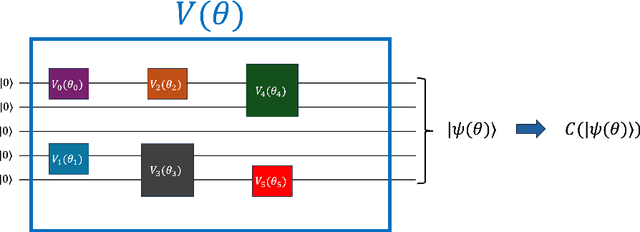
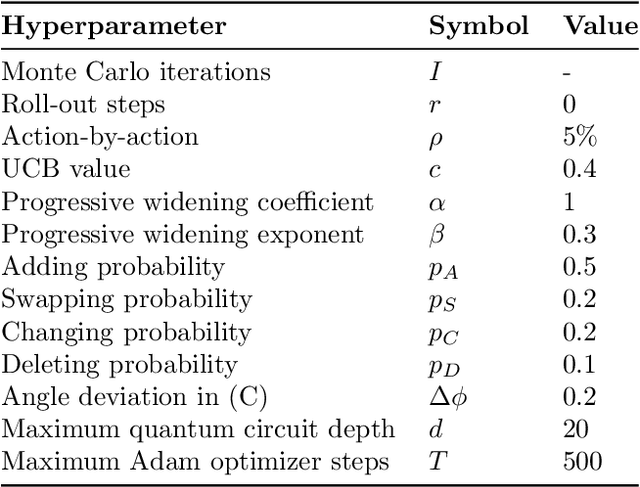
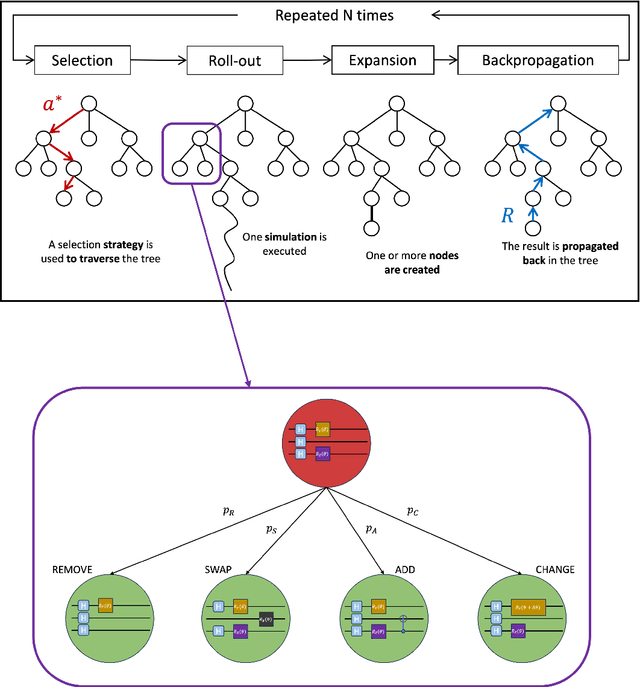
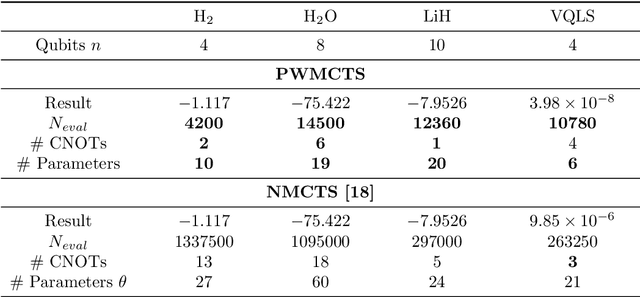
The performance of Variational Quantum Algorithms (VQAs) strongly depends on the choice of the parameterized quantum circuit to optimize. One of the biggest challenges in VQAs is designing quantum circuits tailored to the particular problem and to the quantum hardware. This article proposes a gradient-free Monte Carlo Tree Search (MCTS) technique to automate the process of quantum circuit design. It introduces a novel formulation of the action space based on a sampling scheme and a progressive widening technique to explore the space dynamically. When testing our MCTS approach on the domain of random quantum circuits, MCTS approximates unstructured circuits under different values of stabilizer R\'enyi entropy. It turns out that MCTS manages to approximate the benchmark quantum states independently from their degree of nonstabilizerness. Next, our technique exhibits robustness across various application domains, including quantum chemistry and systems of linear equations. Compared to previous MCTS research, our technique reduces the number of quantum circuit evaluations by a factor of 10 to 100 while achieving equal or better results. In addition, the resulting quantum circuits have up to three times fewer CNOT gates.