 Add to Chrome
 Add to Firefox
 Add to Edge
Neural Module Networks
Jul 24, 2017
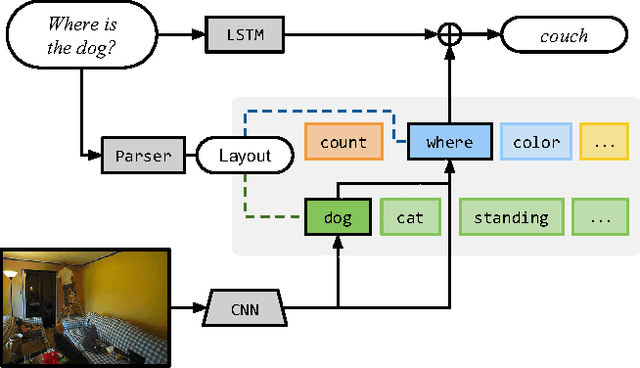

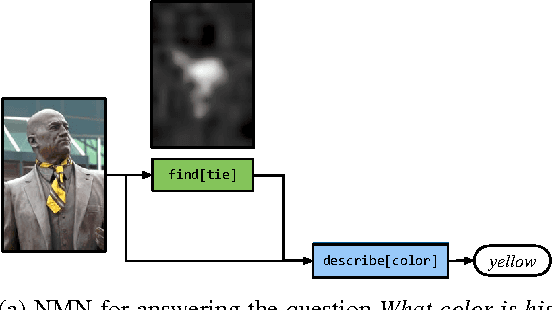
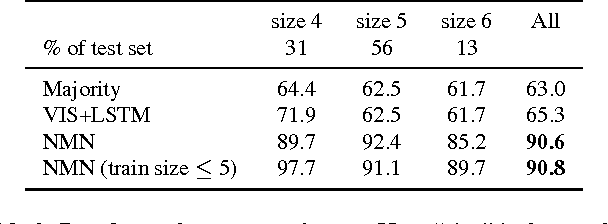
Visual question answering is fundamentally compositional in nature---a question like "where is the dog?" shares substructure with questions like "what color is the dog?" and "where is the cat?" This paper seeks to simultaneously exploit the representational capacity of deep networks and the compositional linguistic structure of questions. We describe a procedure for constructing and learning *neural module networks*, which compose collections of jointly-trained neural "modules" into deep networks for question answering. Our approach decomposes questions into their linguistic substructures, and uses these structures to dynamically instantiate modular networks (with reusable components for recognizing dogs, classifying colors, etc.). The resulting compound networks are jointly trained. We evaluate our approach on two challenging datasets for visual question answering, achieving state-of-the-art results on both the VQA natural image dataset and a new dataset of complex questions about abstract shapes.

Captioning Images with Diverse Objects
Jul 20, 2017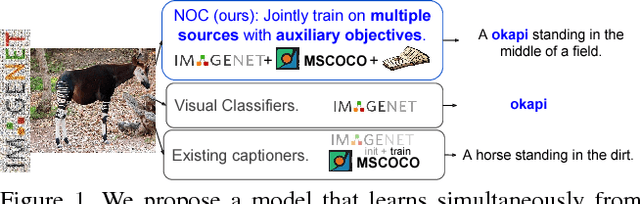

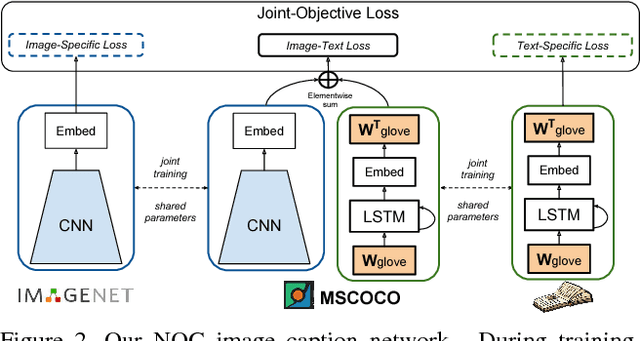
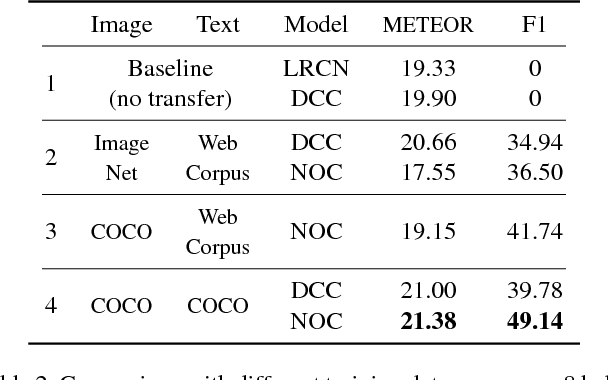
Recent captioning models are limited in their ability to scale and describe concepts unseen in paired image-text corpora. We propose the Novel Object Captioner (NOC), a deep visual semantic captioning model that can describe a large number of object categories not present in existing image-caption datasets. Our model takes advantage of external sources -- labeled images from object recognition datasets, and semantic knowledge extracted from unannotated text. We propose minimizing a joint objective which can learn from these diverse data sources and leverage distributional semantic embeddings, enabling the model to generalize and describe novel objects outside of image-caption datasets. We demonstrate that our model exploits semantic information to generate captions for hundreds of object categories in the ImageNet object recognition dataset that are not observed in MSCOCO image-caption training data, as well as many categories that are observed very rarely. Both automatic evaluations and human judgements show that our model considerably outperforms prior work in being able to describe many more categories of objects.
Generating Descriptions with Grounded and Co-Referenced People
Apr 05, 2017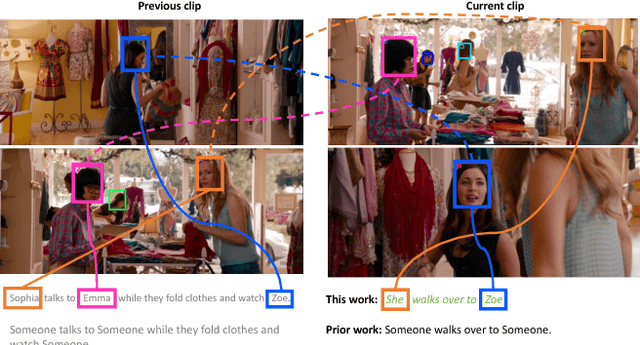
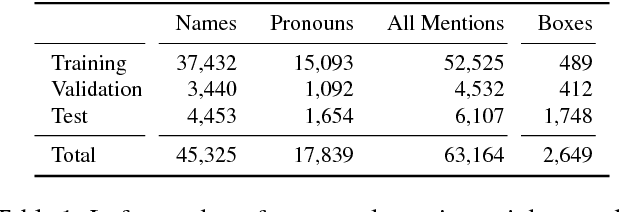
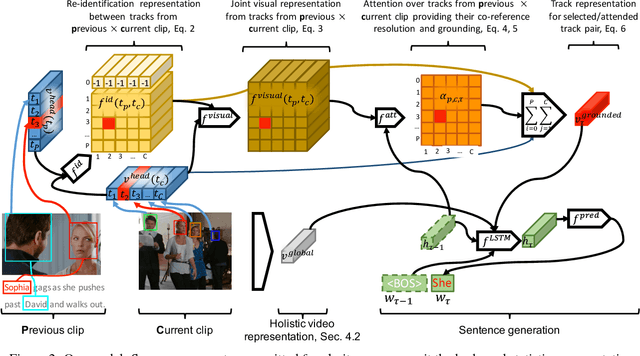
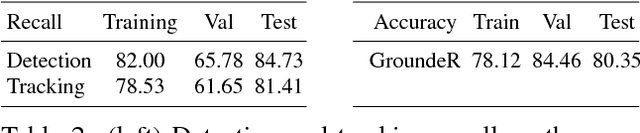
Learning how to generate descriptions of images or videos received major interest both in the Computer Vision and Natural Language Processing communities. While a few works have proposed to learn a grounding during the generation process in an unsupervised way (via an attention mechanism), it remains unclear how good the quality of the grounding is and whether it benefits the description quality. In this work we propose a movie description model which learns to generate description and jointly ground (localize) the mentioned characters as well as do visual co-reference resolution between pairs of consecutive sentences/clips. We also propose to use weak localization supervision through character mentions provided in movie descriptions to learn the character grounding. At training time, we first learn how to localize characters by relating their visual appearance to mentions in the descriptions via a semi-supervised approach. We then provide this (noisy) supervision into our description model which greatly improves its performance. Our proposed description model improves over prior work w.r.t. generated description quality and additionally provides grounding and local co-reference resolution. We evaluate it on the MPII Movie Description dataset using automatic and human evaluation measures and using our newly collected grounding and co-reference data for characters.
Grounding of Textual Phrases in Images by Reconstruction
Feb 17, 2017Grounding (i.e. localizing) arbitrary, free-form textual phrases in visual content is a challenging problem with many applications for human-computer interaction and image-text reference resolution. Few datasets provide the ground truth spatial localization of phrases, thus it is desirable to learn from data with no or little grounding supervision. We propose a novel approach which learns grounding by reconstructing a given phrase using an attention mechanism, which can be either latent or optimized directly. During training our approach encodes the phrase using a recurrent network language model and then learns to attend to the relevant image region in order to reconstruct the input phrase. At test time, the correct attention, i.e., the grounding, is evaluated. If grounding supervision is available it can be directly applied via a loss over the attention mechanism. We demonstrate the effectiveness of our approach on the Flickr 30k Entities and ReferItGame datasets with different levels of supervision, ranging from no supervision over partial supervision to full supervision. Our supervised variant improves by a large margin over the state-of-the-art on both datasets.
Modeling Relationships in Referential Expressions with Compositional Modular Networks
Nov 30, 2016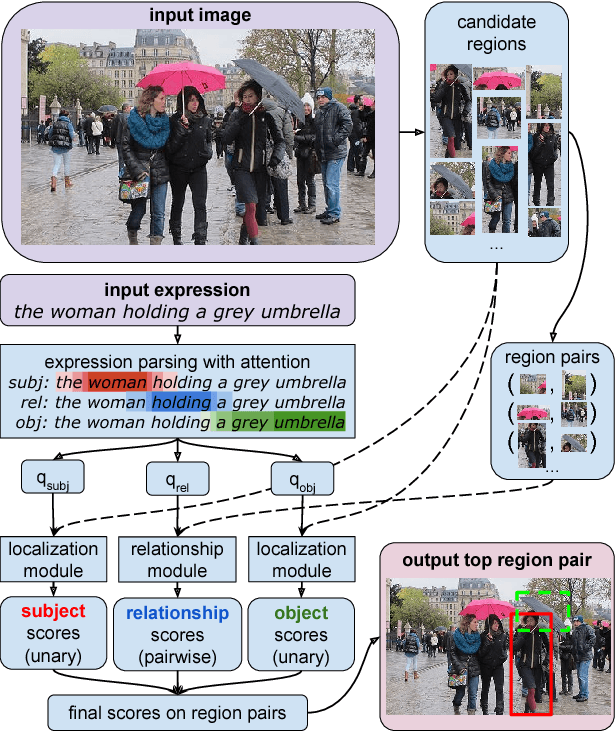
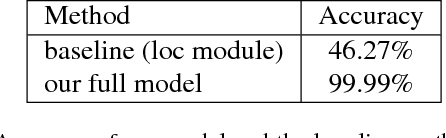
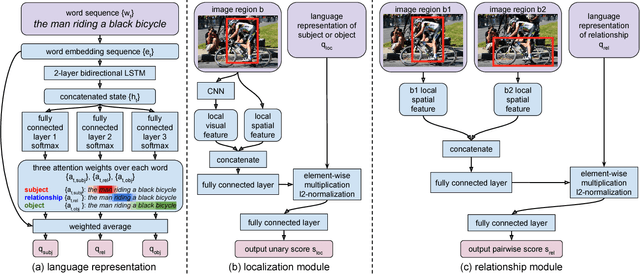
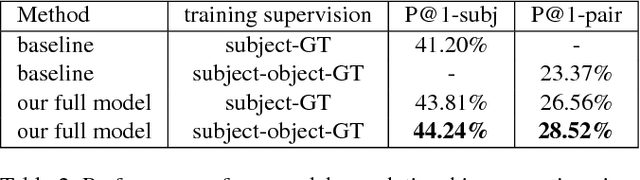
People often refer to entities in an image in terms of their relationships with other entities. For example, "the black cat sitting under the table" refers to both a "black cat" entity and its relationship with another "table" entity. Understanding these relationships is essential for interpreting and grounding such natural language expressions. Most prior work focuses on either grounding entire referential expressions holistically to one region, or localizing relationships based on a fixed set of categories. In this paper we instead present a modular deep architecture capable of analyzing referential expressions into their component parts, identifying entities and relationships mentioned in the input expression and grounding them all in the scene. We call this approach Compositional Modular Networks (CMNs): a novel architecture that learns linguistic analysis and visual inference end-to-end. Our approach is built around two types of neural modules that inspect local regions and pairwise interactions between regions. We evaluate CMNs on multiple referential expression datasets, outperforming state-of-the-art approaches on all tasks.
Ask Your Neurons: A Deep Learning Approach to Visual Question Answering
Nov 24, 2016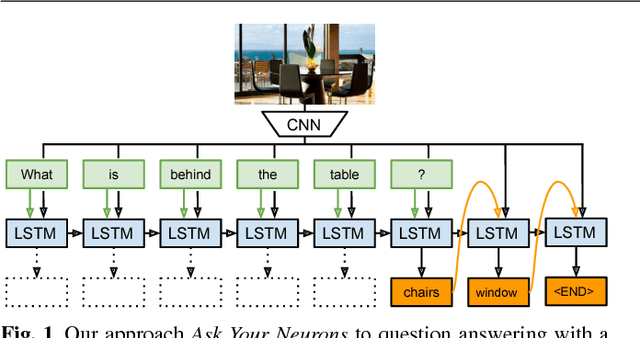
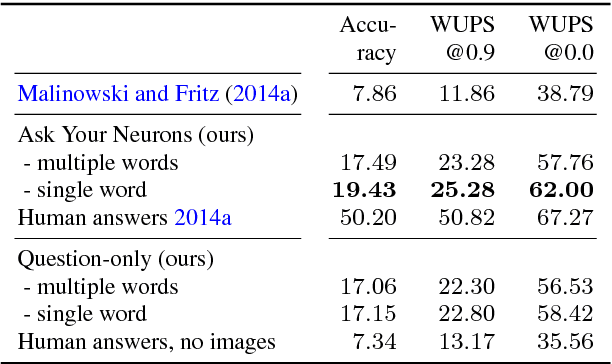
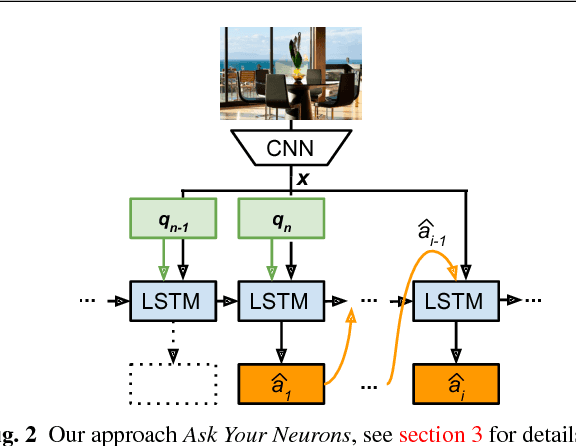
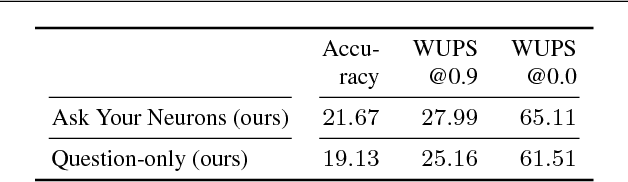
We address a question answering task on real-world images that is set up as a Visual Turing Test. By combining latest advances in image representation and natural language processing, we propose Ask Your Neurons, a scalable, jointly trained, end-to-end formulation to this problem. In contrast to previous efforts, we are facing a multi-modal problem where the language output (answer) is conditioned on visual and natural language inputs (image and question). We provide additional insights into the problem by analyzing how much information is contained only in the language part for which we provide a new human baseline. To study human consensus, which is related to the ambiguities inherent in this challenging task, we propose two novel metrics and collect additional answers which extend the original DAQUAR dataset to DAQUAR-Consensus. Moreover, we also extend our analysis to VQA, a large-scale question answering about images dataset, where we investigate some particular design choices and show the importance of stronger visual models. At the same time, we achieve strong performance of our model that still uses a global image representation. Finally, based on such analysis, we refine our Ask Your Neurons on DAQUAR, which also leads to a better performance on this challenging task.
Multimodal Compact Bilinear Pooling for Visual Question Answering and Visual Grounding
Sep 24, 2016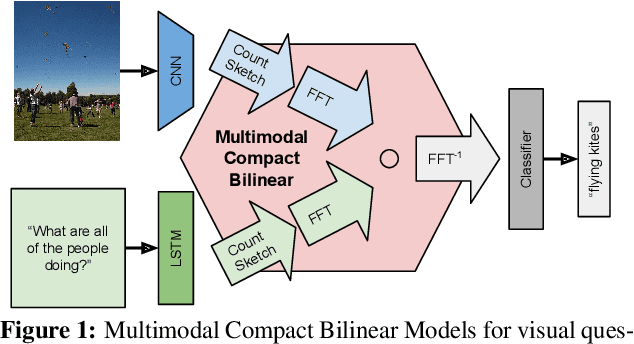
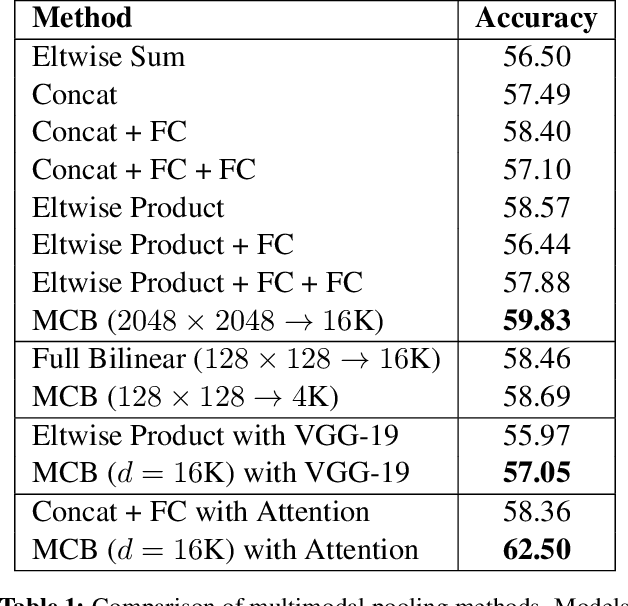
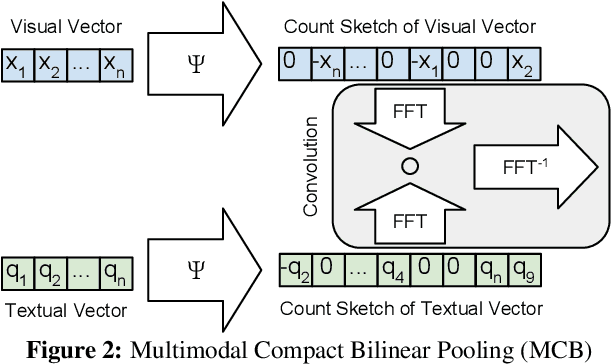
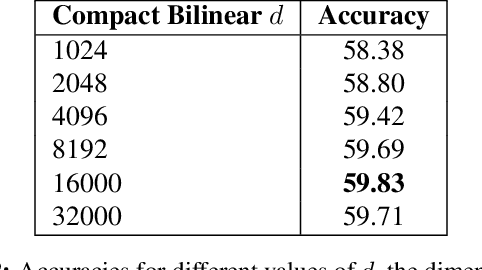
Modeling textual or visual information with vector representations trained from large language or visual datasets has been successfully explored in recent years. However, tasks such as visual question answering require combining these vector representations with each other. Approaches to multimodal pooling include element-wise product or sum, as well as concatenation of the visual and textual representations. We hypothesize that these methods are not as expressive as an outer product of the visual and textual vectors. As the outer product is typically infeasible due to its high dimensionality, we instead propose utilizing Multimodal Compact Bilinear pooling (MCB) to efficiently and expressively combine multimodal features. We extensively evaluate MCB on the visual question answering and grounding tasks. We consistently show the benefit of MCB over ablations without MCB. For visual question answering, we present an architecture which uses MCB twice, once for predicting attention over spatial features and again to combine the attended representation with the question representation. This model outperforms the state-of-the-art on the Visual7W dataset and the VQA challenge.
Utilizing Large Scale Vision and Text Datasets for Image Segmentation from Referring Expressions
Aug 30, 2016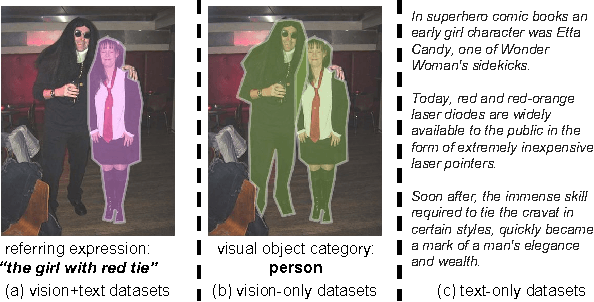
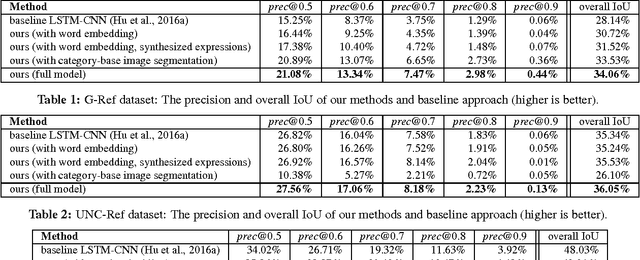
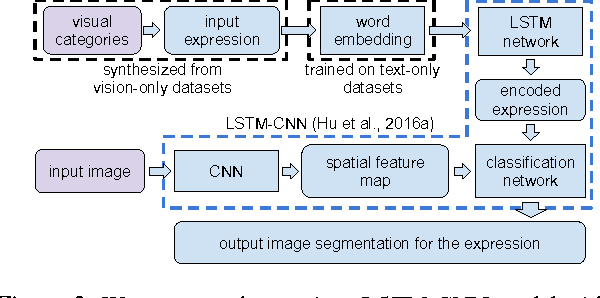
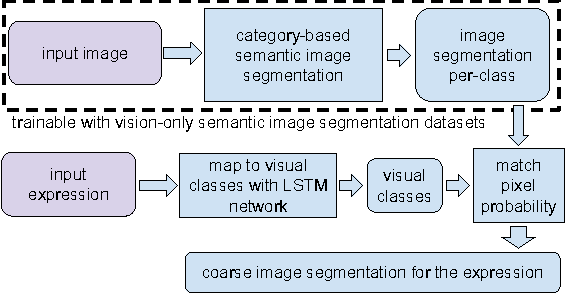
Image segmentation from referring expressions is a joint vision and language modeling task, where the input is an image and a textual expression describing a particular region in the image; and the goal is to localize and segment the specific image region based on the given expression. One major difficulty to train such language-based image segmentation systems is the lack of datasets with joint vision and text annotations. Although existing vision datasets such as MS COCO provide image captions, there are few datasets with region-level textual annotations for images, and these are often smaller in scale. In this paper, we explore how existing large scale vision-only and text-only datasets can be utilized to train models for image segmentation from referring expressions. We propose a method to address this problem, and show in experiments that our method can help this joint vision and language modeling task with vision-only and text-only data and outperforms previous results.
Learning to Compose Neural Networks for Question Answering
Jun 07, 2016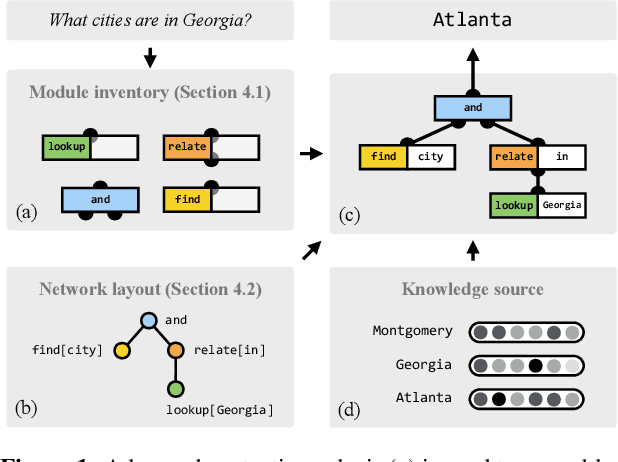
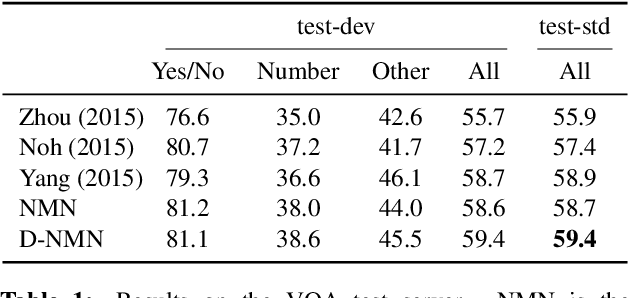
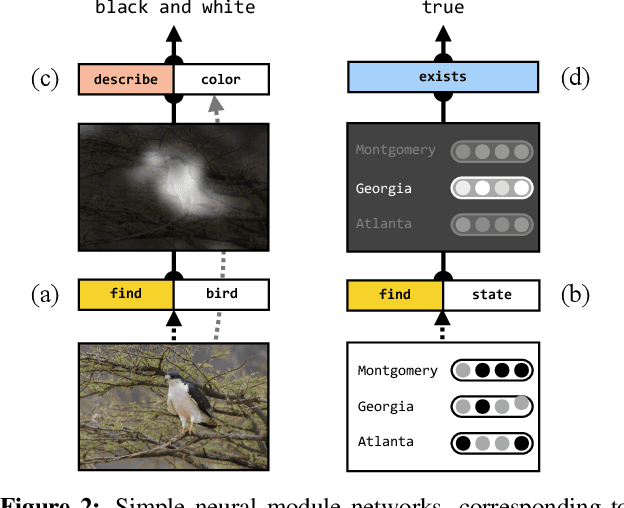
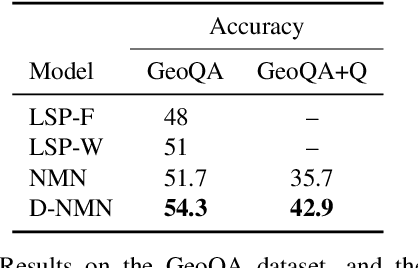
We describe a question answering model that applies to both images and structured knowledge bases. The model uses natural language strings to automatically assemble neural networks from a collection of composable modules. Parameters for these modules are learned jointly with network-assembly parameters via reinforcement learning, with only (world, question, answer) triples as supervision. Our approach, which we term a dynamic neural model network, achieves state-of-the-art results on benchmark datasets in both visual and structured domains.
Long-term Recurrent Convolutional Networks for Visual Recognition and Description
May 31, 2016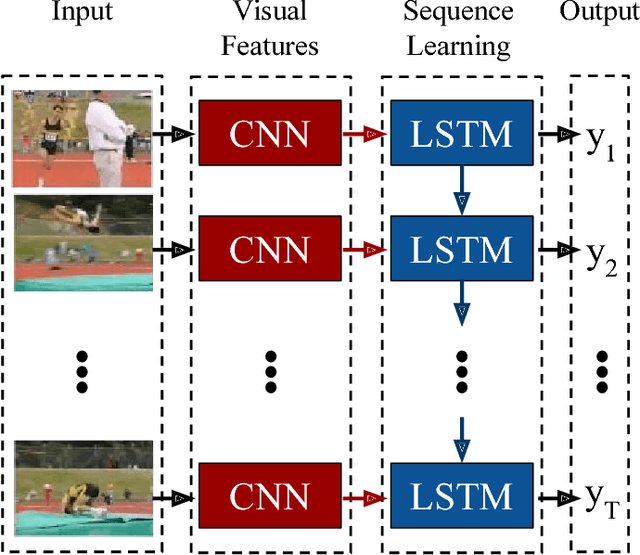
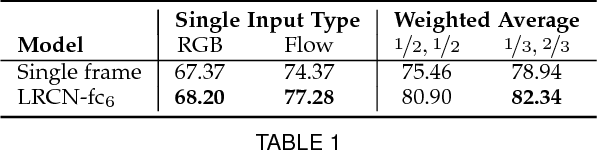
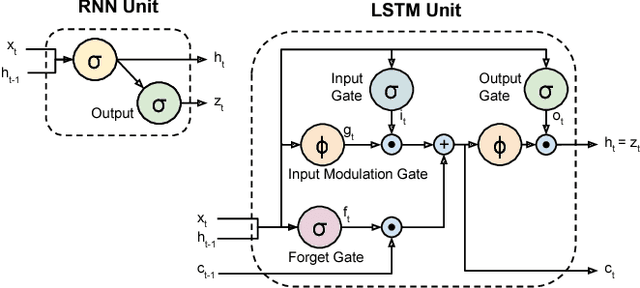
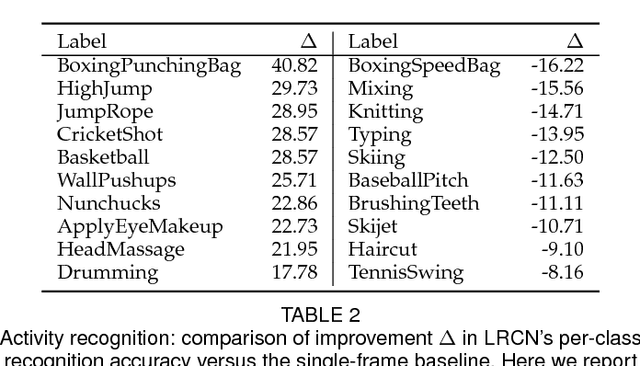
Models based on deep convolutional networks have dominated recent image interpretation tasks; we investigate whether models which are also recurrent, or "temporally deep", are effective for tasks involving sequences, visual and otherwise. We develop a novel recurrent convolutional architecture suitable for large-scale visual learning which is end-to-end trainable, and demonstrate the value of these models on benchmark video recognition tasks, image description and retrieval problems, and video narration challenges. In contrast to current models which assume a fixed spatio-temporal receptive field or simple temporal averaging for sequential processing, recurrent convolutional models are "doubly deep"' in that they can be compositional in spatial and temporal "layers". Such models may have advantages when target concepts are complex and/or training data are limited. Learning long-term dependencies is possible when nonlinearities are incorporated into the network state updates. Long-term RNN models are appealing in that they directly can map variable-length inputs (e.g., video frames) to variable length outputs (e.g., natural language text) and can model complex temporal dynamics; yet they can be optimized with backpropagation. Our recurrent long-term models are directly connected to modern visual convnet models and can be jointly trained to simultaneously learn temporal dynamics and convolutional perceptual representations. Our results show such models have distinct advantages over state-of-the-art models for recognition or generation which are separately defined and/or optimized.