 Add to Chrome
 Add to Firefox
 Add to Edge
AI-Generated Images: What Humans and Machines See When They Look at the Same Image
May 07, 2026
The misuse of generative AI in online disinformation campaigns highlights the urgent need for transparent and explainable detection systems. In this work, we investigate how detectors for AI-generated images can be more effective in providing human-understandable explanations for their predictions. To this end, we develop a suite of detectors with various architectures and fine-tuning strategies, trained on our large-scale photorealistic fake image dataset, AIText2Image, and assess their performance on state-of-the-art text-to-image AI generators. We integrate 16 different explainable AI (XAI) methods into our detection framework, and the visual explanations are comprehensively refined and evaluated through a novel approach that prioritizes human understanding of AI-generated images, using both textual and visual responses collected from a survey of 100 participants. This framework offers insights into visual-language cues in fake image detection and into the clarity of XAI methods from a human perspective, measuring the alignment of XAI outputs with human preferences.

A General Model for Deepfake Speech Detection: Diverse Bonafide Resources or Diverse AI-Based Generators
Mar 29, 2026In this paper, we analyze two main factors of Bonafide Resource (BR) or AI-based Generator (AG) which affect the performance and the generality of a Deepfake Speech Detection (DSD) model. To this end, we first propose a deep-learning based model, referred to as the baseline. Then, we conducted experiments on the baseline by which we indicate how Bonafide Resource (BR) and AI-based Generator (AG) factors affect the threshold score used to detect fake or bonafide input audio in the inference process. Given the experimental results, a dataset, which re-uses public Deepfake Speech Detection (DSD) datasets and shows a balance between Bonafide Resource (BR) or AI-based Generator (AG), is proposed. We then train various deep-learning based models on the proposed dataset and conduct cross-dataset evaluation on different benchmark datasets. The cross-dataset evaluation results prove that the balance of Bonafide Resources (BR) and AI-based Generators (AG) is the key factor to train and achieve a general Deepfake Speech Detection (DSD) model.
Aud-Sur: An Audio Analyzer Assistant for Audio Surveillance Applications
Mar 31, 2025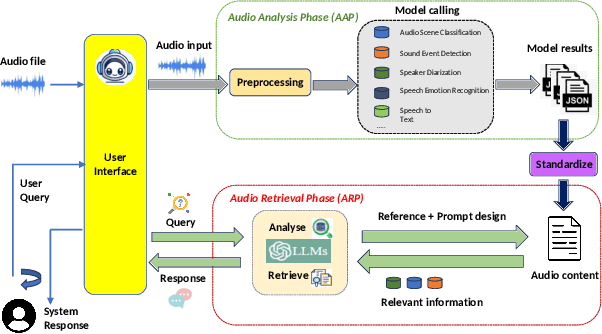
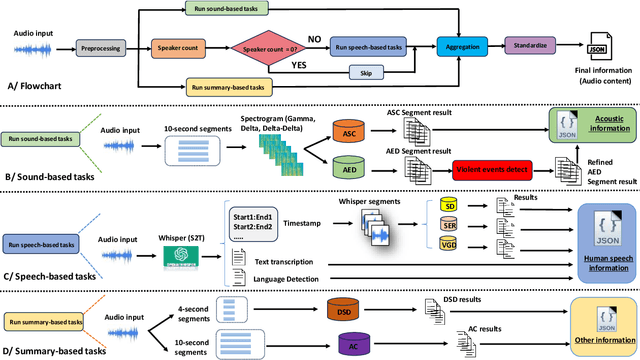
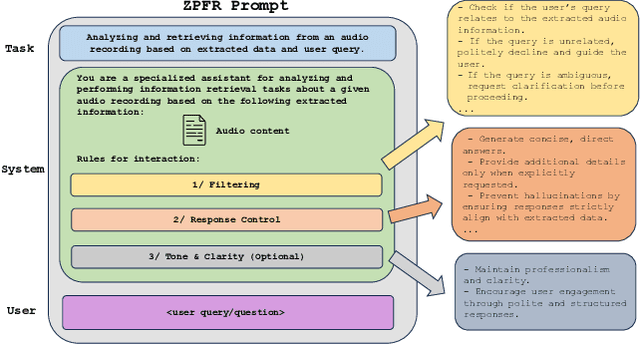
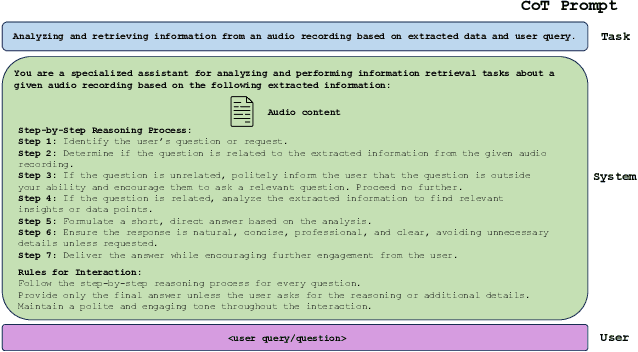
In this paper, we present an audio analyzer assistant tool designed for a wide range of audio-based surveillance applications (This work is a part of our DEFAME FAKES and EUCINF projects). The proposed tool, refered to as Aud-Sur, comprises two main phases Audio Analysis and Audio Retrieval, respectively. In the first phase, multiple open-source audio models are leveraged to extract information from input audio recording uploaded by a user. In the second phase, users interact with the Aud-Sur tool via a natural question-and-answer manner, powered by a large language model (LLM), to retrieve the information extracted from the processed audio file. The Aud-Sur tool was deployed using Docker on a microservices-based architecture design. By leveraging open-source audio models for information extraction, LLM for audio information retrieval, and a microservices-based deployment approach, the proposed Aud-Sur tool offers a highly extensible and adaptable framework that can integrate more audio tasks, and be widely shared within the audio community for further development.