 Add to Chrome
 Add to Firefox
 Add to Edge
A Collision-Free Sway Damping Model Predictive Controller for Safe and Reactive Forestry Crane Navigation
Feb 10, 2026
Forestry cranes operate in dynamic, unstructured outdoor environments where simultaneous collision avoidance and payload sway control are critical for safe navigation. Existing approaches address these challenges separately, either focusing on sway damping with predefined collision-free paths or performing collision avoidance only at the global planning level. We present the first collision-free, sway-damping model predictive controller (MPC) for a forestry crane that unifies both objectives in a single control framework. Our approach integrates LiDAR-based environment mapping directly into the MPC using online Euclidean distance fields (EDF), enabling real-time environmental adaptation. The controller simultaneously enforces collision constraints while damping payload sway, allowing it to (i) replan upon quasi-static environmental changes, (ii) maintain collision-free operation under disturbances, and (iii) provide safe stopping when no bypass exists. Experimental validation on a real forestry crane demonstrates effective sway damping and successful obstacle avoidance. A video can be found at https://youtu.be/tEXDoeLLTxA.

Efficient Collision Detection for Long and Slender Robotic Links in Euclidean Distance Fields: Application to a Forestry Crane
Jul 02, 2025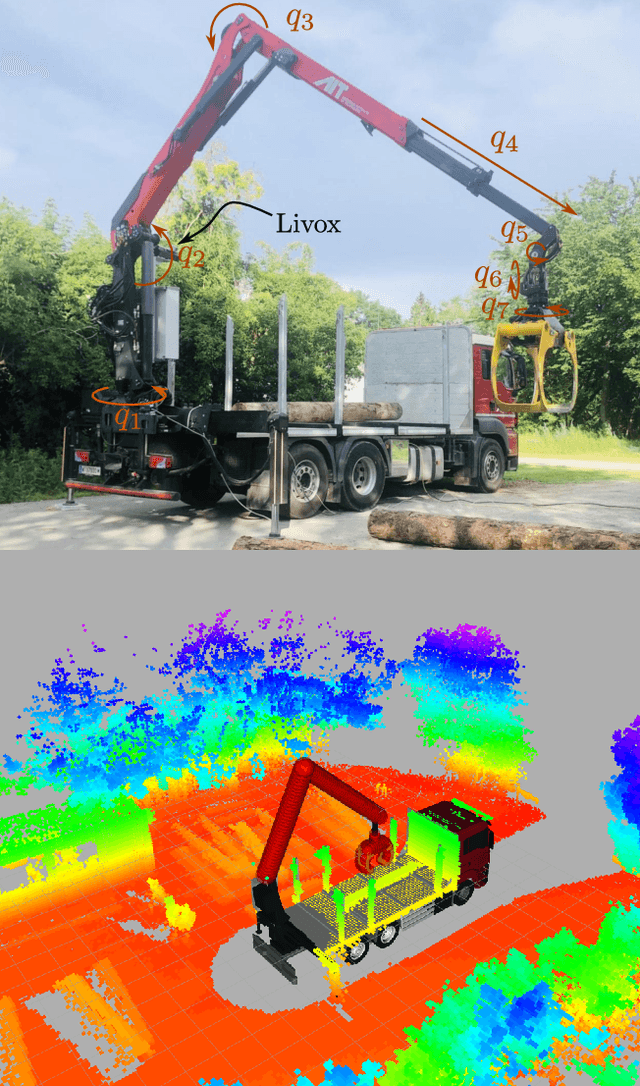
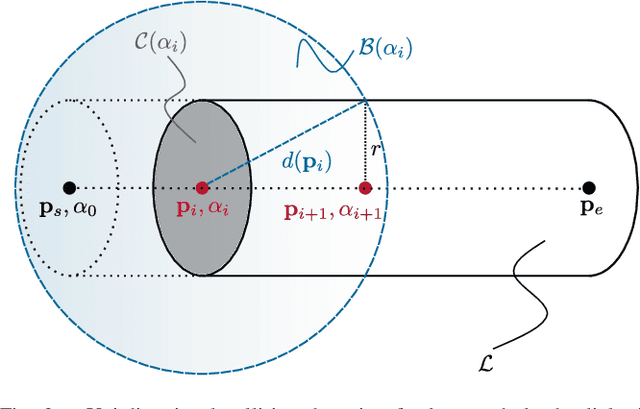
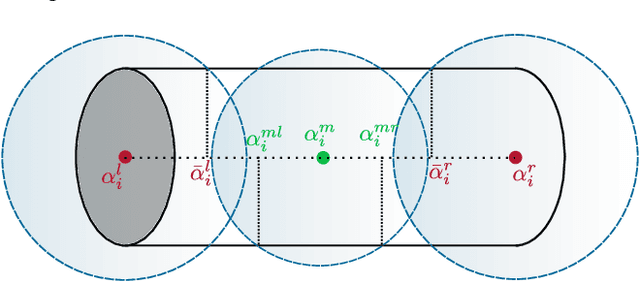
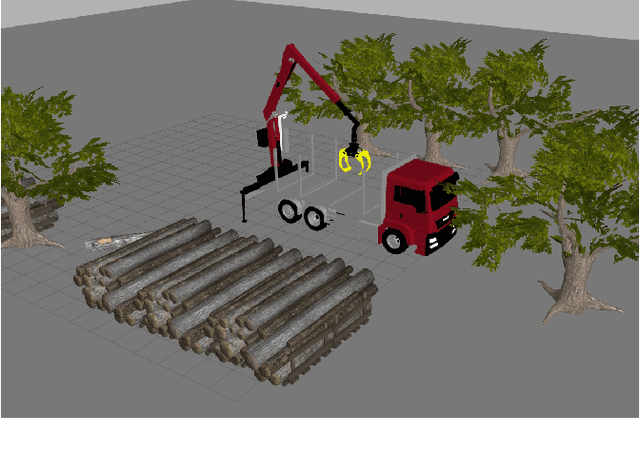
Collision-free motion planning in complex outdoor environments relies heavily on perceiving the surroundings through exteroceptive sensors. A widely used approach represents the environment as a voxelized Euclidean distance field, where robots are typically approximated by spheres. However, for large-scale manipulators such as forestry cranes, which feature long and slender links, this conventional spherical approximation becomes inefficient and inaccurate. This work presents a novel collision detection algorithm specifically designed to exploit the elongated structure of such manipulators, significantly enhancing the computational efficiency of motion planning algorithms. Unlike traditional sphere decomposition methods, our approach not only improves computational efficiency but also naturally eliminates the need to fine-tune the approximation accuracy as an additional parameter. We validate the algorithm's effectiveness using real-world LiDAR data from a forestry crane application, as well as simulated environment data.