 Add to Chrome
 Add to Firefox
 Add to Edge
Spatially-Aware Adaptive Trajectory Optimization with Controller-Guided Feedback for Autonomous Racing
Feb 17, 2026
We present a closed-loop framework for autonomous raceline optimization that combines NURBS-based trajectory representation, CMA-ES global trajectory optimization, and controller-guided spatial feedback. Instead of treating tracking errors as transient disturbances, our method exploits them as informative signals of local track characteristics via a Kalman-inspired spatial update. This enables the construction of an adaptive, acceleration-based constraint map that iteratively refines trajectories toward near-optimal performance under spatially varying track and vehicle behavior. In simulation, our approach achieves a 17.38% lap time reduction compared to a controller parametrized with maximum static acceleration. On real hardware, tested with different tire compounds ranging from high to low friction, we obtain a 7.60% lap time improvement without explicitly parametrizing friction. This demonstrates robustness to changing grip conditions in real-world scenarios.

Towards Autonomous Wood-Log Grasping with a Forestry Crane: Simulator and Benchmarking
Feb 03, 2025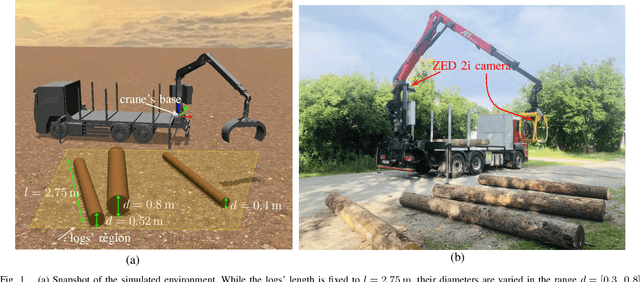
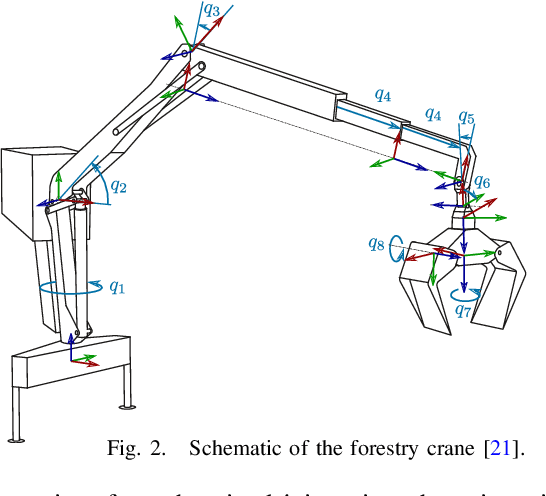

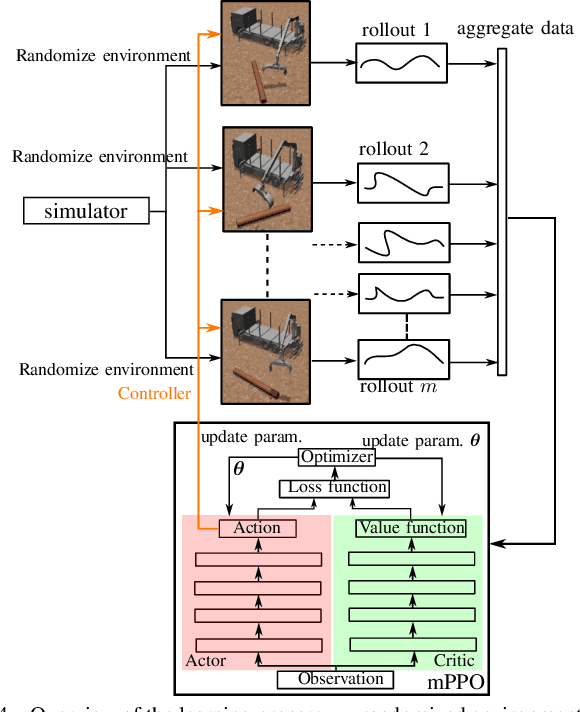
Forestry machines operated in forest production environments face challenges when performing manipulation tasks, especially regarding the complicated dynamics of underactuated crane systems and the heavy weight of logs to be grasped. This study investigates the feasibility of using reinforcement learning for forestry crane manipulators in grasping and lifting heavy wood logs autonomously. We first build a simulator using Mujoco physics engine to create realistic scenarios, including modeling a forestry crane with 8 degrees of freedom from CAD data and wood logs of different sizes. We further implement a velocity controller for autonomous log grasping with deep reinforcement learning using a curriculum strategy. Utilizing our new simulator, the proposed control strategy exhibits a success rate of 96% when grasping logs of different diameters and under random initial configurations of the forestry crane. In addition, reward functions and reinforcement learning baselines are implemented to provide an open-source benchmark for the community in large-scale manipulation tasks. A video with several demonstrations can be seen at https://www.acin.tuwien.ac.at/en/d18a/