 Add to Chrome
 Add to Firefox
 Add to Edge
Towards Robot Skill Learning and Adaptation with Gaussian Processes
Mar 02, 2026
General robot skill adaptation requires expressive representations robust to varying task configurations. While recent learning-based skill adaptation methods refined via Reinforcement Learning (RL), have shown success, existing skill models often lack sufficient representational capacity for anything beyond minor environmental changes. In contrast, Gaussian Process (GP)-based skill modelling provides an expressive representation with useful analytical properties; however, adaptation of GP-based skills remains underexplored. This paper proposes a novel, robust skill adaptation framework that utilises GPs with sparse via-points for compact and expressive modelling. The model considers the trajectory's poses and leverages its first and second analytical derivatives to preserve the skill's kinematic profile. We present three adaptation methods to cater for the variability between initial and observed configurations. Firstly, an optimisation agent that adjusts the path's via-points while preserving the demonstration velocity. Second, a behaviour cloning agent trained to replicate output trajectories from the optimisation agent. Lastly, an RL agent that has learnt to modify via-points whilst maintaining the kinematic profile and enabling online capabilities. Evaluated across three tasks (drawer opening, cube-pushing and bar manipulation) in both simulation and hardware, our proposed methods outperform every benchmark in success rates. Furthermore, the results demonstrate that the GP-based representation enables all three methods to attain high cosine similarity and low velocity magnitude errors, indicating strong preservation of the kinematic profile. Overall, our formulation provides a compact representation capable of adapting to large deviations from a single demonstrated skill.

Guide-LLM: An Embodied LLM Agent and Text-Based Topological Map for Robotic Guidance of People with Visual Impairments
Oct 28, 2024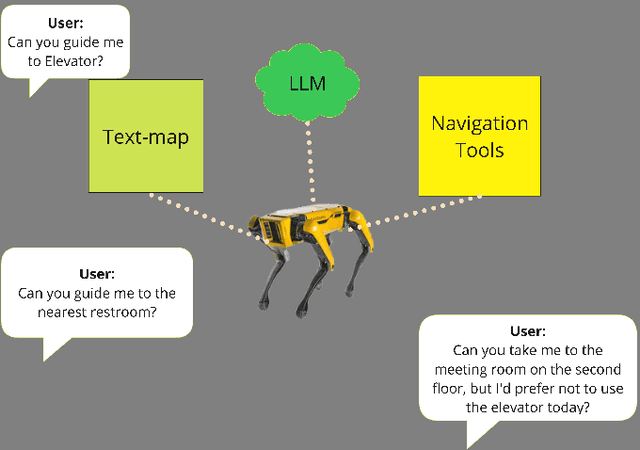
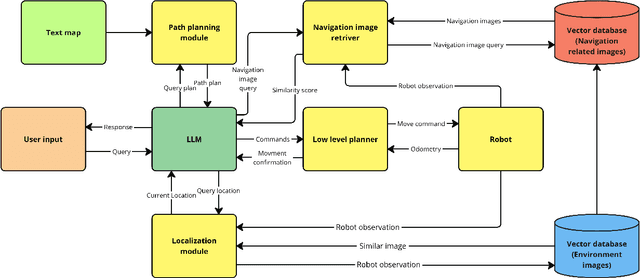
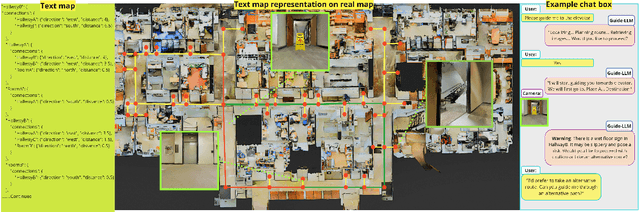
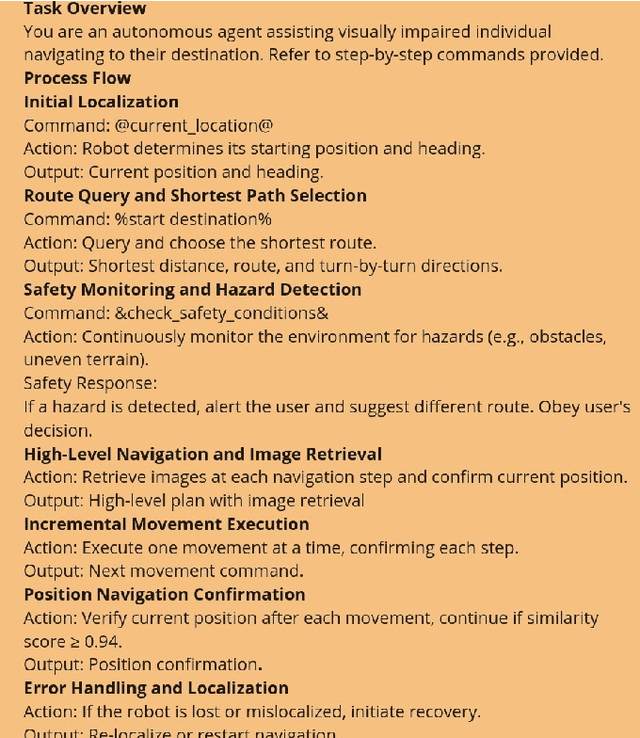
Navigation presents a significant challenge for persons with visual impairments (PVI). While traditional aids such as white canes and guide dogs are invaluable, they fall short in delivering detailed spatial information and precise guidance to desired locations. Recent developments in large language models (LLMs) and vision-language models (VLMs) offer new avenues for enhancing assistive navigation. In this paper, we introduce Guide-LLM, an embodied LLM-based agent designed to assist PVI in navigating large indoor environments. Our approach features a novel text-based topological map that enables the LLM to plan global paths using a simplified environmental representation, focusing on straight paths and right-angle turns to facilitate navigation. Additionally, we utilize the LLM's commonsense reasoning for hazard detection and personalized path planning based on user preferences. Simulated experiments demonstrate the system's efficacy in guiding PVI, underscoring its potential as a significant advancement in assistive technology. The results highlight Guide-LLM's ability to offer efficient, adaptive, and personalized navigation assistance, pointing to promising advancements in this field.