 Add to Chrome
 Add to Firefox
 Add to Edge
Overcoming Visual Clutter in Vision Language Action Models via Concept-Gated Visual Distillation
Mar 11, 2026
Vision-Language-Action (VLA) models demonstrate impressive zero-shot generalization but frequently suffer from a "Precision-Reasoning Gap" in cluttered environments. This failure is driven by background-induced feature dilution, where high-frequency semantic noise corrupts the geometric grounding required for precise manipulation. To bridge this gap, we propose Concept-Gated Visual Distillation (CGVD), a training-free, model-agnostic inference framework that stabilizes VLA policies. CGVD operates by parsing instructions into safe and distractor sets, utilizing a two-layer target refinement process--combining cross-validation and spatial disambiguation--to explicitly penalize false positives and isolate genuine manipulation targets. We then process the scene via Fourier-based inpainting, generating a clean observation that actively suppresses semantic distractors while preserving critical spatial geometry and visual proprioception. Extensive evaluations in highly cluttered manipulation tasks demonstrate that CGVD prevents performance collapse. In environments with dense semantic distractors, our method significantly outperforms state-of-the-art baselines, achieving a 77.5% success rate compared to the baseline's 43.0%. By enforcing strict attribute adherence, CGVD establishes inference-time visual distillation as a critical prerequisite for robust robotic manipulation in the clutter.

Guide-LLM: An Embodied LLM Agent and Text-Based Topological Map for Robotic Guidance of People with Visual Impairments
Oct 28, 2024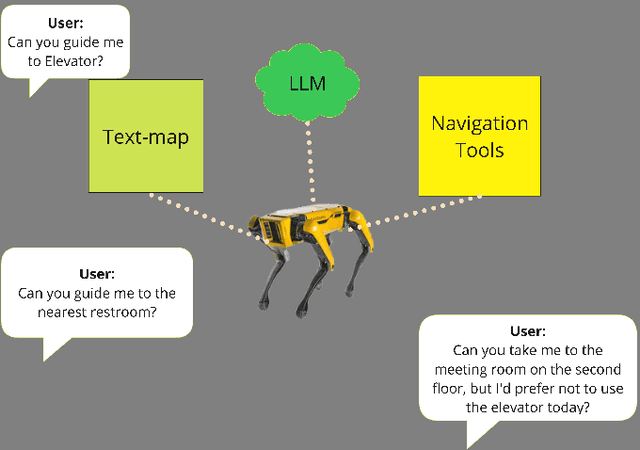
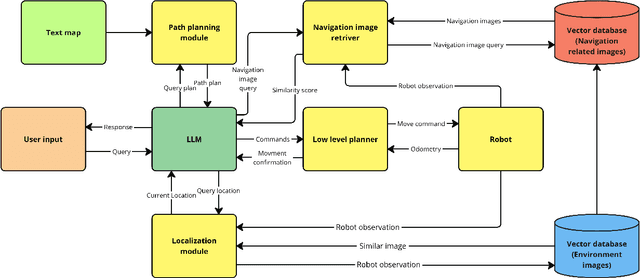
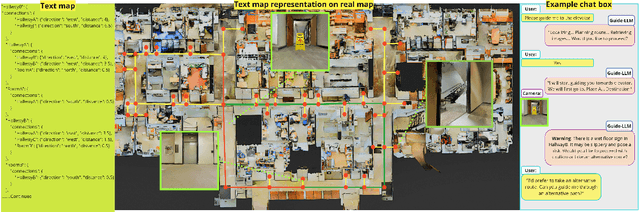
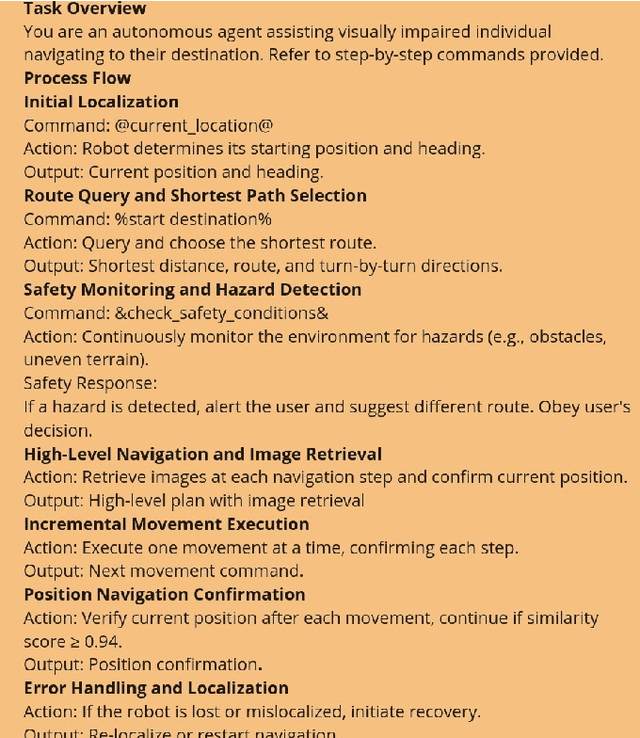
Navigation presents a significant challenge for persons with visual impairments (PVI). While traditional aids such as white canes and guide dogs are invaluable, they fall short in delivering detailed spatial information and precise guidance to desired locations. Recent developments in large language models (LLMs) and vision-language models (VLMs) offer new avenues for enhancing assistive navigation. In this paper, we introduce Guide-LLM, an embodied LLM-based agent designed to assist PVI in navigating large indoor environments. Our approach features a novel text-based topological map that enables the LLM to plan global paths using a simplified environmental representation, focusing on straight paths and right-angle turns to facilitate navigation. Additionally, we utilize the LLM's commonsense reasoning for hazard detection and personalized path planning based on user preferences. Simulated experiments demonstrate the system's efficacy in guiding PVI, underscoring its potential as a significant advancement in assistive technology. The results highlight Guide-LLM's ability to offer efficient, adaptive, and personalized navigation assistance, pointing to promising advancements in this field.