 Add to Chrome
 Add to Firefox
 Add to Edge
Multi-Agent Framework for Audit Risk Assessment with Explicit Uncertainty and Evidence Conflict Modeling
Jun 14, 2026
Audit risk assessment increasingly benefits from combining heterogeneous evidence sources, yet existing approaches typically produce point predictions without quantifying how well different evidence streams agree. We propose UMAR (Uncertainty-Aware Multi-Agent Risk Assessment), a framework that employs three specialized agents: an MD&A Text Agent, a Financial Ratio Agent, and a CAM Agent, each producing independent risk scores with calibrated uncertainty estimates. An Uncertainty Aggregator based on Dempster-Shafer evidence theory fuses these scores while explicitly measuring inter-agent conflict. We evaluate UMAR on a U.S. dataset of 3,200 firm-year observations from SEC 10-K filings (2019-2023), with financial restatement as the target label. Experimental results show that UMAR achieves an AUROC of 0.782 and a PR-AUC of 0.341, outperforming logistic regression, XGBoost, FinBERT, and single-agent and dual-agent LLM baselines. UMAR attains the lowest expected calibration error (ECE = 0.052) among all methods and identifies evidence-conflict patterns that correlate with actual restatement risk, offering auditors potentially actionable and interpretable risk signals.

DeepACC:Automate Chromosome Classification based on Metaphase Images using Deep Learning Framework Fused with Prior Knowledge
Jun 28, 2020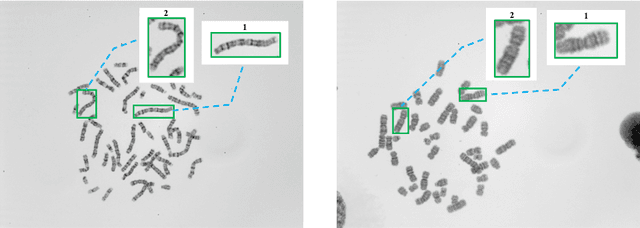
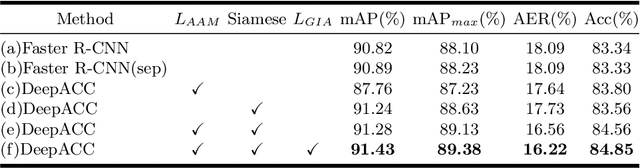
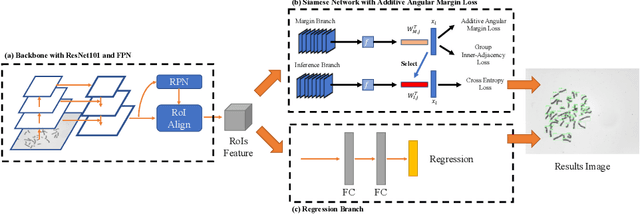
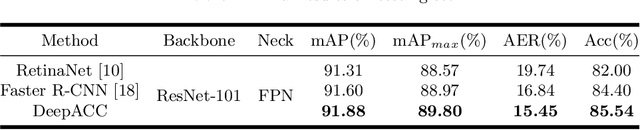
Chromosome classification is an important but difficult and tedious task in karyotyping. Previous methods only classify manually segmented single chromosome, which is far from clinical practice. In this work, we propose a detection based method, DeepACC, to locate and fine classify chromosomes simultaneously based on the whole metaphase image. We firstly introduce the Additive Angular Margin Loss to enhance the discriminative power of model. To alleviate batch effects, we transform decision boundary of each class case-by-case through a siamese network which make full use of prior knowledges that chromosomes usually appear in pairs. Furthermore, we take the clinically seven group criterion as a prior knowledge and design an additional Group Inner-Adjacency Loss to further reduce inter-class similarities. 3390 metaphase images from clinical laboratory are collected and labelled to evaluate the performance. Results show that the new design brings encouraging performance gains comparing to the state-of-the-art baselines.