 Add to Chrome
 Add to Firefox
 Add to Edge
The Individual-Targeting Assumption: A Systematic Review of Proactive Robots in Human Group Settings
Jul 02, 2026
Proactive robots are increasingly deployed in public environments where people are encountered not as isolated individuals but as members of cohesive social groups. Yet whether the prevailing design paradigm in proactive human-robot interaction (HRI) accounts for the relational structure that defines a group as a social unit remains largely unexamined. Through a systematic review of 63 proactive HRI studies in group settings from 2000 to 2025, we identify a recurring tendency, the Individual-Targeting Assumption (ITA), in which robots treat co-present people as independent engagement targets. We find that ITA is present in 60.3% of the corpus, with group-aware approaches emerging almost entirely after the robot is already embedded in an ongoing interaction. Critically, how a robot should detect and negotiate entry into a pre-formed group before initiating contact remains unaddressed across the corpus. Three failure modes, engagement misdetection, social ratification blindness, and bystander neglect, emerge as recurring patterns when proactive robots interact with human groups. These findings reframe proactive HRI in group settings not as an extension of dyadic interaction but as a qualitatively distinct design problem, and they identify the robot's approach to the group during the entry phase as a critical and understudied open challenge.

Rapidly Built Medical Crash Cart! Lessons Learned and Impacts on High-Stakes Team Collaboration in the Emergency Room
Feb 25, 2025


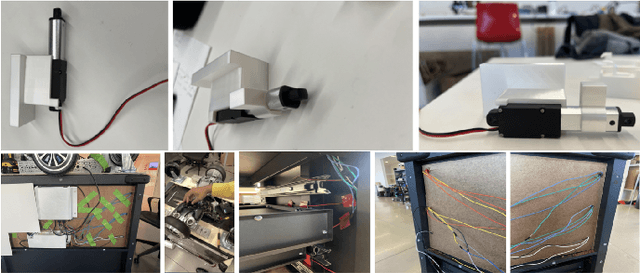
Designing robots to support high-stakes teamwork in emergency settings presents unique challenges, including seamless integration into fast-paced environments, facilitating effective communication among team members, and adapting to rapidly changing situations. While teleoperated robots have been successfully used in high-stakes domains such as firefighting and space exploration, autonomous robots that aid highs-takes teamwork remain underexplored. To address this gap, we conducted a rapid prototyping process to develop a series of seemingly autonomous robot designed to assist clinical teams in the Emergency Room. We transformed a standard crash cart--which stores medical equipment and emergency supplies into a medical robotic crash cart (MCCR). The MCCR was evaluated through field deployments to assess its impact on team workload and usability, identified taxonomies of failure, and refined the MCCR in collaboration with healthcare professionals. Our work advances the understanding of robot design for high-stakes, time-sensitive settings, providing insights into useful MCCR capabilities and considerations for effective human-robot collaboration. By publicly disseminating our MCCR tutorial, we hope to encourage HRI researchers to explore the design of robots for high-stakes teamwork.
Social Mediation through Robots -- A Scoping Review on Improving Group Interactions through Directed Robot Action using an Extended Group Process Model
Sep 10, 2024
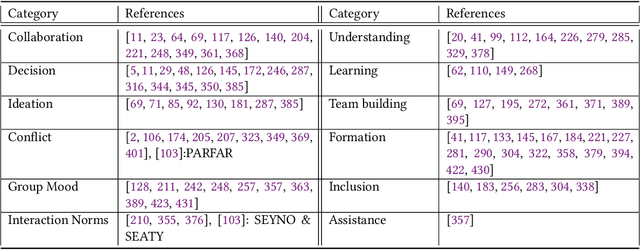
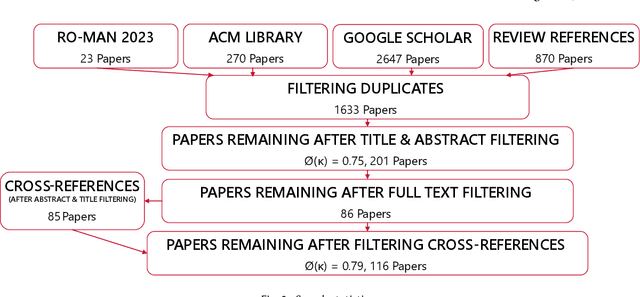
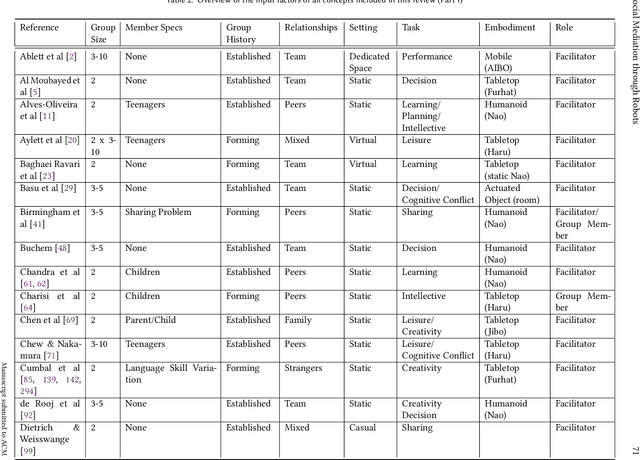
Group processes refer to the dynamics that occur within a group and are critical for understanding how groups function. With robots being increasingly placed within small groups, improving these processes has emerged as an important application of social robotics. Social Mediation Robots elicit behavioral change within groups by deliberately influencing the processes of groups. While research in this field has demonstrated that robots can effectively affect interpersonal dynamics, there is a notable gap in integrating these insights to develop coherent understanding and theory. We present a scoping review of literature targeting changes in social interactions between multiple humans through intentional action from robotic agents. To guide our review, we adapt the classical Input-Process-Output (I-P-O) models that we call "Mediation I-P-O model". We evaluated 1633 publications, which yielded 89 distinct social mediation concepts. We construct 11 mediation approaches robots can use to shape processes in small groups and teams. This work strives to produce generalizable insights and evaluate the extent to which the potential of social mediation through robots has been realized thus far. We hope that the proposed framework encourages a holistic approach to the study of social mediation and provides a foundation to standardize future reporting in the domain.
Robot Assisted Tower Construction - A Resource Distribution Task to Study Human-Robot Collaboration and Interaction with Groups of People
Dec 22, 2018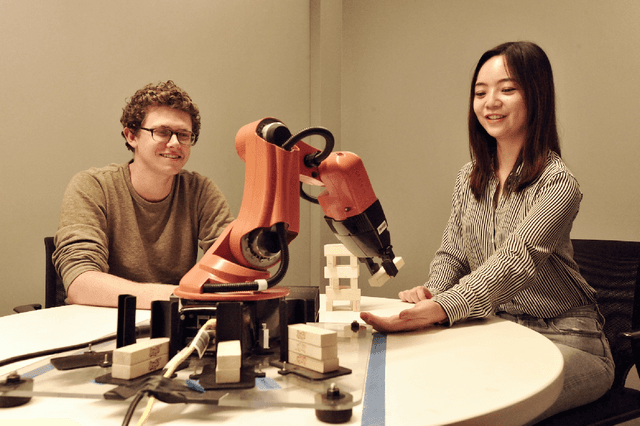

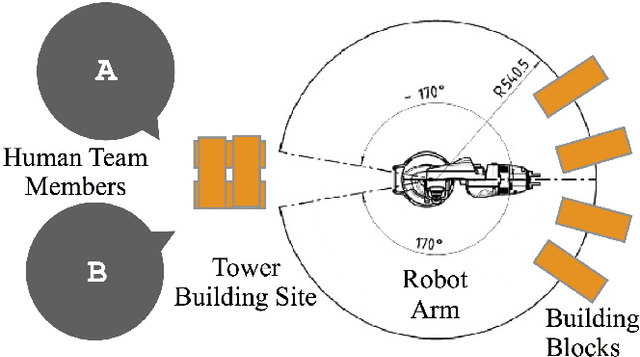

Research on human-robot collaboration or human-robot teaming, has focused predominantly on understanding and enabling collaboration between a single robot and a single human. Extending human-robot collaboration research beyond the dyad, raises novel questions about how a robot should distribute resources among group members and about what the social and task related consequences of the distribution are. Methodological advances are needed to allow researchers to collect data about human robot collaboration that involves multiple people. This paper presents Tower Construction, a novel resource distribution task that allows researchers to examine collaboration between a robot and groups of people. By focusing on the question of whether and how a robot's distribution of resources (wooden blocks required for a building task) affects collaboration dynamics and outcomes, we provide a case of how this task can be applied in a laboratory study with 124 participants to collect data about human robot collaboration that involves multiple humans. We highlight the kinds of insights the task can yield. In particular we find that the distribution of resources affects perceptions of performance, and interpersonal dynamics between human team-members.