 Add to Chrome
 Add to Firefox
 Add to Edge
The Individual-Targeting Assumption: A Systematic Review of Proactive Robots in Human Group Settings
Jul 02, 2026
Proactive robots are increasingly deployed in public environments where people are encountered not as isolated individuals but as members of cohesive social groups. Yet whether the prevailing design paradigm in proactive human-robot interaction (HRI) accounts for the relational structure that defines a group as a social unit remains largely unexamined. Through a systematic review of 63 proactive HRI studies in group settings from 2000 to 2025, we identify a recurring tendency, the Individual-Targeting Assumption (ITA), in which robots treat co-present people as independent engagement targets. We find that ITA is present in 60.3% of the corpus, with group-aware approaches emerging almost entirely after the robot is already embedded in an ongoing interaction. Critically, how a robot should detect and negotiate entry into a pre-formed group before initiating contact remains unaddressed across the corpus. Three failure modes, engagement misdetection, social ratification blindness, and bystander neglect, emerge as recurring patterns when proactive robots interact with human groups. These findings reframe proactive HRI in group settings not as an extension of dyadic interaction but as a qualitatively distinct design problem, and they identify the robot's approach to the group during the entry phase as a critical and understudied open challenge.

Facilitating the Communication of Politeness through Fine-Grained Paraphrasing
Nov 30, 2020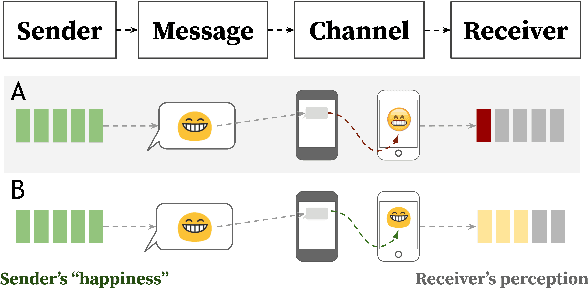
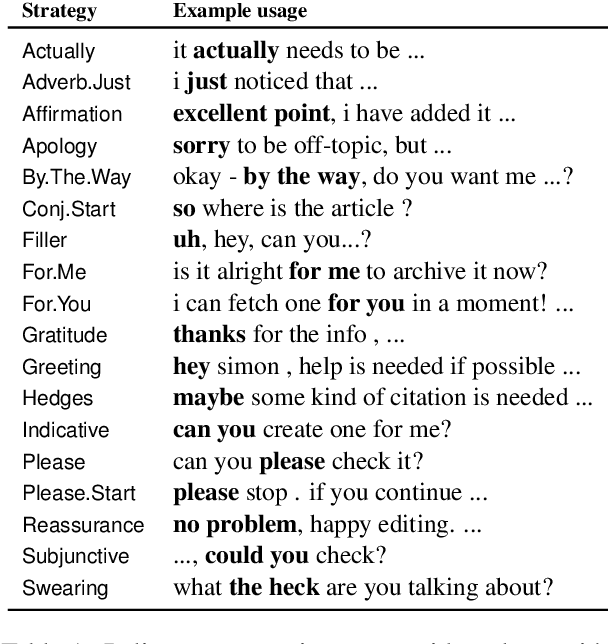
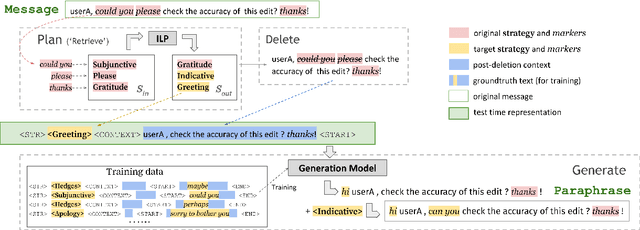
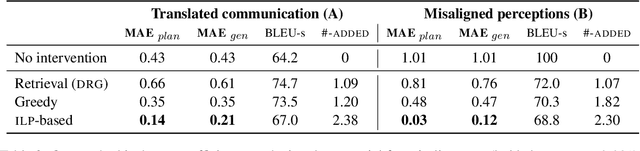
Aided by technology, people are increasingly able to communicate across geographical, cultural, and language barriers. This ability also results in new challenges, as interlocutors need to adapt their communication approaches to increasingly diverse circumstances. In this work, we take the first steps towards automatically assisting people in adjusting their language to a specific communication circumstance. As a case study, we focus on facilitating the accurate transmission of pragmatic intentions and introduce a methodology for suggesting paraphrases that achieve the intended level of politeness under a given communication circumstance. We demonstrate the feasibility of this approach by evaluating our method in two realistic communication scenarios and show that it can reduce the potential for misalignment between the speaker's intentions and the listener's perceptions in both cases.