 Add to Chrome
 Add to Firefox
 Add to Edge
Assessment of RAG and Fine-Tuning for Industrial Question-Answering-Applications
May 10, 2026
Large Language Models (LLMs) are increasingly employed in enterprise question-answering (QA) systems, requiring adaptation to domain-specific knowledge. Among the most prevalent methods for incorporating such knowledge are Retrieval-Augmented Generation (RAG) and fine-tuning (FT). Yet, from a cost-accuracy trade-off perspective, it remains unclear which approach best suits industry scenarios. This study examines the impact of RAG and FT on two closed datasets specific to the automotive industry, assessing answer quality and operational costs. We extend the Cost-of-Pass framework proposed by Erol et al. (arXiv:2504.13359) to jointly assess output quality, generation cost, and user interaction cost. Our findings reveal that while premium models perform best out of the box, open-source models can achieve comparable quality when enhanced with RAG. Overall, RAG emerges as the most effective and cost-efficient adaptation method for both closed- and open-source models.

Shape-Guided Diffusion with Inside-Outside Attention
Dec 01, 2022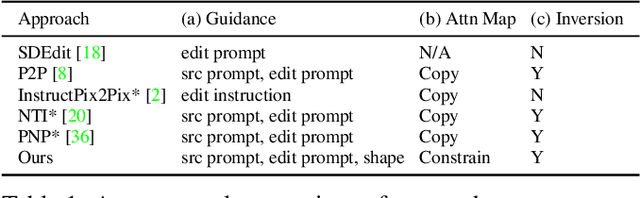
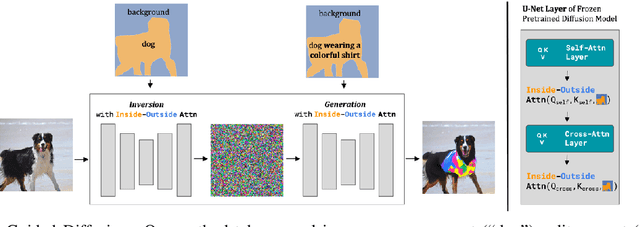
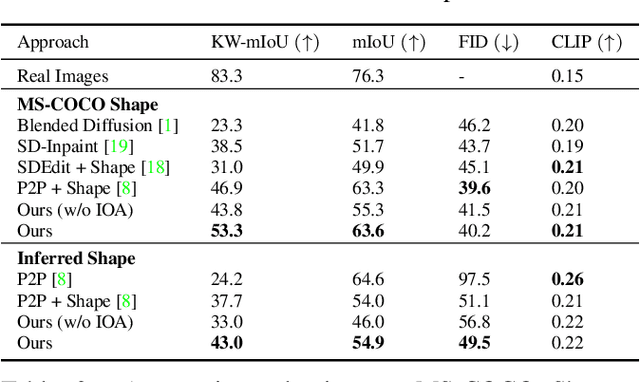
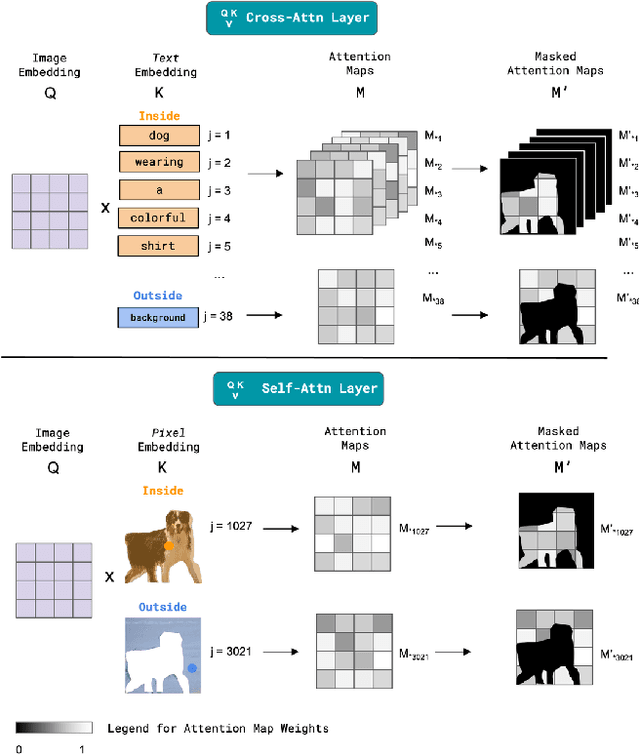
Shape can specify key object constraints, yet existing text-to-image diffusion models ignore this cue and synthesize objects that are incorrectly scaled, cut off, or replaced with background content. We propose a training-free method, Shape-Guided Diffusion, which uses a novel Inside-Outside Attention mechanism to constrain the cross-attention (and self-attention) maps such that prompt tokens (and pixels) referring to the inside of the shape cannot attend outside the shape, and vice versa. To demonstrate the efficacy of our method, we propose a new image editing task where the model must replace an object specified by its mask and a text prompt. We curate a new ShapePrompts benchmark based on MS-COCO and achieve SOTA results in shape faithfulness, text alignment, and realism according to both quantitative metrics and human preferences. Our data and code will be made available at https://shape-guided-diffusion.github.io.