 Add to Chrome
 Add to Firefox
 Add to Edge
Assessment of RAG and Fine-Tuning for Industrial Question-Answering-Applications
May 10, 2026
Large Language Models (LLMs) are increasingly employed in enterprise question-answering (QA) systems, requiring adaptation to domain-specific knowledge. Among the most prevalent methods for incorporating such knowledge are Retrieval-Augmented Generation (RAG) and fine-tuning (FT). Yet, from a cost-accuracy trade-off perspective, it remains unclear which approach best suits industry scenarios. This study examines the impact of RAG and FT on two closed datasets specific to the automotive industry, assessing answer quality and operational costs. We extend the Cost-of-Pass framework proposed by Erol et al. (arXiv:2504.13359) to jointly assess output quality, generation cost, and user interaction cost. Our findings reveal that while premium models perform best out of the box, open-source models can achieve comparable quality when enhanced with RAG. Overall, RAG emerges as the most effective and cost-efficient adaptation method for both closed- and open-source models.

Application-Oriented Benchmarking of Quantum Generative Learning Using QUARK
Aug 08, 2023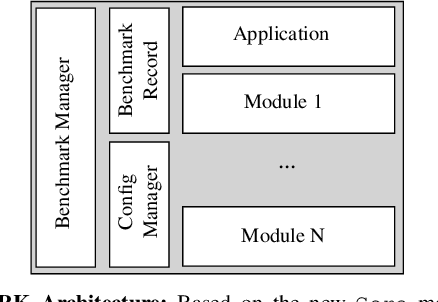
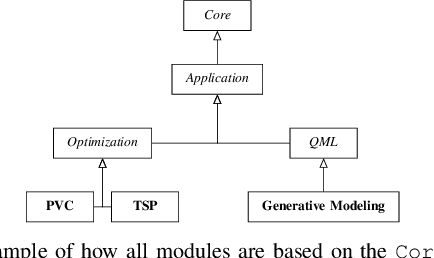
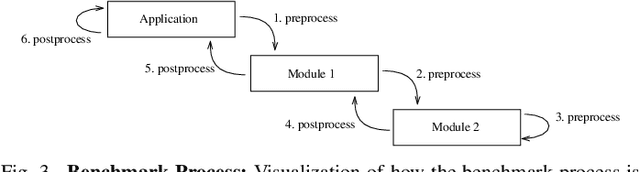
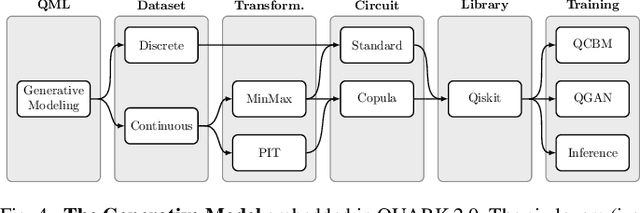
Benchmarking of quantum machine learning (QML) algorithms is challenging due to the complexity and variability of QML systems, e.g., regarding model ansatzes, data sets, training techniques, and hyper-parameters selection. The QUantum computing Application benchmaRK (QUARK) framework simplifies and standardizes benchmarking studies for quantum computing applications. Here, we propose several extensions of QUARK to include the ability to evaluate the training and deployment of quantum generative models. We describe the updated software architecture and illustrate its flexibility through several example applications: (1) We trained different quantum generative models using several circuit ansatzes, data sets, and data transformations. (2) We evaluated our models on GPU and real quantum hardware. (3) We assessed the generalization capabilities of our generative models using a broad set of metrics that capture, e.g., the novelty and validity of the generated data.
Optimization of Robot Trajectory Planning with Nature-Inspired and Hybrid Quantum Algorithms
Jun 08, 2022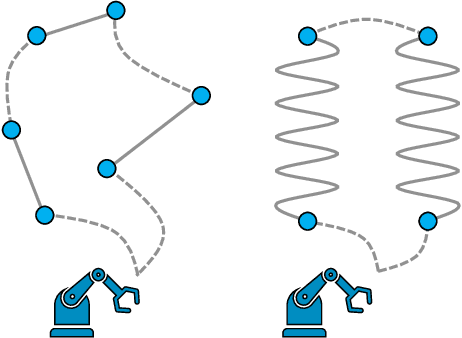
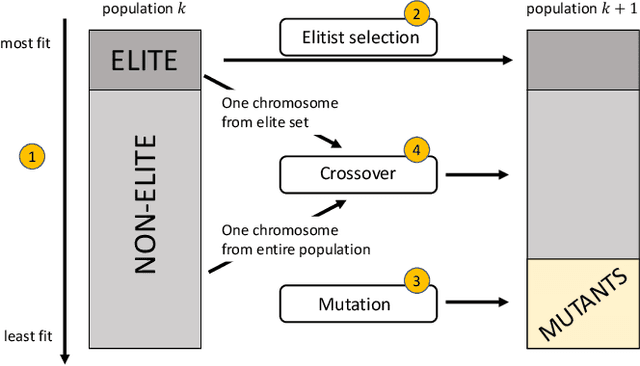
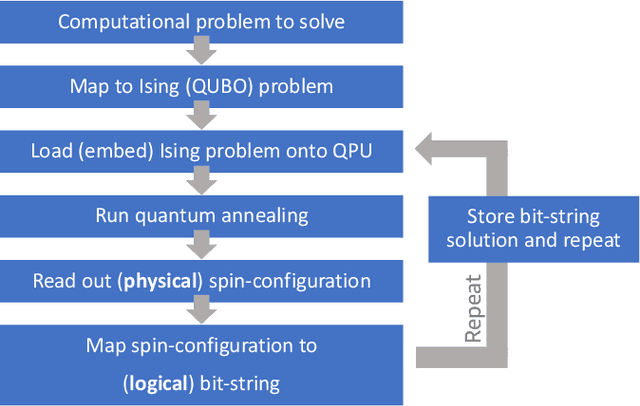
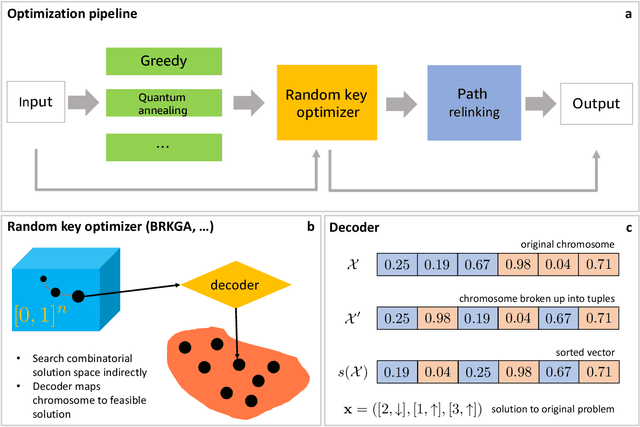
We solve robot trajectory planning problems at industry-relevant scales. Our end-to-end solution integrates highly versatile random-key algorithms with model stacking and ensemble techniques, as well as path relinking for solution refinement. The core optimization module consists of a biased random-key genetic algorithm. Through a distinct separation of problem-independent and problem-dependent modules, we achieve an efficient problem representation, with a native encoding of constraints. We show that generalizations to alternative algorithmic paradigms such as simulated annealing are straightforward. We provide numerical benchmark results for industry-scale data sets. Our approach is found to consistently outperform greedy baseline results. To assess the capabilities of today's quantum hardware, we complement the classical approach with results obtained on quantum annealing hardware, using qbsolv on Amazon Braket. Finally, we show how the latter can be integrated into our larger pipeline, providing a quantum-ready hybrid solution to the problem.