 Add to Chrome
 Add to Firefox
 Add to Edge
LLM-as-a-Judge is Bad, Based on AI Attempting the Exam Qualifying for the Member of the Polish National Board of Appeal
Nov 06, 2025
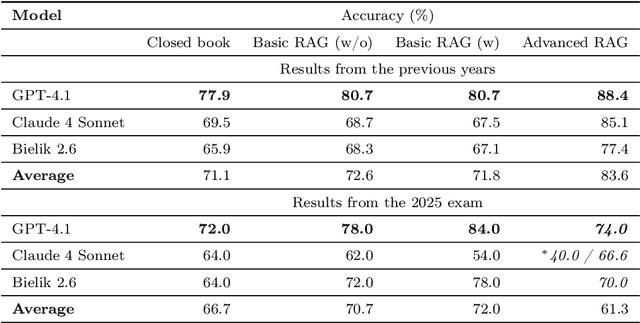
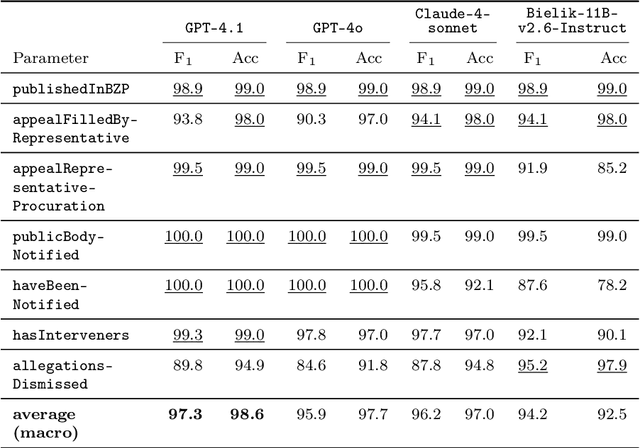
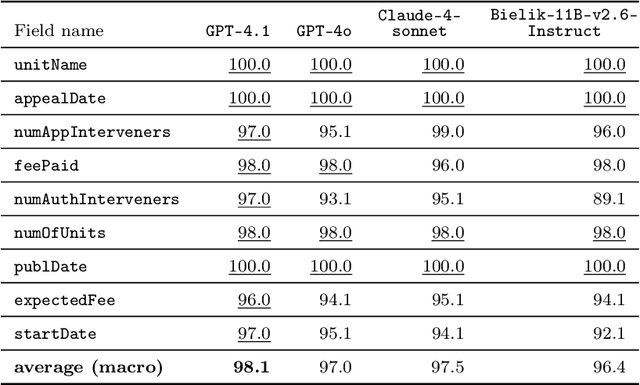
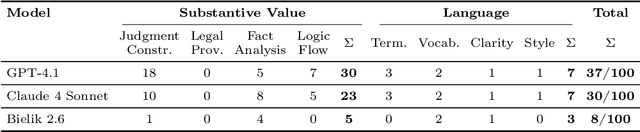
This study provides an empirical assessment of whether current large language models (LLMs) can pass the official qualifying examination for membership in Poland's National Appeal Chamber (Krajowa Izba Odwoławcza). The authors examine two related ideas: using LLM as actual exam candidates and applying the 'LLM-as-a-judge' approach, in which model-generated answers are automatically evaluated by other models. The paper describes the structure of the exam, which includes a multiple-choice knowledge test on public procurement law and a written judgment, and presents the hybrid information recovery and extraction pipeline built to support the models. Several LLMs (including GPT-4.1, Claude 4 Sonnet and Bielik-11B-v2.6) were tested in closed-book and various Retrieval-Augmented Generation settings. The results show that although the models achieved satisfactory scores in the knowledge test, none met the passing threshold in the practical written part, and the evaluations of the 'LLM-as-a-judge' often diverged from the judgments of the official examining committee. The authors highlight key limitations: susceptibility to hallucinations, incorrect citation of legal provisions, weaknesses in logical argumentation, and the need for close collaboration between legal experts and technical teams. The findings indicate that, despite rapid technological progress, current LLMs cannot yet replace human judges or independent examiners in Polish public procurement adjudication.

Sequential, Parallel and Consecutive Hybrid Evolutionary-Swarm Optimization Metaheuristics
Aug 01, 2025The goal of this paper is twofold. First, it explores hybrid evolutionary-swarm metaheuristics that combine the features of PSO and GA in a sequential, parallel and consecutive manner in comparison with their standard basic form: Genetic Algorithm and Particle Swarm Optimization. The algorithms were tested on a set of benchmark functions, including Ackley, Griewank, Levy, Michalewicz, Rastrigin, Schwefel, and Shifted Rotated Weierstrass, across multiple dimensions. The experimental results demonstrate that the hybrid approaches achieve superior convergence and consistency, especially in higher-dimensional search spaces. The second goal of this paper is to introduce a novel consecutive hybrid PSO-GA evolutionary algorithm that ensures continuity between PSO and GA steps through explicit information transfer mechanisms, specifically by modifying GA's variation operators to inherit velocity and personal best information.
* 16 pages, 2 figures, 5 tables, 5 algorithms, conference