 Add to Chrome
 Add to Firefox
 Add to Edge
An Artificial Intelligence-based Assistant for the Visually Impaired
Nov 11, 2025
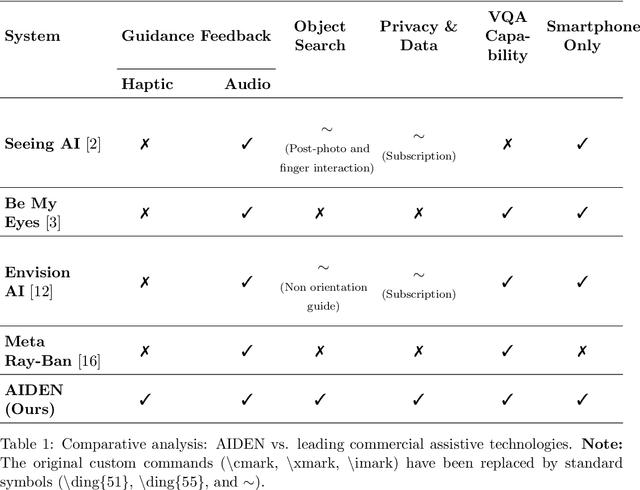
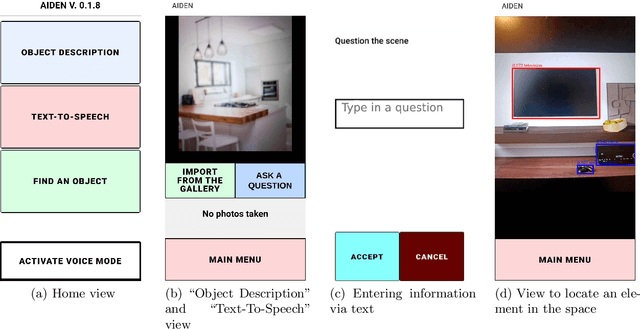
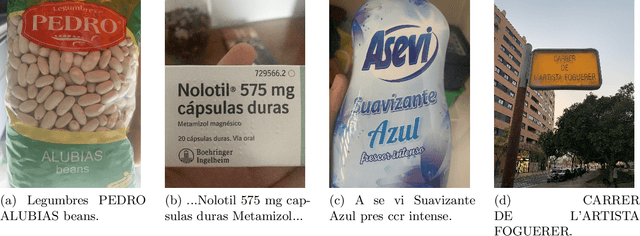
This paper describes an artificial intelligence-based assistant application, AIDEN, developed during 2023 and 2024, aimed at improving the quality of life for visually impaired individuals. Visually impaired individuals face challenges in identifying objects, reading text, and navigating unfamiliar environments, which can limit their independence and reduce their quality of life. Although solutions such as Braille, audio books, and screen readers exist, they may not be effective in all situations. This application leverages state-of-the-art machine learning algorithms to identify and describe objects, read text, and answer questions about the environment. Specifically, it uses You Only Look Once architectures and a Large Language and Vision Assistant. The system incorporates several methods to facilitate the user's interaction with the system and access to textual and visual information in an appropriate manner. AIDEN aims to enhance user autonomy and access to information, contributing to an improved perception of daily usability, as supported by user feedback.

AGENTiGraph: An Interactive Knowledge Graph Platform for LLM-based Chatbots Utilizing Private Data
Oct 15, 2024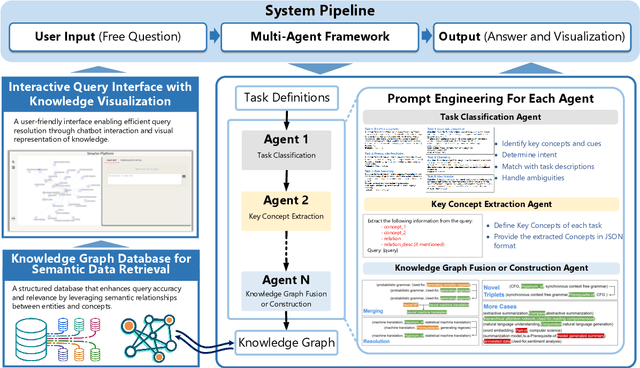

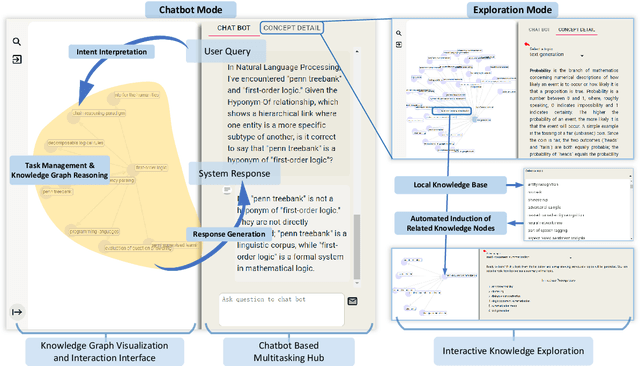

Large Language Models~(LLMs) have demonstrated capabilities across various applications but face challenges such as hallucination, limited reasoning abilities, and factual inconsistencies, especially when tackling complex, domain-specific tasks like question answering~(QA). While Knowledge Graphs~(KGs) have been shown to help mitigate these issues, research on the integration of LLMs with background KGs remains limited. In particular, user accessibility and the flexibility of the underlying KG have not been thoroughly explored. We introduce AGENTiGraph (Adaptive Generative ENgine for Task-based Interaction and Graphical Representation), a platform for knowledge management through natural language interaction. It integrates knowledge extraction, integration, and real-time visualization. AGENTiGraph employs a multi-agent architecture to dynamically interpret user intents, manage tasks, and integrate new knowledge, ensuring adaptability to evolving user requirements and data contexts. Our approach demonstrates superior performance in knowledge graph interactions, particularly for complex domain-specific tasks. Experimental results on a dataset of 3,500 test cases show AGENTiGraph significantly outperforms state-of-the-art zero-shot baselines, achieving 95.12\% accuracy in task classification and 90.45\% success rate in task execution. User studies corroborate its effectiveness in real-world scenarios. To showcase versatility, we extended AGENTiGraph to legislation and healthcare domains, constructing specialized KGs capable of answering complex queries in legal and medical contexts.