 Add to Chrome
 Add to Firefox
 Add to Edge
Seeing is Believing: Robust Vision-Guided Cross-Modal Prompt Learning under Label Noise
Apr 10, 2026
Prompt learning is a parameter-efficient approach for vision-language models, yet its robustness under label noise is less investigated. Visual content contains richer and more reliable semantic information, which remains more robust under label noise. However, the prompt itself is highly susceptible to label noise. Motivated by this intuition, we propose VisPrompt, a lightweight and robust vision-guided prompt learning framework for noisy-label settings. Specifically, we exploit a cross-modal attention mechanism to reversely inject visual semantics into prompt representations. This enables the prompt tokens to selectively aggregate visual information relevant to the current sample, thereby improving robustness by anchoring prompt learning to stable instance-level visual evidence and reducing the influence of noisy supervision. To address the instability caused by using the same way of injecting visual information for all samples, despite differences in the quality of their visual cues, we further introduce a lightweight conditional modulation mechanism to adaptively control the strength of visual information injection, which strikes a more robust balance between text-side semantic priors and image-side instance evidence. The proposed framework effectively suppresses the noise-induced disturbances, reduce instability in prompt updates, and alleviate memorization of mislabeled samples. VisPrompt significantly improves robustness while keeping the pretrained VLM backbone frozen and introducing only a small amount of additional trainable parameters. Extensive experiments under synthetic and real-world label noise demonstrate that VisPrompt generally outperforms existing baselines on seven benchmark datasets and achieves stronger robustness. Our code is publicly available at https://github.com/gezbww/Vis_Prompt.

Investigating Large Language Models for Code Vulnerability Detection: An Experimental Study
Dec 24, 2024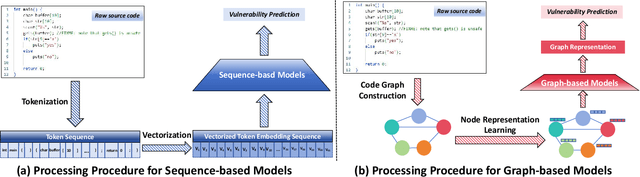
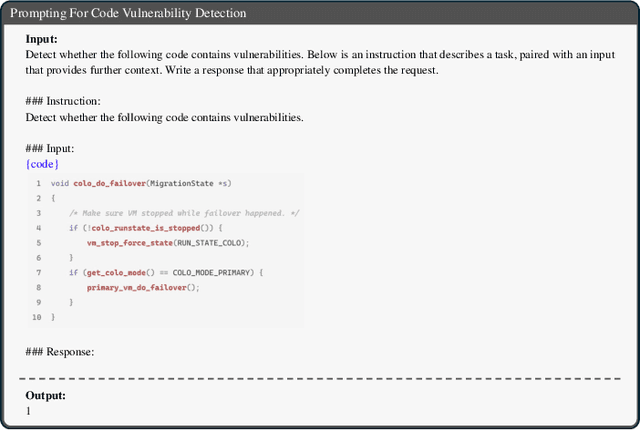


Code vulnerability detection (CVD) is essential for addressing and preventing system security issues, playing a crucial role in ensuring software security. Previous learning-based vulnerability detection methods rely on either fine-tuning medium-size sequence models or training smaller neural networks from scratch. Recent advancements in large pre-trained language models (LLMs) have showcased remarkable capabilities in various code intelligence tasks including code understanding and generation. However, the effectiveness of LLMs in detecting code vulnerabilities is largely under-explored. This work aims to investigate the gap by fine-tuning LLMs for the CVD task, involving four widely-used open-source LLMs. We also implement other five previous graph-based or medium-size sequence models for comparison. Experiments are conducted on five commonly-used CVD datasets, including both the part of short samples and long samples. In addition, we conduct quantitative experiments to investigate the class imbalance issue and the model's performance on samples of different lengths, which are rarely studied in previous works. To better facilitate communities, we open-source all codes and resources of this study in https://github.com/SakiRinn/LLM4CVD and https://huggingface.co/datasets/xuefen/VulResource.