 Add to Chrome
 Add to Firefox
 Add to Edge
Sensing-Aided Ordered Reliability Bits Guessing Random Additive Noise Decoding
Aug 14, 2026
Integrated sensing and communication (ISAC) is a key enabler for future wireless systems, providing environmental information that can support tasks beyond conventional data transmission. However, its impact on channel decoding remains less explored. This paper studies sensing-aided ordered reliability bits guessing random additive noise decoding (ORBGRAND) over single-input single-output narrowband fading channels. Environmental information is used to construct a geometry-based prior for the channel coefficient, which is fused with pilot observations via linear minimum mean square error (LMMSE) estimation. The resulting posterior channel estimate and uncertainty are used to compute the log-likelihood ratios (LLRs) supplied to ORBGRAND, improving the reliability ordering that drives its noise-guessing process. Simulation results demonstrate improved block error rate and reduced average query complexity, with the largest gains in pilot-limited regimes.

Structural Optimization of Factor Graphs for Symbol Detection via Continuous Clustering and Machine Learning
Nov 21, 2022
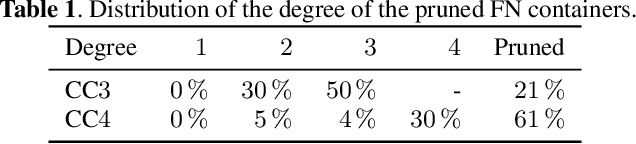
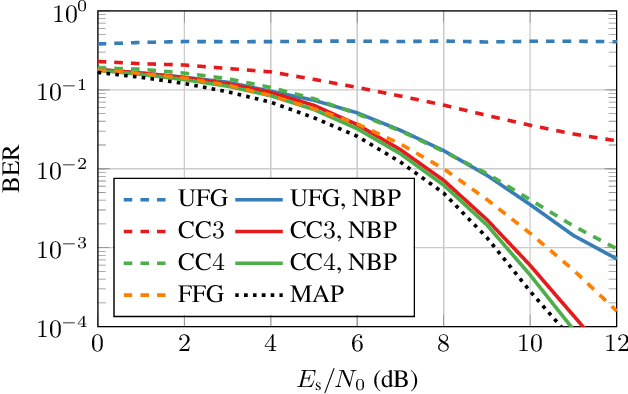
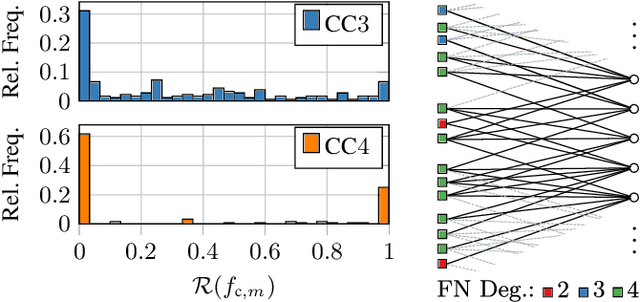
We propose a novel method to optimize the structure of factor graphs for graph-based inference. As an example inference task, we consider symbol detection on linear inter-symbol interference channels. The factor graph framework has the potential to yield low-complexity symbol detectors. However, the sum-product algorithm on cyclic factor graphs is suboptimal and its performance is highly sensitive to the underlying graph. Therefore, we optimize the structure of the underlying factor graphs in an end-to-end manner using machine learning. For that purpose, we transform the structural optimization into a clustering problem of low-degree factor nodes that incorporates the known channel model into the optimization. Furthermore, we study the combination of this approach with neural belief propagation, yielding near-maximum a posteriori symbol detection performance for specific channels.