 Add to Chrome
 Add to Firefox
 Add to Edge
Learned Neighbor Trust for Collaborative Deployment in Model-Agnostic Decentralized Learning
May 06, 2026
Many decentralized distillation methods are designed around training-time coordination, yet deploy each node in isolation even when more capable neighbors remain available at inference time. This is an incomplete objective for settings such as IoT, where devices are heterogeneous, data is scarce and skewed, and a node's strongest neighbors may far exceed its own local capacity. We study how nodes should train so that their predictions compose well at deployment, and how each node should learn whom to trust. Under a server-free, model-agnostic protocol where nodes exchange only queries and soft predictions, we propose Learned Neighbor Trust (LNTrust) wherein each node learns a compact trust function over its neighborhood from local validation evidence. This trust function gates auxiliary distillation during training and defines a deployment ensemble at inference, so that collaboration learned during training transfers directly to deployment. Across datasets and topologies, LNTrust improves deployed accuracy over the strongest output-only baseline by large margins while using significantly less communication than previous methods.

Linear Social Choice with Few Queries: A Moment-Based Approach
Mar 19, 2026Most social choice rules assume access to full rankings, while current alignment practice -- despite aiming for diversity -- typically treats voters as anonymous and comparisons as independent, effectively extracting only about one bit per voter. Motivated by this gap, we study social choice under an extreme communication budget in the linear social choice model, where each voter's utility is the inner product between a latent voter type and the embedding of the context and candidate. The candidate and voter spaces may be very large or even infinite. Our core idea is to model the electorate as an unknown distribution over voter types and to recover its moments as informative summary statistics for candidate selection. We show that one pairwise comparison per voter already suffices to select a candidate that maximizes social welfare, but this elicitation cannot identify the second moment and therefore cannot support objectives that account for inequality. We prove that two pairwise comparisons per voter, or alternatively a single graded comparison, identify the second moment; moreover, these richer queries suffice to identify all moments, and hence the entire voter-type distribution. These results enable principled solutions to a range of social choice objectives including inequality-aware welfare criteria such as taking into account the spread of voter utilities and choosing a representative subset.
Mind the (DH) Gap! A Contrast in Risky Choices Between Reasoning and Conversational LLMs
Feb 16, 2026The use of large language models either as decision support systems, or in agentic workflows, is rapidly transforming the digital ecosystem. However, the understanding of LLM decision-making under uncertainty remains limited. We initiate a comparative study of LLM risky choices along two dimensions: (1) prospect representation (explicit vs. experience based) and (2) decision rationale (explanation). Our study, which involves 20 frontier and open LLMs, is complemented by a matched human subjects experiment, which provides one reference point, while an expected payoff maximizing rational agent model provides another. We find that LLMs cluster into two categories: reasoning models (RMs) and conversational models (CMs). RMs tend towards rational behavior, are insensitive to the order of prospects, gain/loss framing, and explanations, and behave similarly whether prospects are explicit or presented via experience history. CMs are significantly less rational, slightly more human-like, sensitive to prospect ordering, framing, and explanation, and exhibit a large description-history gap. Paired comparisons of open LLMs suggest that a key factor differentiating RMs and CMs is training for mathematical reasoning.
Lifted Relational Probabilistic Inference via Implicit Learning
Feb 16, 2026Reconciling the tension between inductive learning and deductive reasoning in first-order relational domains is a longstanding challenge in AI. We study the problem of answering queries in a first-order relational probabilistic logic through a joint effort of learning and reasoning, without ever constructing an explicit model. Traditional lifted inference assumes access to a complete model and exploits symmetry to evaluate probabilistic queries; however, learning such models from partial, noisy observations is intractable in general. We reconcile these two challenges through implicit learning to reason and first-order relational probabilistic inference techniques. More specifically, we merge incomplete first-order axioms with independently sampled, partially observed examples into a bounded-degree fragment of the sum-of-squares (SOS) hierarchy in polynomial time. Our algorithm performs two lifts simultaneously: (i) grounding-lift, where renaming-equivalent ground moments share one variable, collapsing the domain of individuals; and (ii) world-lift, where all pseudo-models (partial world assignments) are enforced in parallel, producing a global bound that holds across all worlds consistent with the learned constraints. These innovations yield the first polynomial-time framework that implicitly learns a first-order probabilistic logic and performs lifted inference over both individuals and worlds.
Polynomial-Time Relational Probabilistic Inference in Open Universes
May 07, 2025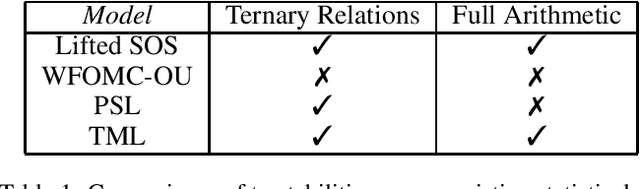
Reasoning under uncertainty is a fundamental challenge in Artificial Intelligence. As with most of these challenges, there is a harsh dilemma between the expressive power of the language used, and the tractability of the computational problem posed by reasoning. Inspired by human reasoning, we introduce a method of first-order relational probabilistic inference that satisfies both criteria, and can handle hybrid (discrete and continuous) variables. Specifically, we extend sum-of-squares logic of expectation to relational settings, demonstrating that lifted reasoning in the bounded-degree fragment for knowledge bases of bounded quantifier rank can be performed in polynomial time, even with an a priori unknown and/or countably infinite set of objects. Crucially, our notion of tractability is framed in proof-theoretic terms, which extends beyond the syntactic properties of the language or queries. We are able to derive the tightest bounds provable by proofs of a given degree and size and establish completeness in our sum-of-squares refutations for fixed degrees.
Axioms for AI Alignment from Human Feedback
May 23, 2024
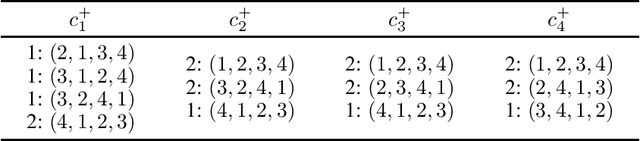
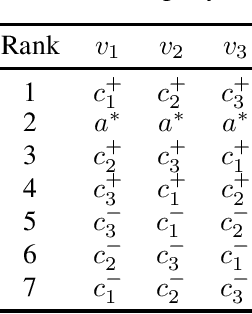
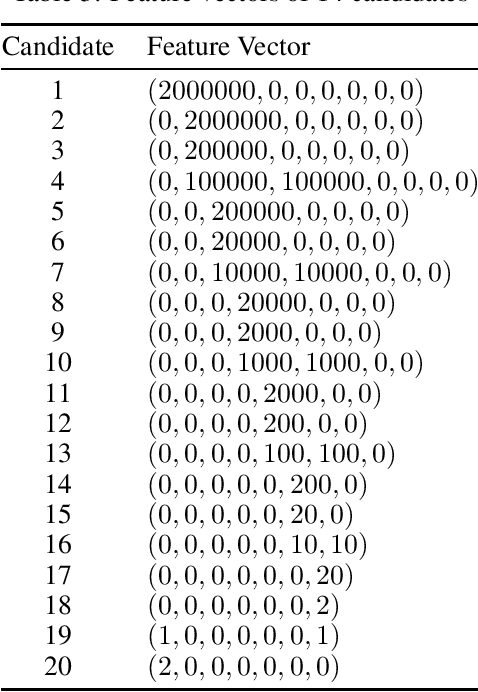
In the context of reinforcement learning from human feedback (RLHF), the reward function is generally derived from maximum likelihood estimation of a random utility model based on pairwise comparisons made by humans. The problem of learning a reward function is one of preference aggregation that, we argue, largely falls within the scope of social choice theory. From this perspective, we can evaluate different aggregation methods via established axioms, examining whether these methods meet or fail well-known standards. We demonstrate that both the Bradley-Terry-Luce Model and its broad generalizations fail to meet basic axioms. In response, we develop novel rules for learning reward functions with strong axiomatic guarantees. A key innovation from the standpoint of social choice is that our problem has a linear structure, which greatly restricts the space of feasible rules and leads to a new paradigm that we call linear social choice.
Learning Linear Utility Functions From Pairwise Comparison Queries
May 07, 2024
We study learnability of linear utility functions from pairwise comparison queries. In particular, we consider two learning objectives. The first objective is to predict out-of-sample responses to pairwise comparisons, whereas the second is to approximately recover the true parameters of the utility function. We show that in the passive learning setting, linear utilities are efficiently learnable with respect to the first objective, both when query responses are uncorrupted by noise, and under Tsybakov noise when the distributions are sufficiently "nice". In contrast, we show that utility parameters are not learnable for a large set of data distributions without strong modeling assumptions, even when query responses are noise-free. Next, we proceed to analyze the learning problem in an active learning setting. In this case, we show that even the second objective is efficiently learnable, and present algorithms for both the noise-free and noisy query response settings. Our results thus exhibit a qualitative learnability gap between passive and active learning from pairwise preference queries, demonstrating the value of the ability to select pairwise queries for utility learning.