 Add to Chrome
 Add to Firefox
 Add to Edge
Lifted Relational Probabilistic Inference via Implicit Learning
Feb 16, 2026
Reconciling the tension between inductive learning and deductive reasoning in first-order relational domains is a longstanding challenge in AI. We study the problem of answering queries in a first-order relational probabilistic logic through a joint effort of learning and reasoning, without ever constructing an explicit model. Traditional lifted inference assumes access to a complete model and exploits symmetry to evaluate probabilistic queries; however, learning such models from partial, noisy observations is intractable in general. We reconcile these two challenges through implicit learning to reason and first-order relational probabilistic inference techniques. More specifically, we merge incomplete first-order axioms with independently sampled, partially observed examples into a bounded-degree fragment of the sum-of-squares (SOS) hierarchy in polynomial time. Our algorithm performs two lifts simultaneously: (i) grounding-lift, where renaming-equivalent ground moments share one variable, collapsing the domain of individuals; and (ii) world-lift, where all pseudo-models (partial world assignments) are enforced in parallel, producing a global bound that holds across all worlds consistent with the learned constraints. These innovations yield the first polynomial-time framework that implicitly learns a first-order probabilistic logic and performs lifted inference over both individuals and worlds.

Polynomial-Time Relational Probabilistic Inference in Open Universes
May 07, 2025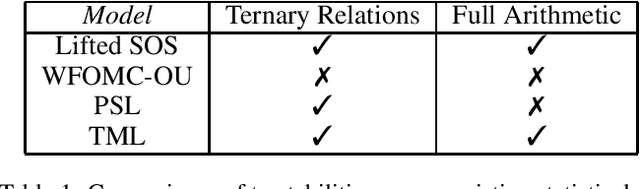
Reasoning under uncertainty is a fundamental challenge in Artificial Intelligence. As with most of these challenges, there is a harsh dilemma between the expressive power of the language used, and the tractability of the computational problem posed by reasoning. Inspired by human reasoning, we introduce a method of first-order relational probabilistic inference that satisfies both criteria, and can handle hybrid (discrete and continuous) variables. Specifically, we extend sum-of-squares logic of expectation to relational settings, demonstrating that lifted reasoning in the bounded-degree fragment for knowledge bases of bounded quantifier rank can be performed in polynomial time, even with an a priori unknown and/or countably infinite set of objects. Crucially, our notion of tractability is framed in proof-theoretic terms, which extends beyond the syntactic properties of the language or queries. We are able to derive the tightest bounds provable by proofs of a given degree and size and establish completeness in our sum-of-squares refutations for fixed degrees.