 Add to Chrome
 Add to Firefox
 Add to Edge
ForesightSafety-VLA: A Unified Diagnostic Safety Benchmark for Vision-Language-Action Models
Jun 25, 2026
In embodied intelligence, safety is a prerequisite for reliable robot deployment in the physical world. Current vision-language-action (VLA) models continue to advance toward general-purpose task capability, yet their embodied safety limits remain poorly understood. To address this gap, we introduce ForesightSafety-VLA, a diagnostic benchmark that makes safety the primary evaluation target for VLA systems. We define a 13-category safety taxonomy covering physical interaction safety (Safe-Core), instruction-side safety (Safe-Lang), and perception-side safety (Safe-Vis), and evaluate policies under three controlled dimensions of variation -- scene structure, language command, and visual observation -- so that failure sources can be diagnosed rather than hidden in a single aggregate score. Beyond binary task success, ForesightSafety-VLA measures process-level risk through cumulative safety cost (CC) and risk exposure time (RET), together with a four-quadrant decomposition of safe/unsafe success and failure. We instantiate 66 safety-augmented base scenarios in RoboTwin across 5 embodiments and report results on representative VLA baselines. Across the evaluated baselines, even the strongest policy incurs non-trivial safety cost and unsafe nominal success, while structure and visual variation induce substantially stronger safety degradation than ordinary language variation. These results suggest that embodied safety is tightly coupled to perception, grounding, and control competence rather than being reducible to post-hoc safety filtering alone.

When Autoregressive Consistency Hurts Safety Alignment
Jun 02, 2026Safety alignment in large language models (LLMs) is fragile in part because it is often shallow: fine-tuning mainly reshapes the model's behavior near the first few output tokens. We argue that this phenomenon can be understood through autoregressive consistency, the tendency of next-token prediction to preserve and extend the current response trajectory consistently. By analyzing the learning dynamics of safety alignment, we show that autoregressive consistency can concentrate alignment updates on early tokens, offering a mechanistic explanation for shallow safety alignment. The same mechanism also predicts a broader class of attacks on LLMs: attacks that induce harmful continuation states at arbitrary positions in the output trajectory. As a concrete example, we introduce random insertion attack, which inserts a short harmful span into an otherwise safe refusal trajectory and exploits autoregressive consistency to sustain the resulting harmful branch, thereby bypassing safety alignment. Notably, a short harmful span can redirect the generation to be harmful even after a long refusal prefix, highlighting autoregressive consistency as a potential broader failure mechanism. This suggests that safety alignment should also break harmful autoregressive consistency throughout the output trajectory. We therefore propose adversarial safety alignment, an initial framework based on worst-case harmful continuation states, and instantiate it with random worst-insertion training. Overall, our results suggest that autoregressive consistency should be treated as a central consideration in both safety alignment and attack design.
Self-Motivated Growing Neural Network for Adaptive Architecture via Local Structural Plasticity
Dec 14, 2025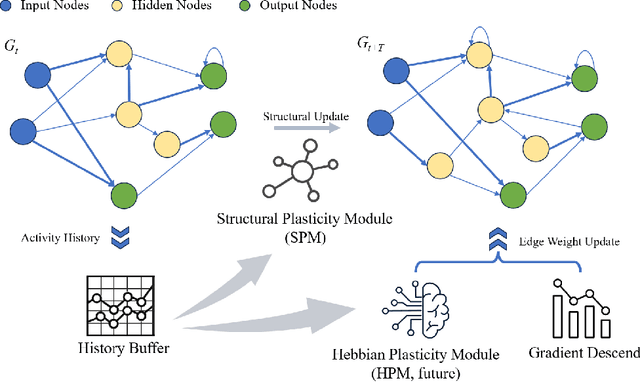

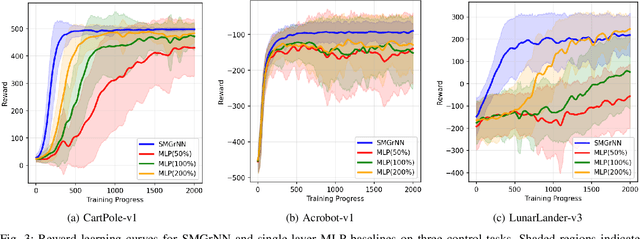
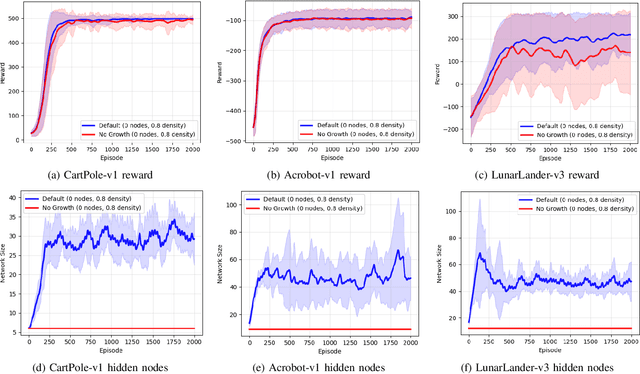
Control policies in deep reinforcement learning are often implemented with fixed-capacity multilayer perceptrons trained by backpropagation, which lack structural plasticity and depend on global error signals. This paper introduces the Self-Motivated Growing Neural Network (SMGrNN), a controller whose topology evolves online through a local Structural Plasticity Module (SPM). The SPM monitors neuron activations and edge-wise weight update statistics over short temporal windows and uses these signals to trigger neuron insertion and pruning, while synaptic weights are updated by a standard gradient-based optimizer. This allows network capacity to be regulated during learning without manual architectural tuning. SMGrNN is evaluated on control benchmarks via policy distillation. Compared with multilayer perceptron baselines, it achieves similar or higher returns, lower variance, and task-appropriate network sizes. Ablation studies with growth disabled and growth-only variants isolate the role of structural plasticity, showing that adaptive topology improves reward stability. The local and modular design of SPM enables future integration of a Hebbian plasticity module and spike-timing-dependent plasticity, so that SMGrNN can support both artificial and spiking neural implementations driven by local rules.
A Categorical Analysis of Large Language Models and Why LLMs Circumvent the Symbol Grounding Problem
Dec 09, 2025This paper presents a formal, categorical framework for analysing how humans and large language models (LLMs) transform content into truth-evaluated propositions about a state space of possible worlds W , in order to argue that LLMs do not solve but circumvent the symbol grounding problem.
Category-Theoretical and Topos-Theoretical Frameworks in Machine Learning: A Survey
Aug 26, 2024In this survey, we provide an overview of category theory-derived machine learning from four mainstream perspectives: gradient-based learning, probability-based learning, invariance and equivalence-based learning, and topos-based learning. For the first three topics, we primarily review research in the past five years, updating and expanding on the previous survey by Shiebler et al.. The fourth topic, which delves into higher category theory, particularly topos theory, is surveyed for the first time in this paper. In certain machine learning methods, the compositionality of functors plays a vital role, prompting the development of specific categorical frameworks. However, when considering how the global properties of a network reflect in local structures and how geometric properties are expressed with logic, the topos structure becomes particularly significant and profound.