 Add to Chrome
 Add to Firefox
 Add to Edge
CoBA: Integrated Deep Learning Model for Reliable Low-Altitude UAV Classification in mmWave Radio Networks
Jan 28, 2026
Uncrewed Aerial Vehicles (UAVs) are increasingly used in civilian and industrial applications, making secure low-altitude operations crucial. In dense mmWave environments, accurately classifying low-altitude UAVs as either inside authorized or restricted airspaces remains challenging, requiring models that handle complex propagation and signal variability. This paper proposes a deep learning model, referred to as CoBA, which stands for integrated Convolutional Neural Network (CNN), Bidirectional Long Short-Term Memory (BiLSTM), and Attention which leverages Fifth Generation (5G) millimeter-wave (mmWave) radio measurements to classify UAV operations in authorized and restricted airspaces at low altitude. The proposed CoBA model integrates convolutional, bidirectional recurrent, and attention layers to capture both spatial and temporal patterns in UAV radio measurements. To validate the model, a dedicated dataset is collected using the 5G mmWave network at TalTech, with controlled low altitude UAV flights in authorized and restricted scenarios. The model is evaluated against conventional ML models and a fingerprinting-based benchmark. Experimental results show that CoBA achieves superior accuracy, significantly outperforming all baseline models and demonstrating its potential for reliable and regulated UAV airspace monitoring.

Energy Optimization for Time-of-Arrival Based Tracking
Dec 22, 2025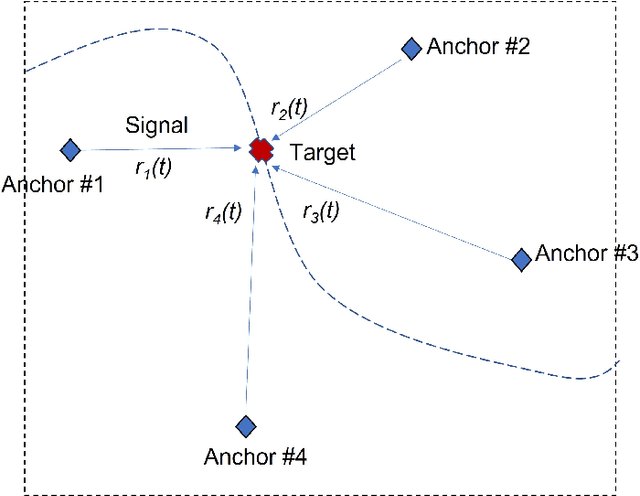
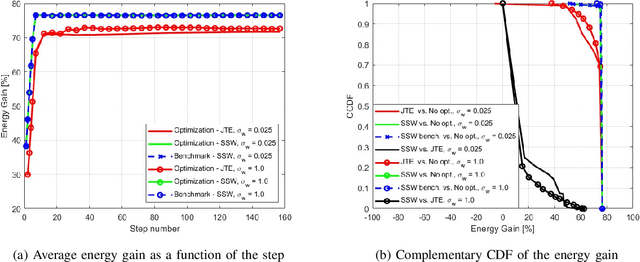
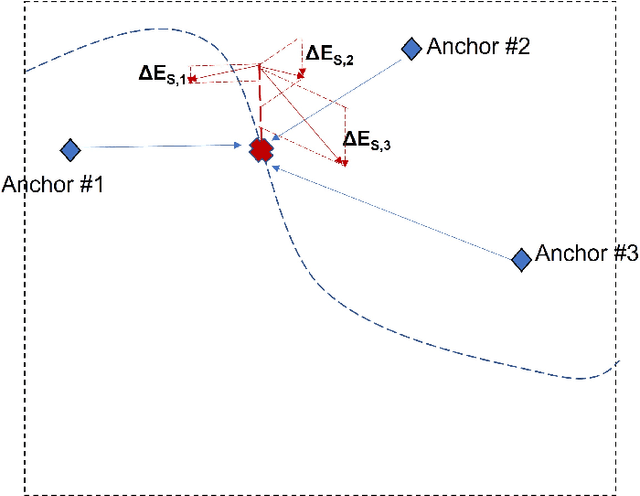
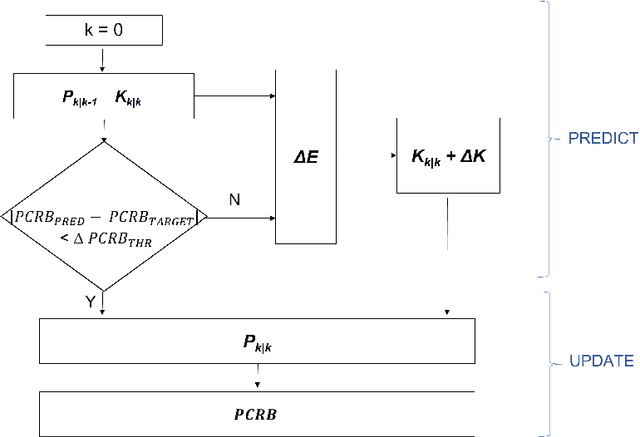
The paper analyzes energy allocation in a scenario where the position of a moving target is tracked by exploiting the Time-of-Arrivals of bandwidth-constrained signals received by or transmitted from a fixed number of anchors located at known positions. The signal of each anchor is generated by transmitting a sequence of known symbols, allowing for amplitude and duration (number of symbols) to be different from anchor to anchor. The problem is the minimization of the sum of the energies of the transmitted signals imposing a constraint on the performance of the tracking procedure. Specifically, the constraint is the Posterior Cramer-Rao Bound, below the mean square error achieved by any unbiased estimator. The main improvement over the previous literature is the derivation of a formula that, at each step of the tracking, allows to calculate in closed form the first-order variation of the Posterior Cramer-Rao Bound as a function of the variation of the total energy. To concretely show the application of our approach, we present also two numerical algorithms that implement the constrained optimization in the case of signals of fixed amplitude and variable duration transmitted from the anchors in a time division multiplexing scheme.