 Add to Chrome
 Add to Firefox
 Add to Edge
Towards a Novel Ultrasound System Based on Low-Frequency Feature Extraction From a Fully-Printed Flexible Transducer
Sep 25, 2023
Ultrasound is a key technology in healthcare, and it is being explored for non-invasive, wearable, continuous monitoring of vital signs. However, its widespread adoption in this scenario is still hindered by the size, complexity, and power consumption of current devices. Moreover, such an application demands adaptability to human anatomy, which is hard to achieve with current transducer technology. This paper presents a novel ultrasound system prototype based on a fully printed, lead-free, and flexible polymer ultrasound transducer, whose bending radius promises good adaptability to the human anatomy. Our application scenario focuses on continuous blood flow monitoring. We implemented a hardware envelope filter to efficiently transpose high-frequency ultrasound signals to a lower-frequency spectrum. This reduces computational and power demands with little to no degradation in the task proposed for this work. We validated our method on a setup that mimics human blood flow by using a flow phantom and a peristaltic pump simulating 3 different heartbeat rhythms: 60, 90 and 120 beats per minute. Our ultrasound setup reconstructs peristaltic pump frequencies with errors of less than 0.05 Hz (3 bpm) from the set pump frequency, both for the raw echo and the enveloped echo. The analog pre-processing showed a promising reduction of signal bandwidth of more than 6x: pulse-echo signals of transducers excited at 12.5 MHz were reduced to about 2 MHz. Thus, allowing consumer MCUs to acquire and elaborate signals within mW-power range in an inexpensive fashion.

Skilog: A Smart Sensor System for Performance Analysis and Biofeedback in Ski Jumping
Sep 25, 2023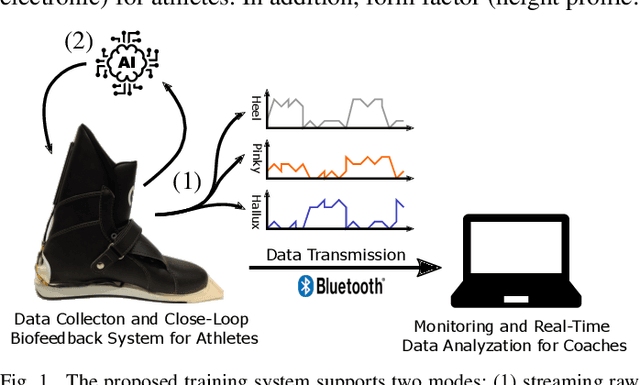
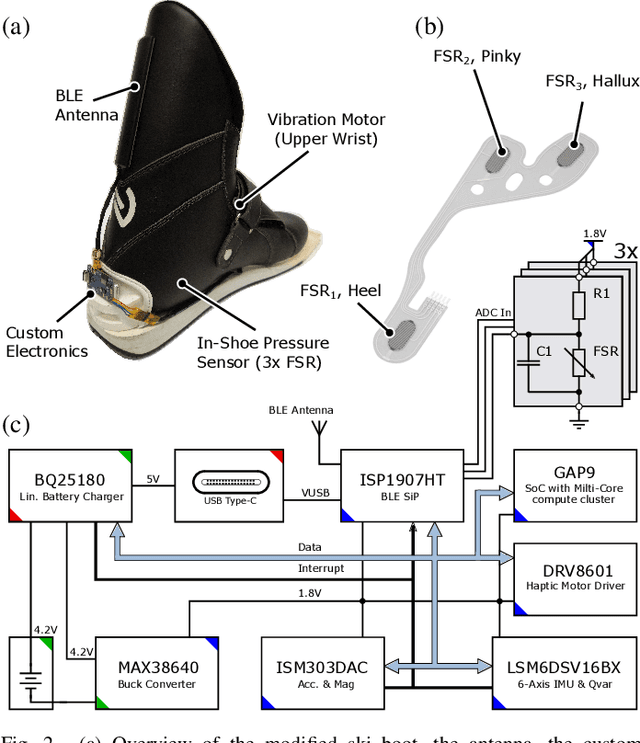


In ski jumping, low repetition rates of jumps limit the effectiveness of training. Thus, increasing learning rate within every single jump is key to success. A critical element of athlete training is motor learning, which has been shown to be accelerated by feedback methods. In particular, a fine-grained control of the center of gravity in the in-run is essential. This is because the actual takeoff occurs within a blink of an eye ($\sim$300ms), thus any unbalanced body posture during the in-run will affect flight. This paper presents a smart, compact, and energy-efficient wireless sensor system for real-time performance analysis and biofeedback during ski jumping. The system operates by gauging foot pressures at three distinct points on the insoles of the ski boot at 100Hz. Foot pressure data can either be directly sent to coaches to improve their feedback, or fed into a ML model to give athletes instantaneous in-action feedback using a vibration motor in the ski boot. In the biofeedback scenario, foot pressures act as input variables for an optimized XGBoost model. We achieve a high predictive accuracy of 92.7% for center of mass predictions (dorsal shift, neutral stand, ventral shift). Subsequently, we parallelized and fine-tuned our XGBoost model for a RISC-V based low power parallel processor (GAP9), based on the PULP architecture. We demonstrate real-time detection and feedback (0.0109ms/inference) using our on-chip deployment. The proposed smart system is unobtrusive with a slim form factor (13mm baseboard, 3.2mm antenna) and a lightweight build (26g). Power consumption analysis reveals that the system's energy-efficient design enables sustained operation over multiple days (up to 300 hours) without requiring recharge.
NanoSLAM: Enabling Fully Onboard SLAM for Tiny Robots
Sep 21, 2023


Perceiving and mapping the surroundings are essential for enabling autonomous navigation in any robotic platform. The algorithm class that enables accurate mapping while correcting the odometry errors present in most robotics systems is Simultaneous Localization and Mapping (SLAM). Today, fully onboard mapping is only achievable on robotic platforms that can host high-wattage processors, mainly due to the significant computational load and memory demands required for executing SLAM algorithms. For this reason, pocket-size hardware-constrained robots offload the execution of SLAM to external infrastructures. To address the challenge of enabling SLAM algorithms on resource-constrained processors, this paper proposes NanoSLAM, a lightweight and optimized end-to-end SLAM approach specifically designed to operate on centimeter-size robots at a power budget of only 87.9 mW. We demonstrate the mapping capabilities in real-world scenarios and deploy NanoSLAM on a nano-drone weighing 44 g and equipped with a novel commercial RISC-V low-power parallel processor called GAP9. The algorithm is designed to leverage the parallel capabilities of the RISC-V processing cores and enables mapping of a general environment with an accuracy of 4.5 cm and an end-to-end execution time of less than 250 ms.
A Wearable Ultra-Low-Power sEMG-Triggered Ultrasound System for Long-Term Muscle Activity Monitoring
Sep 14, 2023Surface electromyography (sEMG) is a well-established approach to monitor muscular activity on wearable and resource-constrained devices. However, when measuring deeper muscles, its low signal-to-noise ratio (SNR), high signal attenuation, and crosstalk degrade sensing performance. Ultrasound (US) complements sEMG effectively with its higher SNR at high penetration depths. In fact, combining US and sEMG improves the accuracy of muscle dynamic assessment, compared to using only one modality. However, the power envelope of US hardware is considerably higher than that of sEMG, thus inflating energy consumption and reducing the battery life. This work proposes a wearable solution that integrates both modalities and utilizes an EMG-driven wake-up approach to achieve ultra-low power consumption as needed for wearable long-term monitoring. We integrate two wearable state-of-the-art (SoA) US and ExG biosignal acquisition devices to acquire time-synchronized measurements of the short head of the biceps. To minimize power consumption, the US probe is kept in a sleep state when there is no muscle activity. sEMG data are processed on the probe (filtering, envelope extraction and thresholding) to identify muscle activity and generate a trigger to wake-up the US counterpart. The US acquisition starts before muscle fascicles displacement thanks to a triggering time faster than the electromechanical delay (30-100 ms) between the neuromuscular junction stimulation and the muscle contraction. Assuming a muscle contraction of 200 ms at a contraction rate of 1 Hz, the proposed approach enables more than 59% energy saving (with a full-system average power consumption of 12.2 mW) as compared to operating both sEMG and US continuously.
Enhancing Performance, Calibration Time and Efficiency in Brain-Machine Interfaces through Transfer Learning and Wearable EEG Technology
Sep 14, 2023Brain-machine interfaces (BMIs) have emerged as a transformative force in assistive technologies, empowering individuals with motor impairments by enabling device control and facilitating functional recovery. However, the persistent challenge of inter-session variability poses a significant hurdle, requiring time-consuming calibration at every new use. Compounding this issue, the low comfort level of current devices further restricts their usage. To address these challenges, we propose a comprehensive solution that combines a tiny CNN-based Transfer Learning (TL) approach with a comfortable, wearable EEG headband. The novel wearable EEG device features soft dry electrodes placed on the headband and is capable of on-board processing. We acquire multiple sessions of motor-movement EEG data and achieve up to 96% inter-session accuracy using TL, greatly reducing the calibration time and improving usability. By executing the inference on the edge every 100ms, the system is estimated to achieve 30h of battery life. The comfortable BMI setup with tiny CNN and TL paves the way to future on-device continual learning, essential for tackling inter-session variability and improving usability.
Fully Onboard SLAM for Distributed Mapping with a Swarm of Nano-Drones
Sep 07, 2023The use of Unmanned Aerial Vehicles (UAVs) is rapidly increasing in applications ranging from surveillance and first-aid missions to industrial automation involving cooperation with other machines or humans. To maximize area coverage and reduce mission latency, swarms of collaborating drones have become a significant research direction. However, this approach requires open challenges in positioning, mapping, and communications to be addressed. This work describes a distributed mapping system based on a swarm of nano-UAVs, characterized by a limited payload of 35 g and tightly constrained on-board sensing and computing capabilities. Each nano-UAV is equipped with four 64-pixel depth sensors that measure the relative distance to obstacles in four directions. The proposed system merges the information from the swarm and generates a coherent grid map without relying on any external infrastructure. The data fusion is performed using the iterative closest point algorithm and a graph-based simultaneous localization and mapping algorithm, running entirely on-board the UAV's low-power ARM Cortex-M microcontroller with just 192 kB of SRAM memory. Field results gathered in three different mazes from a swarm of up to 4 nano-UAVs prove a mapping accuracy of 12 cm and demonstrate that the mapping time is inversely proportional to the number of agents. The proposed framework scales linearly in terms of communication bandwidth and on-board computational complexity, supporting communication between up to 20 nano-UAVs and mapping of areas up to 180 m2 with the chosen configuration requiring only 50 kB of memory.
EpiDeNet: An Energy-Efficient Approach to Seizure Detection for Embedded Systems
Aug 28, 2023Epilepsy is a prevalent neurological disorder that affects millions of individuals globally, and continuous monitoring coupled with automated seizure detection appears as a necessity for effective patient treatment. To enable long-term care in daily-life conditions, comfortable and smart wearable devices with long battery life are required, which in turn set the demand for resource-constrained and energy-efficient computing solutions. In this context, the development of machine learning algorithms for seizure detection faces the challenge of heavily imbalanced datasets. This paper introduces EpiDeNet, a new lightweight seizure detection network, and Sensitivity-Specificity Weighted Cross-Entropy (SSWCE), a new loss function that incorporates sensitivity and specificity, to address the challenge of heavily unbalanced datasets. The proposed EpiDeNet-SSWCE approach demonstrates the successful detection of 91.16% and 92.00% seizure events on two different datasets (CHB-MIT and PEDESITE, respectively), with only four EEG channels. A three-window majority voting-based smoothing scheme combined with the SSWCE loss achieves 3x reduction of false positives to 1.18 FP/h. EpiDeNet is well suited for implementation on low-power embedded platforms, and we evaluate its performance on two ARM Cortex-based platforms (M4F/M7) and two parallel ultra-low power (PULP) systems (GAP8, GAP9). The most efficient implementation (GAP9) achieves an energy efficiency of 40 GMAC/s/W, with an energy consumption per inference of only 0.051 mJ at high performance (726.46 MMAC/s), outperforming the best ARM Cortex-based solutions by approximately 160x in energy efficiency. The EpiDeNet-SSWCE method demonstrates effective and accurate seizure detection performance on heavily imbalanced datasets, while being suited for implementation on energy-constrained platforms.
Land & Localize: An Infrastructure-free and Scalable Nano-Drones Swarm with UWB-based Localization
Jul 17, 2023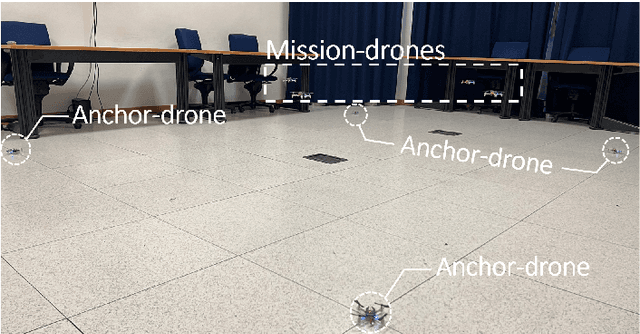
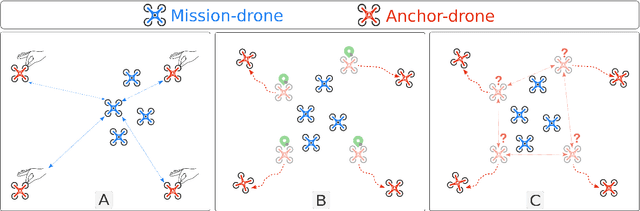
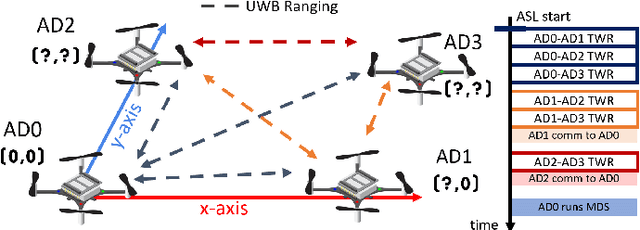
Relative localization is a crucial functional block of any robotic swarm. We address it in a fleet of nano-drones characterized by a 10 cm-scale form factor, which makes them highly versatile but also strictly limited in their onboard power envelope. State-of-the-Art solutions leverage Ultra-WideBand (UWB) technology, allowing distance range measurements between peer nano-drones and a stationary infrastructure of multiple UWB anchors. Therefore, we propose an UWB-based infrastructure-free nano-drones swarm, where part of the fleet acts as dynamic anchors, i.e., anchor-drones (ADs), capable of automatic deployment and landing. By varying the Ads' position constraint, we develop three alternative solutions with different trade-offs between flexibility and localization accuracy. In-field results, with four flying mission-drones (MDs), show a localization root mean square error (RMSE) spanning from 15.3 cm to 27.8 cm, at most. Scaling the number of MDs from 4 to 8, the RMSE marginally increases, i.e., less than 10 cm at most. The power consumption of the MDs' UWB module amounts to 342 mW. Ultimately, compared to a fixed-infrastructure commercial solution, our infrastructure-free system can be deployed anywhere and rapidly by taking 5.7 s to self-localize 4 ADs with a localization RMSE of up to 12.3% in the most challenging case with 8 MDs.
Flexible and Fully Quantized Ultra-Lightweight TinyissimoYOLO for Ultra-Low-Power Edge Systems
Jul 14, 2023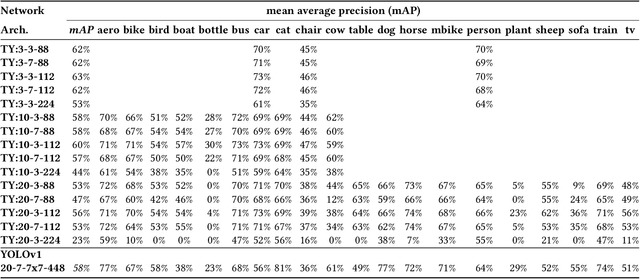
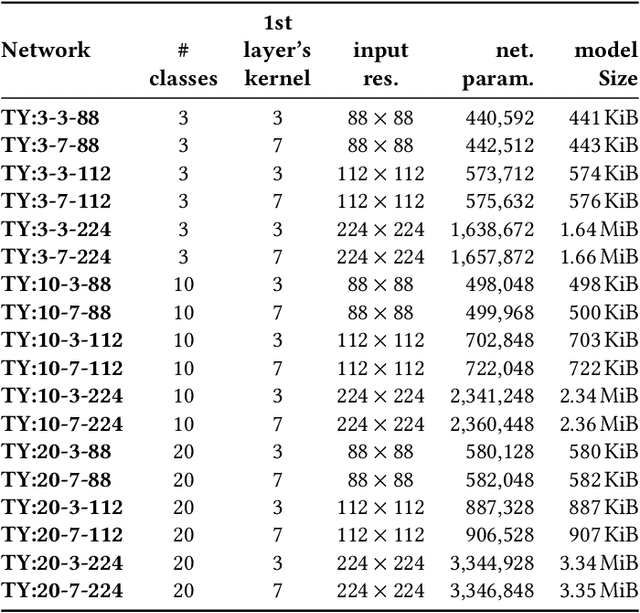
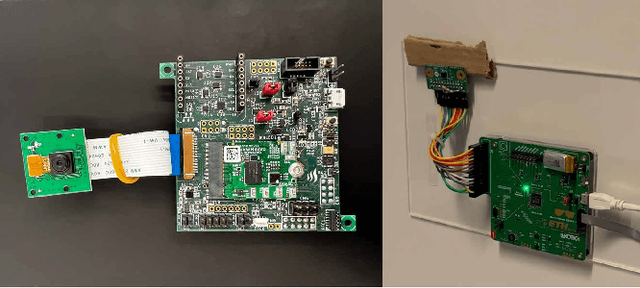
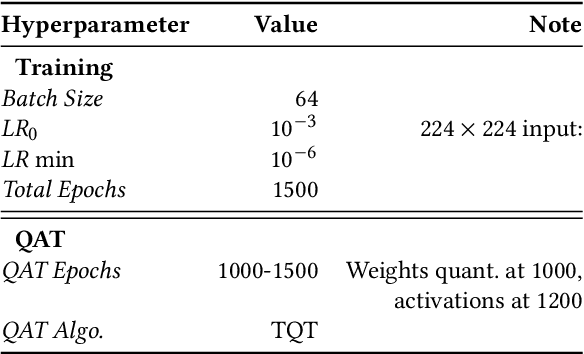
This paper deploys and explores variants of TinyissimoYOLO, a highly flexible and fully quantized ultra-lightweight object detection network designed for edge systems with a power envelope of a few milliwatts. With experimental measurements, we present a comprehensive characterization of the network's detection performance, exploring the impact of various parameters, including input resolution, number of object classes, and hidden layer adjustments. We deploy variants of TinyissimoYOLO on state-of-the-art ultra-low-power extreme edge platforms, presenting an in-depth a comparison on latency, energy efficiency, and their ability to efficiently parallelize the workload. In particular, the paper presents a comparison between a novel parallel RISC-V processor (GAP9 from Greenwaves) with and without use of its on-chip hardware accelerator, an ARM Cortex-M7 core (STM32H7 from ST Microelectronics), two ARM Cortex-M4 cores (STM32L4 from STM and Apollo4b from Ambiq), and a multi-core platform with a CNN hardware accelerator (Analog Devices MAX78000). Experimental results show that the GAP9's hardware accelerator achieves the lowest inference latency and energy at 2.12ms and 150uJ respectively, which is around 2x faster and 20% more efficient than the next best platform, the MAX78000. The hardware accelerator of GAP9 can even run an increased resolution version of TinyissimoYOLO with 112x112 pixels and 10 detection classes within 3.2ms, consuming 245uJ. To showcase the competitiveness of a versatile general-purpose system we also deployed and profiled a multi-core implementation on GAP9 at different operating points, achieving 11.3ms with the lowest-latency and 490uJ with the most energy-efficient configuration. With this paper, we demonstrate the suitability and flexibility of TinyissimoYOLO on state-of-the-art detection datasets for real-time ultra-low-power edge inference.
ITA: An Energy-Efficient Attention and Softmax Accelerator for Quantized Transformers
Jul 10, 2023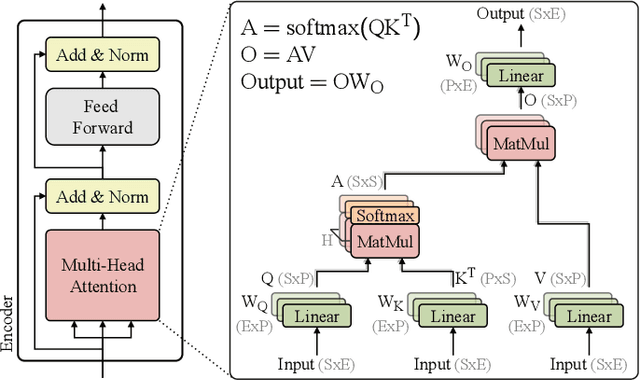
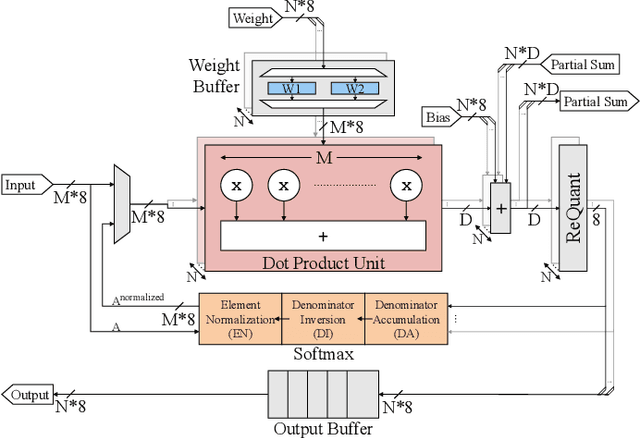
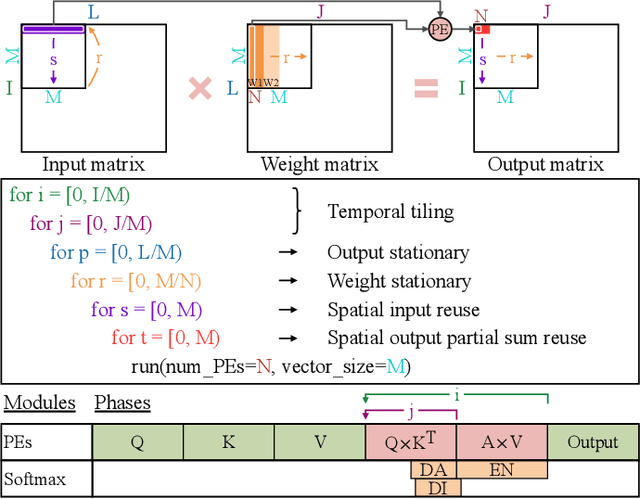

Transformer networks have emerged as the state-of-the-art approach for natural language processing tasks and are gaining popularity in other domains such as computer vision and audio processing. However, the efficient hardware acceleration of transformer models poses new challenges due to their high arithmetic intensities, large memory requirements, and complex dataflow dependencies. In this work, we propose ITA, a novel accelerator architecture for transformers and related models that targets efficient inference on embedded systems by exploiting 8-bit quantization and an innovative softmax implementation that operates exclusively on integer values. By computing on-the-fly in streaming mode, our softmax implementation minimizes data movement and energy consumption. ITA achieves competitive energy efficiency with respect to state-of-the-art transformer accelerators with 16.9 TOPS/W, while outperforming them in area efficiency with 5.93 TOPS/mm$^2$ in 22 nm fully-depleted silicon-on-insulator technology at 0.8 V.