 Add to Chrome
 Add to Firefox
 Add to Edge
FPLIER: Federated Pathway-Level Information Extractor
May 28, 2026
In transcriptomics, gene-set-aware factorization methods such as the Pathway Level Information Extractor (PLIER) are most effective when trained on large, heterogeneous expression compendia. Yet, many clinically relevant cohorts cannot be pooled into a single dataset due to privacy and governance constraints. We present FPLIER, a federated extension of PLIER that enables distributed training across multiple data holders while incorporating publicly available datasets. Through secure aggregation, FPLIER produces training updates algebraically equivalent to those of a centralized pooled-data approach while keeping expression data local. We evaluate FPLIER across multiple scenarios in two simulated consortia (from the K-CLIER and MultiPLIER studies) and demonstrate stable convergence. We further conduct a systematic analysis of membership inference attacks targeting both intermediate training statistics and the released model. Our results show that privacy risk is governed by the rank of the training expression matrix. Incorporating public data or reducing data dimensionality increases this rank, moving the system toward a full-rank regime in which training and non-training samples become indistinguishable to the attacker, and membership-inference performance approaches random guessing.

Tiny-DroNeRF: Tiny Neural Radiance Fields aboard Federated Learning-enabled Nano-drones
Mar 02, 2026Sub-30g nano-sized aerial robots can leverage their agility and form factor to autonomously explore cluttered and narrow environments, like in industrial inspection and search and rescue missions. However, the price for their tiny size is a strong limit in their resources, i.e., sub-100 mW microcontroller units (MCUs) delivering $\sim$100 GOps/s at best, and memory budgets well below 100 MB. Despite these strict constraints, we aim to enable complex vision-based tasks aboard nano-drones, such as dense 3D scene reconstruction: a key robotic task underlying fundamental capabilities like spatial awareness and motion planning. Top-performing 3D reconstruction methods leverage neural radiance fields (NeRF) models, which require GBs of memory and massive computation, usually delivered by high-end GPUs consuming 100s of Watts. Our work introduces Tiny-DroNeRF, a lightweight NeRF model, based on Instant-NGP, and optimized for running on a GAP9 ultra-low-power (ULP) MCU aboard our nano-drones. Then, we further empower our Tiny-DroNeRF by leveraging a collaborative federated learning scheme, which distributes the model training among multiple nano-drones. Our experimental results show a 96% reduction in Tiny-DroNeRF's memory footprint compared to Instant-NGP, with only a 5.7 dB drop in reconstruction accuracy. Finally, our federated learning scheme allows Tiny-DroNeRF to train with an amount of data otherwise impossible to keep in a single drone's memory, increasing the overall reconstruction accuracy. Ultimately, our work combines, for the first time, NeRF training on an ULP MCU with federated learning on nano-drones.
Technical Insights and Legal Considerations for Advancing Federated Learning in Bioinformatics
Mar 12, 2025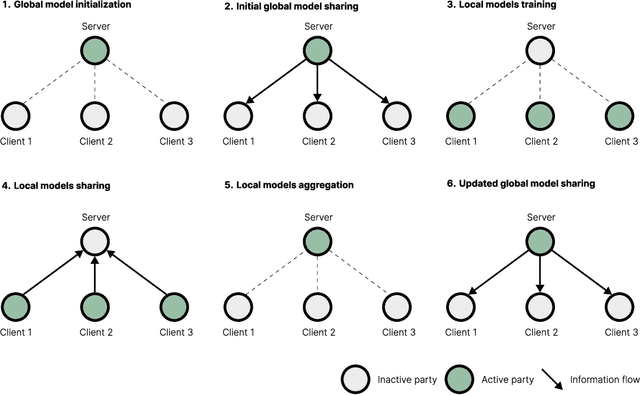
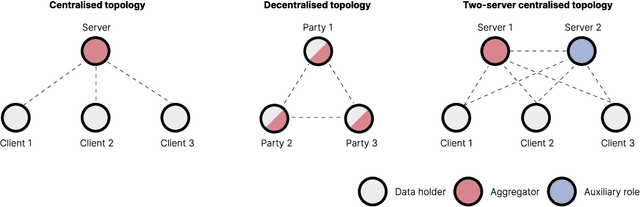
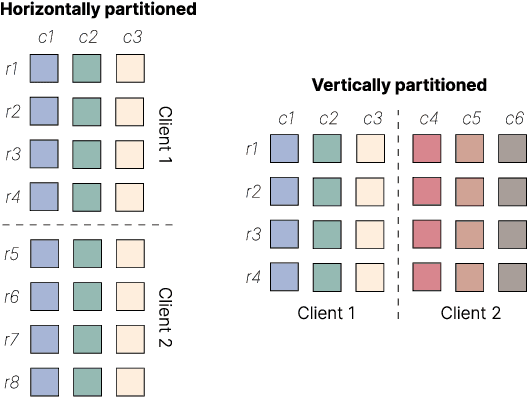
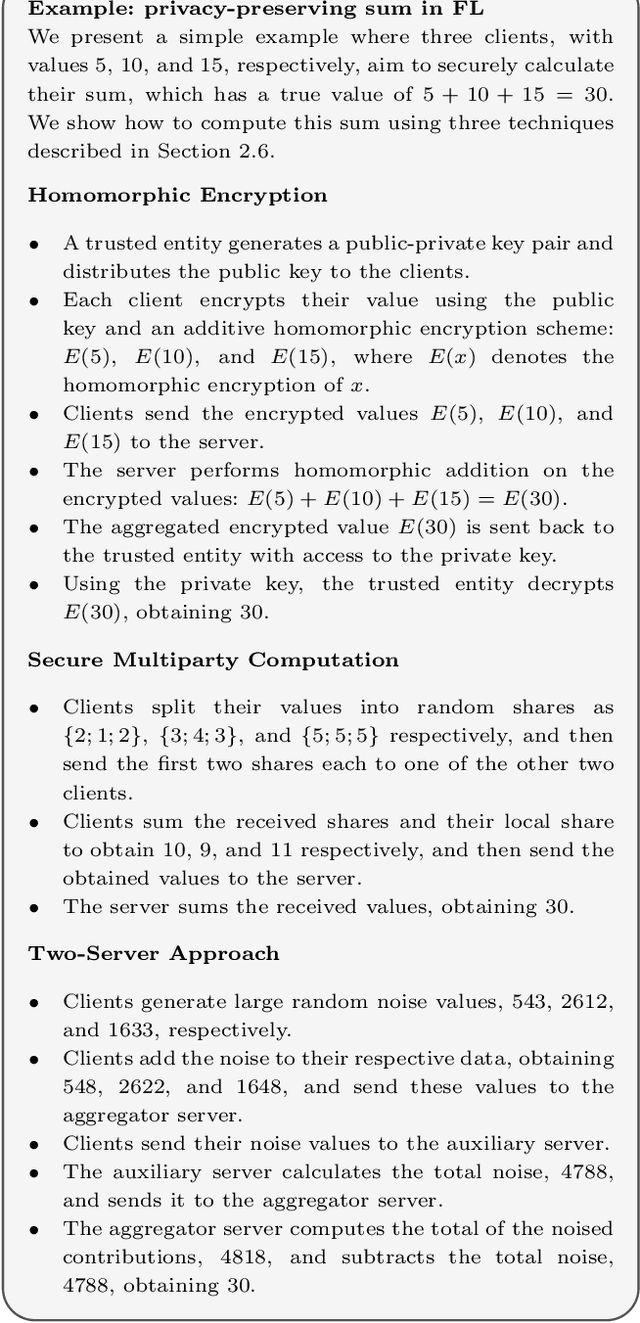
Federated learning leverages data across institutions to improve clinical discovery while complying with data-sharing restrictions and protecting patient privacy. As the evolution of biobanks in genetics and systems biology has proved, accessing more extensive and varied data pools leads to a faster and more robust exploration and translation of results. More widespread use of federated learning may have the same impact in bioinformatics, allowing access to many combinations of genotypic, phenotypic and environmental information that are undercovered or not included in existing biobanks. This paper reviews the methodological, infrastructural and legal issues that academic and clinical institutions must address before implementing it. Finally, we provide recommendations for the reliable use of federated learning and its effective translation into clinical practice.