 Add to Chrome
 Add to Firefox
 Add to Edge
Question Begets Question: Self-Evolving Curriculum for Reinforcement Fine-Tuning on Competition Mathematics
Aug 02, 2026
Teaching a language model a skill it has not mastered is obstructed by three recurring difficulties: training data is scarce, ground-truth reasoning traces are usually unavailable, and models often exhibit an apparent ceiling beyond which additional data yields no further improvement. We study these difficulties in a controlled setting, fine-tuning Qwen2.5-Math-7B on competition mathematics (AIME), a task on which it initially solves only 5.6\% of problems (pass@1). To address data scarcity, we introduce Question-begets-Question (QbQ), a scalable procedure in which a teacher transforms existing problems into diverse variants that probe the same underlying skills; to model the absence of oracle reasoning, we train exclusively via reinforcement learning on problem statements and final answers, never on teacher reasoning traces. Static training on such data, however, plateaus well short of the task: real-plus-synthetic augmentation and non-curriculum QbQ generated synthetic data training cap pass@1 at 12.5\% and 14.5\% respectively, despite large increases in data. Our central finding is that this ceiling is not intrinsic to the model. We propose a self-evolving curriculum that, each round, evaluates the current checkpoint, seeds QbQ from the problems it can mostly get right, and trains on the resulting variants; under an identical data budget, this breaks the ceiling and lifts pass@1 to 16.5\% with no sign of saturation after 20 rounds. Counterintuitively, we find that models improve when trained on variants of problems they can mostly get right, and that models trained this way go on to solve harder problems never seen during training.

DeepImagine: Learning Biomedical Reasoning via Successive Counterfactual Imagining
Apr 24, 2026Predicting the outcomes of prospective clinical trials remains a major challenge for large language models. Prior work has shown that both traditional correlational predictors, such as random forests and logistic regression, and strong commercial LLMs achieve limited performance on this task. In this paper, we propose DeepImagine, a framework for teaching LLMs biomedical reasoning through successive counterfactual imagining. The central idea is to approximate hidden causal mechanisms of clinical trials by training models to infer how observed trial results would change under controlled perturbations of experimental conditions, such as dosage, outcome measures, study arms, geography, and other trial attributes. To support this objective, we construct both natural and approximate counterfactual pairs from real clinical trials with reported outcomes. For settings where strict counterfactual supervision is available, such as paired outcome measures or dose-ranging study arms within the same trial, we train models with supervised fine-tuning. For broader settings where only approximate counterfactual pairs can be retrieved, we optimize models with reinforcement learning using verifiable rewards based on downstream benchmark correctness. We further augment training with synthetic reasoning traces that provide causally plausible explanations for local counterfactual transitions. Using this pipeline, we train language models under 10B parameters, including Qwen3.5-9B, and evaluate them on clinical trial outcome prediction. We aim to show that DeepImagine consistently improves over untuned language models and traditional correlational baselines. Finally, we aim to show that the learned reasoning trajectories provide interpretable signals about how models represent trial-level mechanisms, suggesting a practical path toward more mechanistic and scientifically useful biomedical language models.
Single-Pass Document Scanning for Question Answering
Apr 04, 2025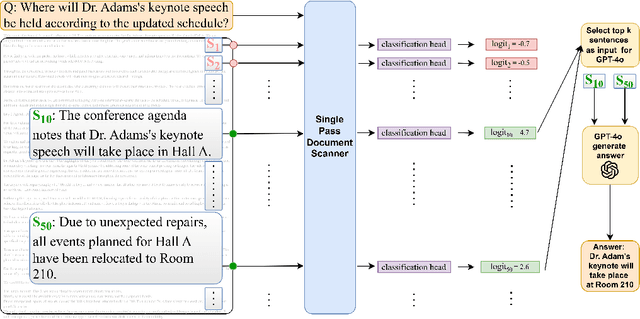
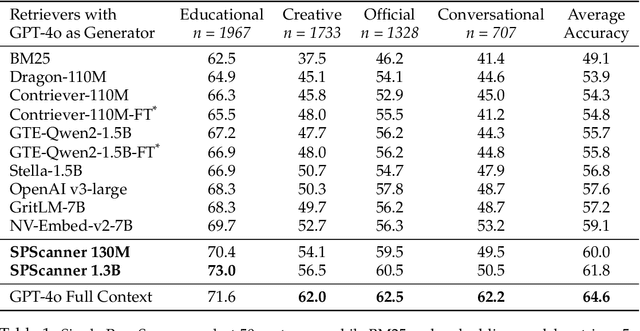
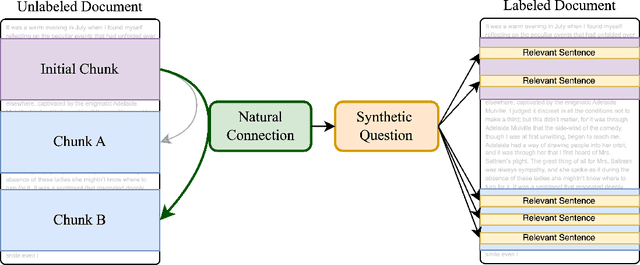
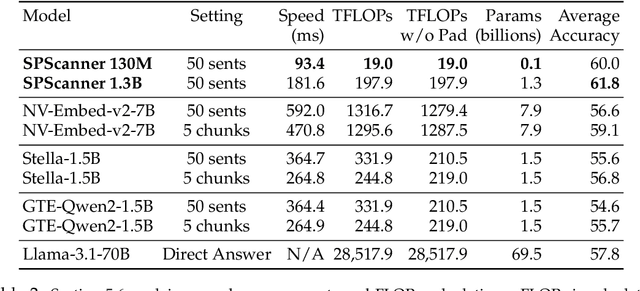
Handling extremely large documents for question answering is challenging: chunk-based embedding methods often lose track of important global context, while full-context transformers can be prohibitively expensive for hundreds of thousands of tokens. We propose a single-pass document scanning approach that processes the entire text in linear time, preserving global coherence while deciding which sentences are most relevant to the query. On 41 QA benchmarks, our single-pass scanner consistently outperforms chunk-based embedding methods and competes with large language models at a fraction of the computational cost. By conditioning on the entire preceding context without chunk breaks, the method preserves global coherence, which is especially important for long documents. Overall, single-pass document scanning offers a simple solution for question answering over massive text. All code, datasets, and model checkpoints are available at https://github.com/MambaRetriever/MambaRetriever
Measuring Risk of Bias in Biomedical Reports: The RoBBR Benchmark
Nov 28, 2024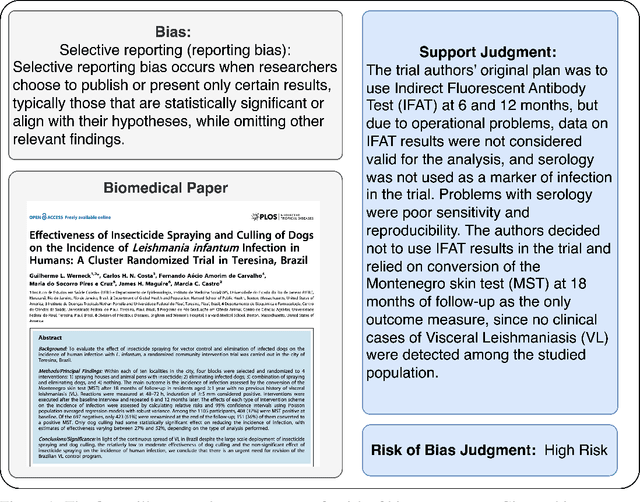

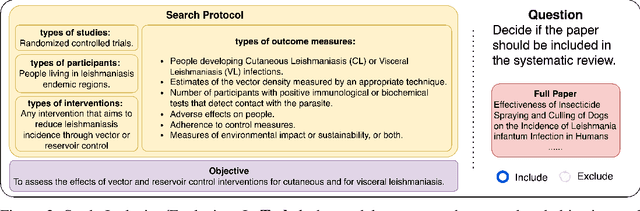
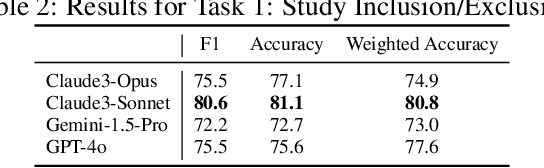
Systems that answer questions by reviewing the scientific literature are becoming increasingly feasible. To draw reliable conclusions, these systems should take into account the quality of available evidence, placing more weight on studies that use a valid methodology. We present a benchmark for measuring the methodological strength of biomedical papers, drawing on the risk-of-bias framework used for systematic reviews. The four benchmark tasks, drawn from more than 500 papers, cover the analysis of research study methodology, followed by evaluation of risk of bias in these studies. The benchmark contains 2000 expert-generated bias annotations, and a human-validated pipeline for fine-grained alignment with research paper content. We evaluate a range of large language models on the benchmark, and find that these models fall significantly short of expert-level performance. By providing a standardized tool for measuring judgments of study quality, the benchmark can help to guide systems that perform large-scale aggregation of scientific data. The dataset is available at https://github.com/RoBBR-Benchmark/RoBBR.