 Add to Chrome
 Add to Firefox
 Add to Edge
DeepImagine: Learning Biomedical Reasoning via Successive Counterfactual Imagining
Apr 24, 2026
Predicting the outcomes of prospective clinical trials remains a major challenge for large language models. Prior work has shown that both traditional correlational predictors, such as random forests and logistic regression, and strong commercial LLMs achieve limited performance on this task. In this paper, we propose DeepImagine, a framework for teaching LLMs biomedical reasoning through successive counterfactual imagining. The central idea is to approximate hidden causal mechanisms of clinical trials by training models to infer how observed trial results would change under controlled perturbations of experimental conditions, such as dosage, outcome measures, study arms, geography, and other trial attributes. To support this objective, we construct both natural and approximate counterfactual pairs from real clinical trials with reported outcomes. For settings where strict counterfactual supervision is available, such as paired outcome measures or dose-ranging study arms within the same trial, we train models with supervised fine-tuning. For broader settings where only approximate counterfactual pairs can be retrieved, we optimize models with reinforcement learning using verifiable rewards based on downstream benchmark correctness. We further augment training with synthetic reasoning traces that provide causally plausible explanations for local counterfactual transitions. Using this pipeline, we train language models under 10B parameters, including Qwen3.5-9B, and evaluate them on clinical trial outcome prediction. We aim to show that DeepImagine consistently improves over untuned language models and traditional correlational baselines. Finally, we aim to show that the learned reasoning trajectories provide interpretable signals about how models represent trial-level mechanisms, suggesting a practical path toward more mechanistic and scientifically useful biomedical language models.

EvidenceBench: A Benchmark for Extracting Evidence from Biomedical Papers
Apr 25, 2025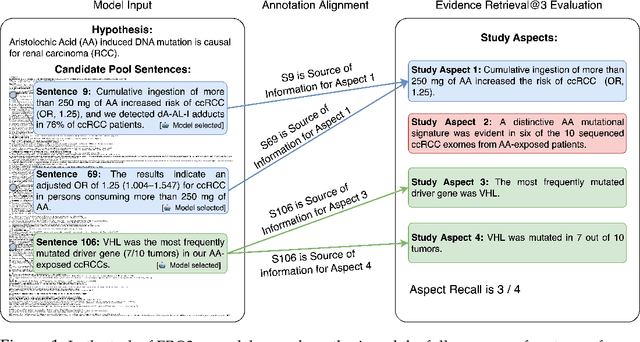

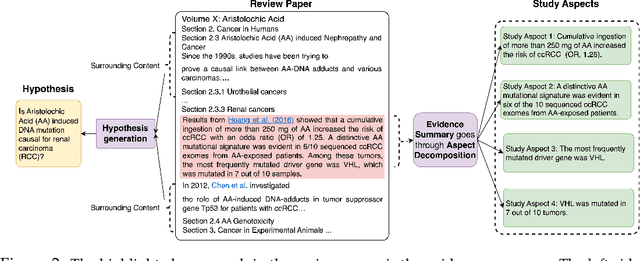

We study the task of automatically finding evidence relevant to hypotheses in biomedical papers. Finding relevant evidence is an important step when researchers investigate scientific hypotheses. We introduce EvidenceBench to measure models performance on this task, which is created by a novel pipeline that consists of hypothesis generation and sentence-by-sentence annotation of biomedical papers for relevant evidence, completely guided by and faithfully following existing human experts judgment. We demonstrate the pipeline's validity and accuracy with multiple sets of human-expert annotations. We evaluated a diverse set of language models and retrieval systems on the benchmark and found that model performances still fall significantly short of the expert level on this task. To show the scalability of our proposed pipeline, we create a larger EvidenceBench-100k with 107,461 fully annotated papers with hypotheses to facilitate model training and development. Both datasets are available at https://github.com/EvidenceBench/EvidenceBench