 Add to Chrome
 Add to Firefox
 Add to Edge
The Effect of Perceived Race and Gender on Police Language Use: Experimental Evidence from VR Simulations
Aug 05, 2026
Against the backdrop of violence in police interactions with the U.S. public, we explore how deferentially police officers speak to virtual characters depicted as Black adult males in vir- tual reality (VR) simulations. We evaluate the effect of seeing and communicating with these characters through a causal in- ference lens, where the assignment of the Black man character to a police officer and simulation is the treatment variable. Our (marginal) average treatment effect AT E measures the social impact of the character on the deference of officer statements with each turn of the conversation. Soberingly, we find that most officers speak less deferentially to Black man characters, except for White, biracial, and multiracial female officers, es- pecially in settings where the VR character was known to be a suspect. Across a full conversation of a typical VR scene, these marginal AT Es can result in notable changes in def- erence of tone (two to several points difference on a scale of 0-10), above and beyond that due to the initial effect of per- ceiving a Black male character. Even more disconcerting is that this can contribute to conversation breakdowns that po- tentially result in violence or danger to both the public and the police. We also explored the capabilities of large language models (LLMs) for ATE estimation. From our methods com- parison analysis, including model validation against synthetic data, we provide unique scientific insights on LLM-assisted methodologies for ATE estimation. As such, for ATE esti- mation with multilevel data with text, we recommend mixed effects models with the inverse propensity treatment weighted (iptw) approach, which utilized an LLM for text feature cre- ation. While we also tested LLMs for finetuning prediction models ultimately for ATE estimation, we conclude they are an area for further development and refinement.

QDEvo: A Multi-Objective Quality-Diversity Framework for Automated Heuristic Design
Jul 06, 2026The integration of Large Language Models (LLMs) with evolutionary computation has emerged as a powerful paradigm for automated heuristic design in combinatorial optimization. However, existing approaches suffer from mode collapse, converging to homogeneous populations that lack semantic diversity and fail to explore the full algorithmic space. We propose Quality-Diversity Evolution (QDEvo), a multi-objective framework that integrates Quality-Diversity optimization with LLM-driven heuristic search, maintaining an unbounded archive of semantically diverse algorithms using pre-trained code embeddings and incorporating hierarchical self-reflection to guide the evolutionary process. Extensive experiments across standard benchmarks and real-world industrial applications demonstrate that QDEvo significantly outperforms state-of-the-art methods in both Hypervolume and Inverted Generational Distance metrics. Our framework enables the discovery of heuristics that are simultaneously high-performing, computationally efficient, and semantically diverse, providing practitioners with a rich portfolio of solutions for complex optimization problems.
ProMUSE: Progressive Multi-modal Uncertainty-guided Staged Evidential Alzheimer Disease Classification
Jun 11, 2026Alzheimer's disease (AD) is a fatal disorder that destroys memory and cognitive skills in the elderly population. Most treatments for AD are effective in the early stage, leading to an increasing demand for early AD diagnosis. AD diagnosis increasingly relies on multimodal data such as clinical assessments, structural Magnetic Resonance Imaging (MRI), and Positron Emission Tomography (PET) imaging. However, MRI and PET acquisition remain costly and not universally accessible, making full-modality inference impractical in real-world clinical workflows. We propose ProMUSE, a Progressive Multi-modal Uncertainty Guided Staged Evidential Network that adaptively determines when additional modalities are necessary, helping reduce the overall cost of data acquisition while maintaining accuracy. ProMUSE first performs evidential classification using low-cost clinical data and quantifies uncertainty via a Dirichlet-based subjective logic model. When uncertainty exceeds a learned threshold, ProMUSE progressively incorporates MRI or PET features, fusing modality-wise belief and uncertainty through Dempster-Shafer theory to obtain a calibrated multimodal prediction. This staged acquisition strategy enables accurate diagnosis while minimizing reliance on expensive imaging. Experiments on ADNI, AIBL, and OASIS across CN-AD, CN-MCI, and MCI-AD tasks demonstrate that ProMUSE achieves competitive or superior accuracy compared to full-modality baselines while reducing MRI/PET usage by 50-90%, yielding substantial cost savings. These results highlight ProMUSE as a practical, uncertainty-aware, and resource-efficient solution for real-world AD screening.
HSEvo: Elevating Automatic Heuristic Design with Diversity-Driven Harmony Search and Genetic Algorithm Using LLMs
Dec 19, 2024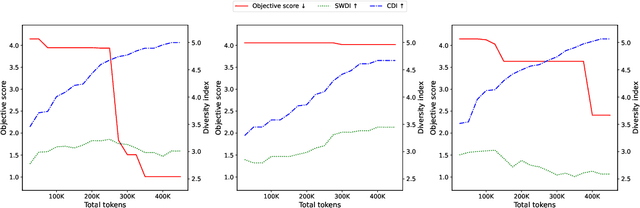
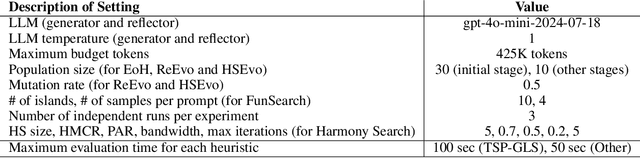
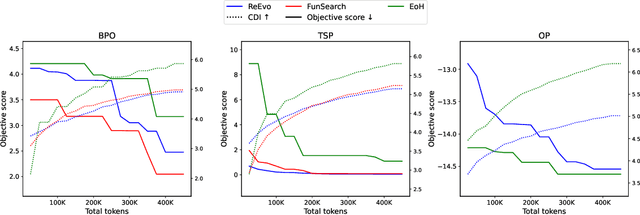

Automatic Heuristic Design (AHD) is an active research area due to its utility in solving complex search and NP-hard combinatorial optimization problems in the real world. The recent advancements in Large Language Models (LLMs) introduce new possibilities by coupling LLMs with evolutionary computation to automatically generate heuristics, known as LLM-based Evolutionary Program Search (LLM-EPS). While previous LLM-EPS studies obtained great performance on various tasks, there is still a gap in understanding the properties of heuristic search spaces and achieving a balance between exploration and exploitation, which is a critical factor in large heuristic search spaces. In this study, we address this gap by proposing two diversity measurement metrics and perform an analysis on previous LLM-EPS approaches, including FunSearch, EoH, and ReEvo. Results on black-box AHD problems reveal that while EoH demonstrates higher diversity than FunSearch and ReEvo, its objective score is unstable. Conversely, ReEvo's reflection mechanism yields good objective scores but fails to optimize diversity effectively. With this finding in mind, we introduce HSEvo, an adaptive LLM-EPS framework that maintains a balance between diversity and convergence with a harmony search algorithm. Through experimentation, we find that HSEvo achieved high diversity indices and good objective scores while remaining cost-effective. These results underscore the importance of balancing exploration and exploitation and understanding heuristic search spaces in designing frameworks in LLM-EPS.
A High-Quality and Large-Scale Dataset for English-Vietnamese Speech Translation
Aug 08, 2022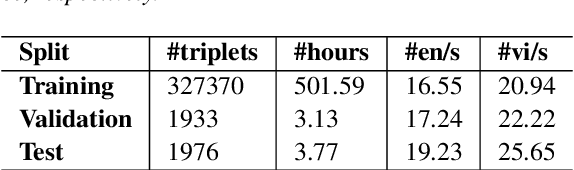
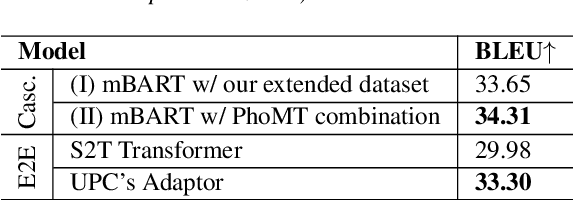
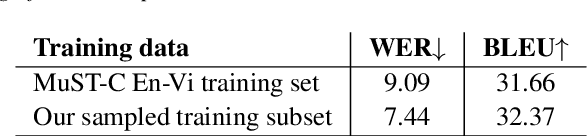
In this paper, we introduce a high-quality and large-scale benchmark dataset for English-Vietnamese speech translation with 508 audio hours, consisting of 331K triplets of (sentence-lengthed audio, English source transcript sentence, Vietnamese target subtitle sentence). We also conduct empirical experiments using strong baselines and find that the traditional "Cascaded" approach still outperforms the modern "End-to-End" approach. To the best of our knowledge, this is the first large-scale English-Vietnamese speech translation study. We hope both our publicly available dataset and study can serve as a starting point for future research and applications on English-Vietnamese speech translation. Our dataset is available at https://github.com/VinAIResearch/PhoST
PhoMT: A High-Quality and Large-Scale Benchmark Dataset for Vietnamese-English Machine Translation
Oct 23, 2021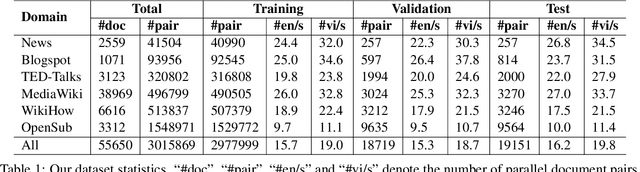
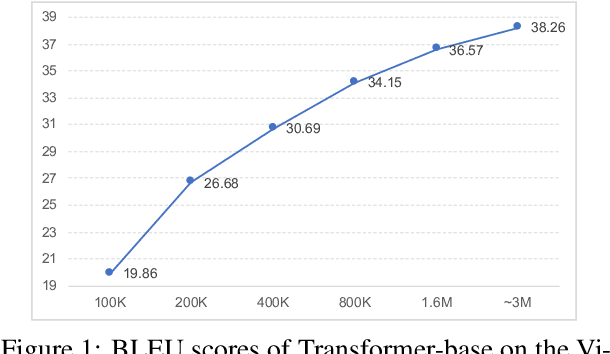
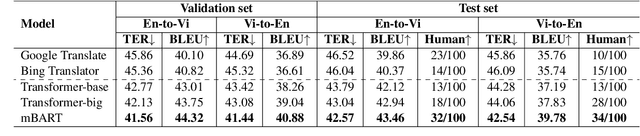
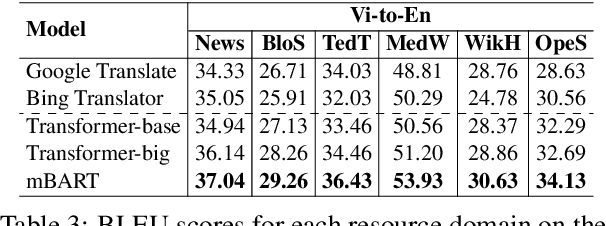
We introduce a high-quality and large-scale Vietnamese-English parallel dataset of 3.02M sentence pairs, which is 2.9M pairs larger than the benchmark Vietnamese-English machine translation corpus IWSLT15. We conduct experiments comparing strong neural baselines and well-known automatic translation engines on our dataset and find that in both automatic and human evaluations: the best performance is obtained by fine-tuning the pre-trained sequence-to-sequence denoising auto-encoder mBART. To our best knowledge, this is the first large-scale Vietnamese-English machine translation study. We hope our publicly available dataset and study can serve as a starting point for future research and applications on Vietnamese-English machine translation.
WNUT-2020 Task 2: Identification of Informative COVID-19 English Tweets
Oct 16, 2020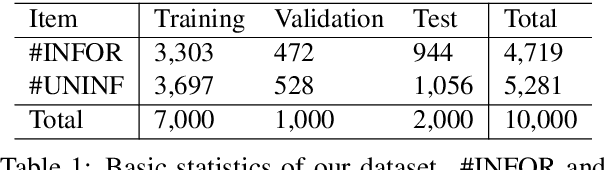
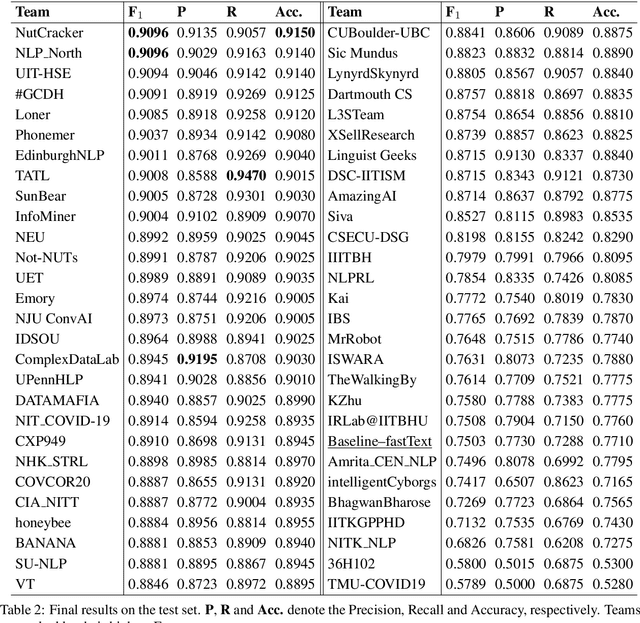
In this paper, we provide an overview of the WNUT-2020 shared task on the identification of informative COVID-19 English Tweets. We describe how we construct a corpus of 10K Tweets and organize the development and evaluation phases for this task. In addition, we also present a brief summary of results obtained from the final system evaluation submissions of 55 teams, finding that (i) many systems obtain very high performance, up to 0.91 F1 score, (ii) the majority of the submissions achieve substantially higher results than the baseline fastText (Joulin et al., 2017), and (iii) fine-tuning pre-trained language models on relevant language data followed by supervised training performs well in this task.