 Add to Chrome
 Add to Firefox
 Add to Edge
FedWeave: Rethinking the Unit of Specialization in Heterogeneous Federated MoE-LoRA
Jul 29, 2026
Federated PEFT enables LLMs to collaboratively adapt to decentralized private data without sharing raw examples. However, task heterogeneity across clients can cause cross-task interference and gradient conflicts during aggregation. Federated MoE-LoRA addresses this challenge through specialized LoRA experts and conditional routing. Yet existing methods typically specialize at client granularity, implicitly assuming task-coherent clients. Our core insight is that experts need purity, namely pattern-coherent updates that preserve specialization, whereas routers need contrast, namely mixed-task observations that support expert comparison. We propose FedWeave, a framework that adopts asymmetric aggregation, separating expert aggregation from router optimization to meet these two requirements. FedWeave uses unsupervised prototype discovery to form local buckets and align them across clients, enabling prototype-level expert aggregation while retaining mixed-task client trajectories for router training. At inference, FedWeave performs sparse inference with one active expert while preserving nearly all soft-routing performance. Our theoretical analysis explains why asymmetric aggregation is advantageous: it controls expert convergence in stationarity through off-pattern contamination, identifies the consensus error induced by fragmented router trajectories, and bounds sparse-inference risk. On a heterogeneous multi-task benchmark with mainstream LLM backbones, FedWeave consistently outperforms strong baselines, while ablations verify the effectiveness of our design.

MA-DAR: Manifold-Aligned Dynamic Adaptive Routing for Continual Temporal Knowledge Graph Reasoning
Jul 24, 2026Continual temporal knowledge graph (TKG) reasoning aims to continuously incorporate newly emerging facts while preserving previously acquired knowledge. Replay-based continual learning has achieved promising performance by revisiting historical representations. However, existing methods primarily focus on what to replay, while largely overlooking how replayed representations should be integrated with current ones. Such direct integration often gives rise to two critical forms of representation conflict: \textit{norm domination} and \textit{semantic blurring}, ultimately degrading continual reasoning performance. To address these challenges, we propose MA-DAR (Manifold-Aligned Dynamic Adaptive Routing), a lightweight plug-and-play framework for replay representation fusion. MA-DAR first aligns replayed and current representations onto a shared manifold to alleviate distribution discrepancies. It then employs a dynamic gating mechanism to learn dimension-wise fusion weights, adaptively determining the contribution of replayed and current representations to the fused representation. Furthermore, a polarization regularizer encourages more decisive routing behaviors by discouraging ambiguous gating decisions, resulting in more stable and effective knowledge integration. Extensive experiments on four public continual TKG benchmarks demonstrate that MA-DAR consistently improves the performance of representative TKG encoders while remaining effective under different replay settings. Comprehensive ablation studies and visualization analyses further verify the effectiveness of manifold alignment and dynamic adaptive routing in mitigating representation conflicts and improving continual reasoning.
Fine-grained Spatio-temporal Event Prediction with Self-adaptive Anchor Graph
Jan 15, 2025Event prediction tasks often handle spatio-temporal data distributed in a large spatial area. Different regions in the area exhibit different characteristics while having latent correlations. This spatial heterogeneity and correlations greatly affect the spatio-temporal distributions of event occurrences, which has not been addressed by state-of-the-art models. Learning spatial dependencies of events in a continuous space is challenging due to its fine granularity and a lack of prior knowledge. In this work, we propose a novel Graph Spatio-Temporal Point Process (GSTPP) model for fine-grained event prediction. It adopts an encoder-decoder architecture that jointly models the state dynamics of spatially localized regions using neural Ordinary Differential Equations (ODEs). The state evolution is built on the foundation of a novel Self-Adaptive Anchor Graph (SAAG) that captures spatial dependencies. By adaptively localizing the anchor nodes in the space and jointly constructing the correlation edges between them, the SAAG enhances the model's ability of learning complex spatial event patterns. The proposed GSTPP model greatly improves the accuracy of fine-grained event prediction. Extensive experimental results show that our method greatly improves the prediction accuracy over existing spatio-temporal event prediction approaches.
Document-level Relation Extraction with Cross-sentence Reasoning Graph
Mar 07, 2023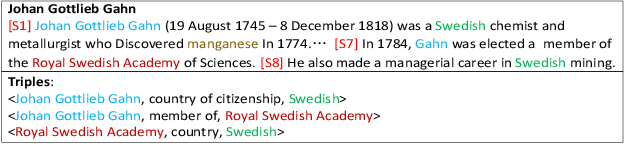

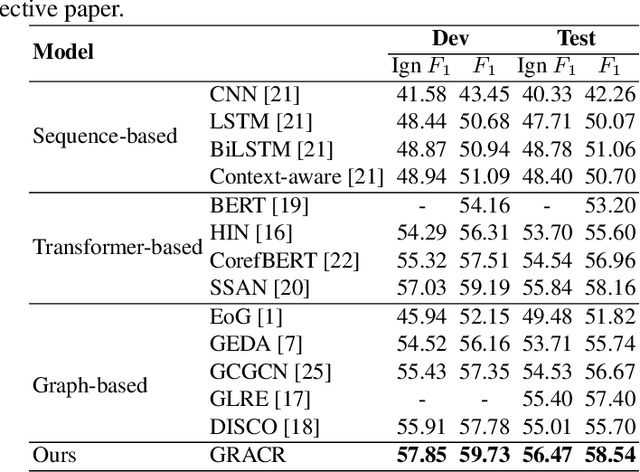

Relation extraction (RE) has recently moved from the sentence-level to document-level, which requires aggregating document information and using entities and mentions for reasoning. Existing works put entity nodes and mention nodes with similar representations in a document-level graph, whose complex edges may incur redundant information. Furthermore, existing studies only focus on entity-level reasoning paths without considering global interactions among entities cross-sentence. To these ends, we propose a novel document-level RE model with a GRaph information Aggregation and Cross-sentence Reasoning network (GRACR). Specifically, a simplified document-level graph is constructed to model the semantic information of all mentions and sentences in a document, and an entity-level graph is designed to explore relations of long-distance cross-sentence entity pairs. Experimental results show that GRACR achieves excellent performance on two public datasets of document-level RE. It is especially effective in extracting potential relations of cross-sentence entity pairs. Our code is available at https://github.com/UESTC-LHF/GRACR.
Behavior Recognition Based on the Integration of Multigranular Motion Features
Mar 07, 2022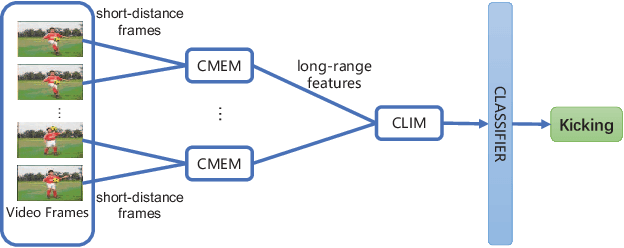
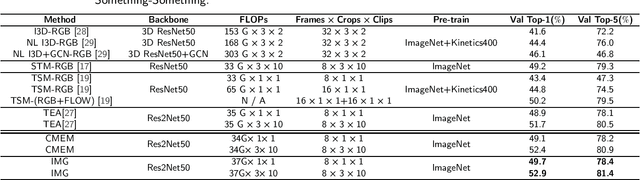
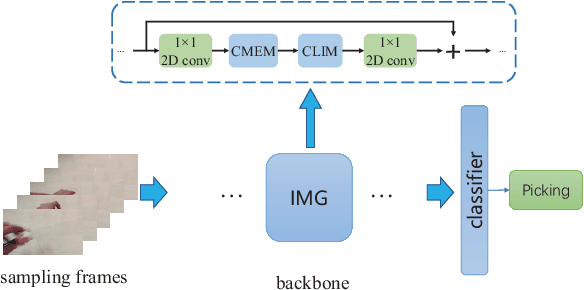
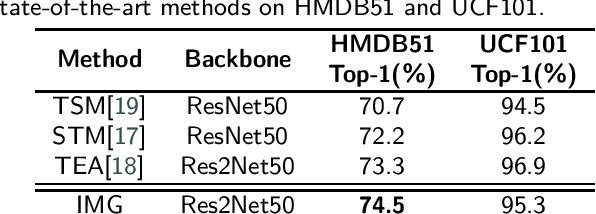
The recognition of behaviors in videos usually requires a combinatorial analysis of the spatial information about objects and their dynamic action information in the temporal dimension. Specifically, behavior recognition may even rely more on the modeling of temporal information containing short-range and long-range motions; this contrasts with computer vision tasks involving images that focus on the understanding of spatial information. However, current solutions fail to jointly and comprehensively analyze short-range motion between adjacent frames and long-range temporal aggregations at large scales in videos. In this paper, we propose a novel behavior recognition method based on the integration of multigranular (IMG) motion features. In particular, we achieve reliable motion information modeling through the synergy of a channel attention-based short-term motion feature enhancement module (CMEM) and a cascaded long-term motion feature integration module (CLIM). We evaluate our model on several action recognition benchmarks such as HMDB51, Something-Something and UCF101. The experimental results demonstrate that our approach outperforms the previous state-of-the-art methods, which confirms its effectiveness and efficiency.