 Add to Chrome
 Add to Firefox
 Add to Edge
FedWeave: Rethinking the Unit of Specialization in Heterogeneous Federated MoE-LoRA
Jul 29, 2026
Federated PEFT enables LLMs to collaboratively adapt to decentralized private data without sharing raw examples. However, task heterogeneity across clients can cause cross-task interference and gradient conflicts during aggregation. Federated MoE-LoRA addresses this challenge through specialized LoRA experts and conditional routing. Yet existing methods typically specialize at client granularity, implicitly assuming task-coherent clients. Our core insight is that experts need purity, namely pattern-coherent updates that preserve specialization, whereas routers need contrast, namely mixed-task observations that support expert comparison. We propose FedWeave, a framework that adopts asymmetric aggregation, separating expert aggregation from router optimization to meet these two requirements. FedWeave uses unsupervised prototype discovery to form local buckets and align them across clients, enabling prototype-level expert aggregation while retaining mixed-task client trajectories for router training. At inference, FedWeave performs sparse inference with one active expert while preserving nearly all soft-routing performance. Our theoretical analysis explains why asymmetric aggregation is advantageous: it controls expert convergence in stationarity through off-pattern contamination, identifies the consensus error induced by fragmented router trajectories, and bounds sparse-inference risk. On a heterogeneous multi-task benchmark with mainstream LLM backbones, FedWeave consistently outperforms strong baselines, while ablations verify the effectiveness of our design.

MA-DAR: Manifold-Aligned Dynamic Adaptive Routing for Continual Temporal Knowledge Graph Reasoning
Jul 24, 2026Continual temporal knowledge graph (TKG) reasoning aims to continuously incorporate newly emerging facts while preserving previously acquired knowledge. Replay-based continual learning has achieved promising performance by revisiting historical representations. However, existing methods primarily focus on what to replay, while largely overlooking how replayed representations should be integrated with current ones. Such direct integration often gives rise to two critical forms of representation conflict: \textit{norm domination} and \textit{semantic blurring}, ultimately degrading continual reasoning performance. To address these challenges, we propose MA-DAR (Manifold-Aligned Dynamic Adaptive Routing), a lightweight plug-and-play framework for replay representation fusion. MA-DAR first aligns replayed and current representations onto a shared manifold to alleviate distribution discrepancies. It then employs a dynamic gating mechanism to learn dimension-wise fusion weights, adaptively determining the contribution of replayed and current representations to the fused representation. Furthermore, a polarization regularizer encourages more decisive routing behaviors by discouraging ambiguous gating decisions, resulting in more stable and effective knowledge integration. Extensive experiments on four public continual TKG benchmarks demonstrate that MA-DAR consistently improves the performance of representative TKG encoders while remaining effective under different replay settings. Comprehensive ablation studies and visualization analyses further verify the effectiveness of manifold alignment and dynamic adaptive routing in mitigating representation conflicts and improving continual reasoning.
SAMA: Semantic Anchor-aligned Augmentation for Unified Low-Resource Multimodal Information Extraction
Jun 17, 2026Multimodal Information Extraction (MIE)-covering tasks such as Multimodal Named Entity Recognition (MNER), Relation Extraction (MRE), and Event Extraction (MEE)-is essential for understanding multimedia content but remains constrained by severe data scarcity. Although data augmentation is a promising remedy, existing approaches are impeded by coarse cross-modal alignment and fragmented, task-specific designs that fail to exploit shared semantic knowledge. To overcome these limitations, we introduce Semantic Anchor-aligned Multimodal Augmentation (SAMA), a unified framework for generating high-fidelity, task-aware synthetic data. SAMA constructs structured semantic anchors from ground-truth labels to guide a Collaborative Multi-Experts Multimodal Large Language Model (CME-MLLM), which integrates a Universal Adapter for shared semantics with Task-Specific Adapters to produce diverse yet constraint-compliant textual samples. For image synthesis, SAMA employs an Anchor-Preserving Diffusion mechanism that uses anchor-weighted prompts and latent conditioning to maintain critical semantic anchors while diversifying visual contexts. To eliminate the need for manual verification, SAMA further introduces a Dual-Constraint Filtering module that selects synthetic samples based on both cross-modal consistency and anchor fidelity. Extensive experiments across benchmark datasets for MNER, MRE, and MEE demonstrate that SAMA consistently outperforms state-of-the-art augmentation baselines under both fully supervised and low-resource settings, underscoring its versatility, robustness, and effectiveness.
Learning Granularity Representation for Temporal Knowledge Graph Completion
Aug 27, 2024

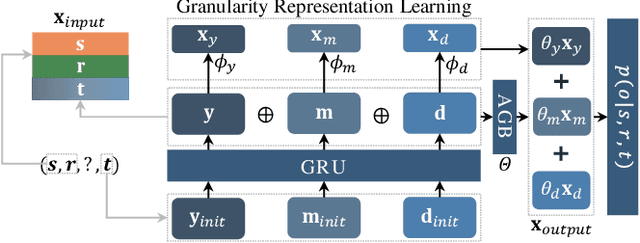

Temporal Knowledge Graphs (TKGs) incorporate temporal information to reflect the dynamic structural knowledge and evolutionary patterns of real-world facts. Nevertheless, TKGs are still limited in downstream applications due to the problem of incompleteness. Consequently, TKG completion (also known as link prediction) has been widely studied, with recent research focusing on incorporating independent embeddings of time or combining them with entities and relations to form temporal representations. However, most existing methods overlook the impact of history from a multi-granularity aspect. The inherent semantics of human-defined temporal granularities, such as ordinal dates, reveal general patterns to which facts typically adhere. To counter this limitation, this paper proposes \textbf{L}earning \textbf{G}ranularity \textbf{Re}presentation (termed $\mathsf{LGRe}$) for TKG completion. It comprises two main components: Granularity Representation Learning (GRL) and Adaptive Granularity Balancing (AGB). Specifically, GRL employs time-specific multi-layer convolutional neural networks to capture interactions between entities and relations at different granularities. After that, AGB generates adaptive weights for these embeddings according to temporal semantics, resulting in expressive representations of predictions. Moreover, to reflect similar semantics of adjacent timestamps, a temporal loss function is introduced. Extensive experimental results on four event benchmarks demonstrate the effectiveness of $\mathsf{LGRe}$ in learning time-related representations. To ensure reproducibility, our code is available at https://github.com/KcAcoZhang/LGRe.
Historically Relevant Event Structuring for Temporal Knowledge Graph Reasoning
May 17, 2024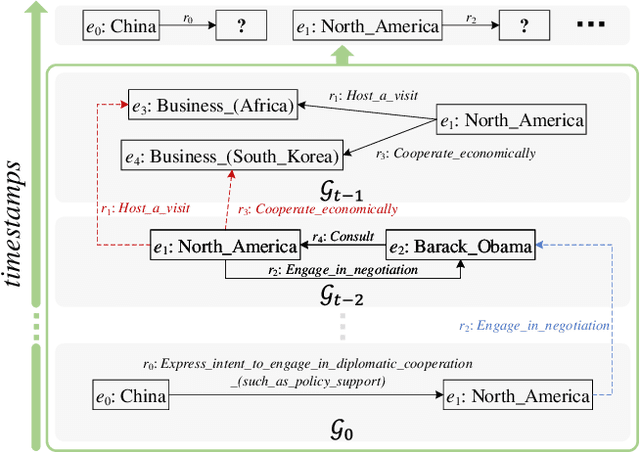
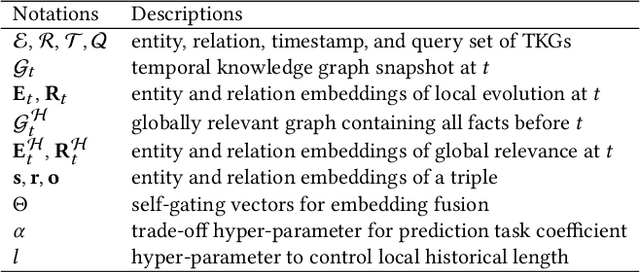
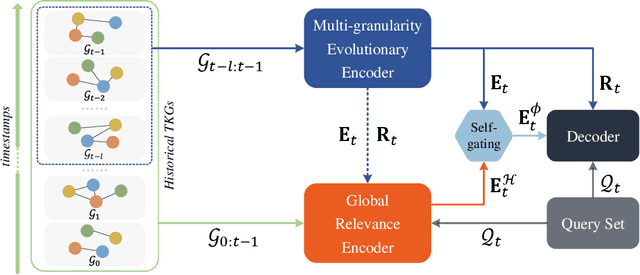

Temporal Knowledge Graph (TKG) reasoning focuses on predicting events through historical information within snapshots distributed on a timeline. Existing studies mainly concentrate on two perspectives of leveraging the history of TKGs, including capturing evolution of each recent snapshot or correlations among global historical facts. Despite the achieved significant accomplishments, these models still fall short of (1) investigating the influences of multi-granularity interactions across recent snapshots and (2) harnessing the expressive semantics of significant links accorded with queries throughout the entire history, especially events exerting a profound impact on the future. These inadequacies restrict representation ability to reflect historical dependencies and future trends thoroughly. To overcome these drawbacks, we propose an innovative TKG reasoning approach towards \textbf{His}torically \textbf{R}elevant \textbf{E}vents \textbf{S}tructuring ($\mathsf{HisRES}$). Concretely, $\mathsf{HisRES}$ comprises two distinctive modules excelling in structuring historically relevant events within TKGs, including a multi-granularity evolutionary encoder that captures structural and temporal dependencies of the most recent snapshots, and a global relevance encoder that concentrates on crucial correlations among events relevant to queries from the entire history. Furthermore, $\mathsf{HisRES}$ incorporates a self-gating mechanism for adaptively merging multi-granularity recent and historically relevant structuring representations. Extensive experiments on four event-based benchmarks demonstrate the state-of-the-art performance of $\mathsf{HisRES}$ and indicate the superiority and effectiveness of structuring historical relevance for TKG reasoning.
Learning Multi-graph Structure for Temporal Knowledge Graph Reasoning
Dec 04, 2023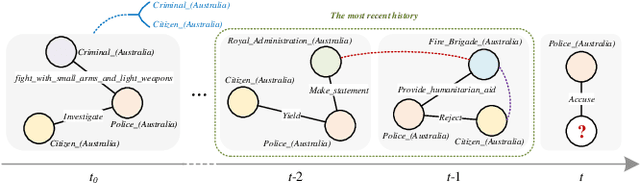
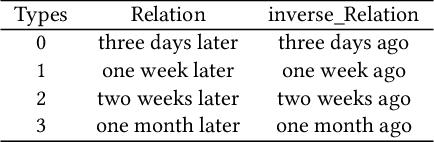
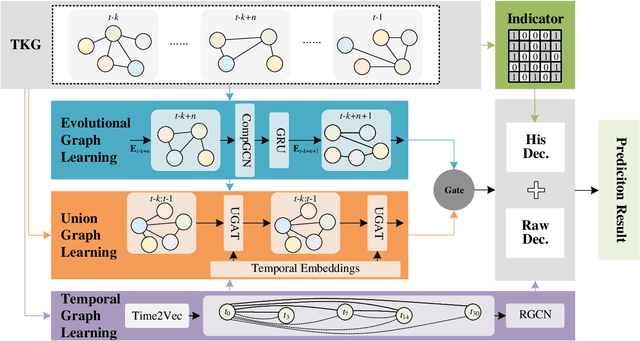

Temporal Knowledge Graph (TKG) reasoning that forecasts future events based on historical snapshots distributed over timestamps is denoted as extrapolation and has gained significant attention. Owing to its extreme versatility and variation in spatial and temporal correlations, TKG reasoning presents a challenging task, demanding efficient capture of concurrent structures and evolutional interactions among facts. While existing methods have made strides in this direction, they still fall short of harnessing the diverse forms of intrinsic expressive semantics of TKGs, which encompass entity correlations across multiple timestamps and periodicity of temporal information. This limitation constrains their ability to thoroughly reflect historical dependencies and future trends. In response to these drawbacks, this paper proposes an innovative reasoning approach that focuses on Learning Multi-graph Structure (LMS). Concretely, it comprises three distinct modules concentrating on multiple aspects of graph structure knowledge within TKGs, including concurrent and evolutional patterns along timestamps, query-specific correlations across timestamps, and semantic dependencies of timestamps, which capture TKG features from various perspectives. Besides, LMS incorporates an adaptive gate for merging entity representations both along and across timestamps effectively. Moreover, it integrates timestamp semantics into graph attention calculations and time-aware decoders, in order to impose temporal constraints on events and narrow down prediction scopes with historical statistics. Extensive experimental results on five event-based benchmark datasets demonstrate that LMS outperforms state-of-the-art extrapolation models, indicating the superiority of modeling a multi-graph perspective for TKG reasoning.