 Add to Chrome
 Add to Firefox
 Add to Edge
A Differentiable Composite Approximation Framework for Autonomous Underwater Vehicle Maneuvering Modeling from Sea-Trial Data
Jun 18, 2026
Field-based modeling from onboard measurements can produce autonomous underwater vehicle (AUV) maneuvering models that reflect real operating characteristics. From an approximation perspective, conventional maneuvering models use predefined constraint polynomial bases, whereas data-driven models use data-adaptive bases. Motivated by this basis-function view, this paper presents a differentiable composite-approximation formulation, in which the polynomial-basis component and the data-adaptive basis component are treated as differentiable parts of a single predictor and calibrated jointly. A gradient-based co-calibration method is developed for full-scale AUV maneuvering prediction, where a sensitivity-aware mechanism regulates bounded polynomial updates while the neural residual captures remaining nonlinear discrepancies under a shared prediction objective. To account for ocean-current effects in field data, a turning-motion-based current estimation and compensation procedure is incorporated to construct current-compensated learning targets for training and rollout. The framework is evaluated using sea-trial data collected from a 7-meter AUV under multiple maneuvering conditions. Results show that the proposed method improves recursive trajectory and velocity prediction compared with polynomial-only, neural-only, and frozen-prior hybrid baselines, demonstrating its applicability to field-data-based AUV maneuvering modeling.

Hybrid Physics-ML Modeling for Marine Vehicle Maneuvering Motions in the Presence of Environmental Disturbances
Nov 21, 2024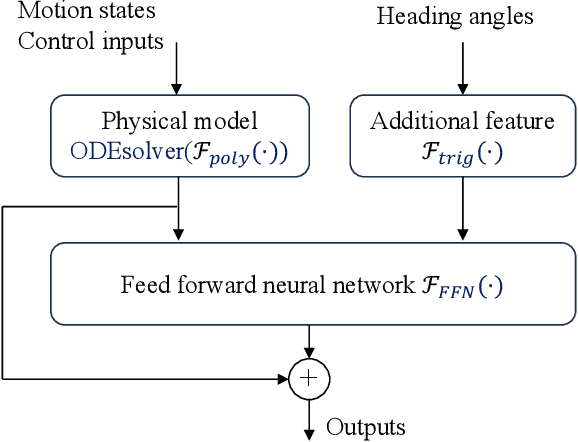

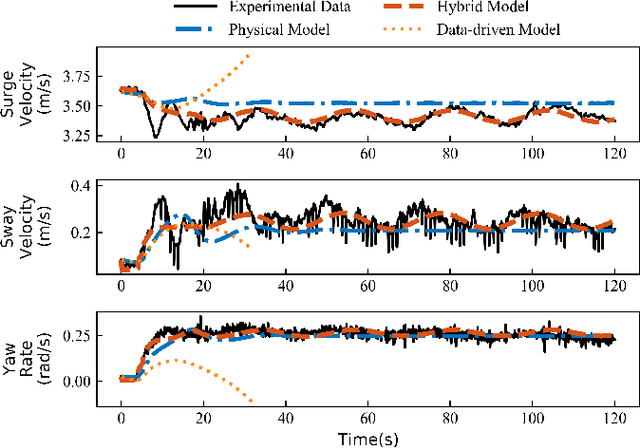
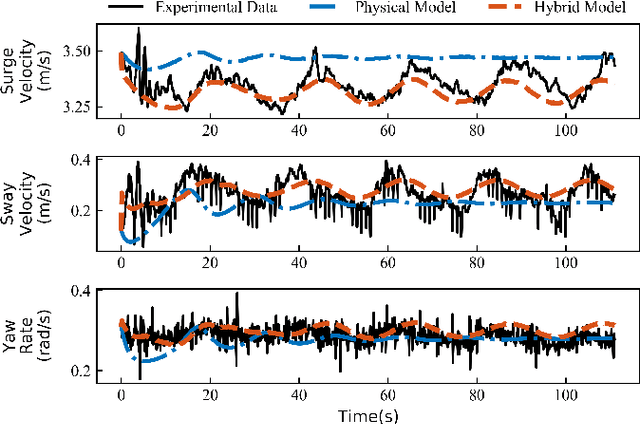
A hybrid physics-machine learning modeling framework is proposed for the surface vehicles' maneuvering motions to address the modeling capability and stability in the presence of environmental disturbances. From a deep learning perspective, the framework is based on a variant version of residual networks with additional feature extraction. Initially, an imperfect physical model is derived and identified to capture the fundamental hydrodynamic characteristics of marine vehicles. This model is then integrated with a feedforward network through a residual block. Additionally, feature extraction from trigonometric transformations is employed in the machine learning component to account for the periodic influence of currents and waves. The proposed method is evaluated using real navigational data from the 'JH7500' unmanned surface vehicle. The results demonstrate the robust generalizability and accurate long-term prediction capabilities of the nonlinear dynamic model in specific environmental conditions. This approach has the potential to be extended and applied to develop a comprehensive high-fidelity simulator.