 Add to Chrome
 Add to Firefox
 Add to Edge
SkillAligner: Treating Retrieved Skills as Adaptable Drafts at Execution Time
Aug 07, 2026
General-purpose skills promise reusable procedural knowledge for language agents, yet semantic relevance does not guarantee execution utility: a retrieved skill may encode assumptions that conflict with the current task, execution environment, or other retrieved skills. We formalize this problem as the skill--execution misfit. To address it, we propose SkillAligner, a training-free execution-time skill adaptation framework that treats retrieved skills as adaptable drafts rather than fixed instructions. Before execution, SkillAligner performs a one-time joint adaptation that specializes useful skill fragments to task requirements, aligns their procedural assumptions with the available execution interface, and composes the resulting guidance by resolving dependencies, conflicts, and redundancy across skills. The adapted content is consolidated into a compact execution guide and reused throughout the subsequent trajectory. Extensive experiments across diverse agent benchmarks and model backbones show that SkillAligner substantially improves task performance over existing skill-use baselines, reduces skill-induced regressions at the instance level, and lowers total inference cost.

Interpreting Chest X-rays Like a Radiologist: A Benchmark with Clinical Reasoning
May 29, 2025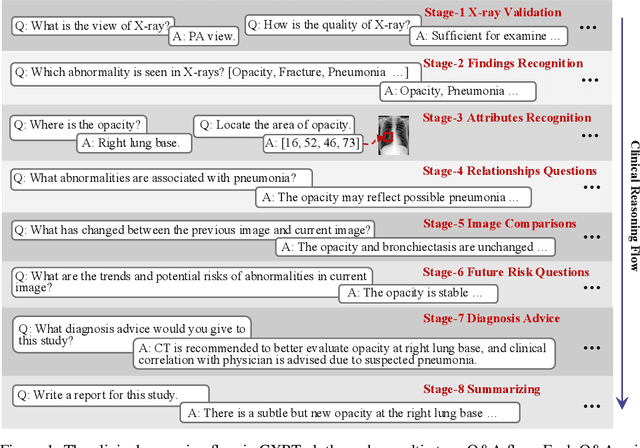
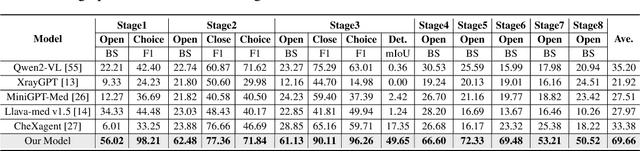
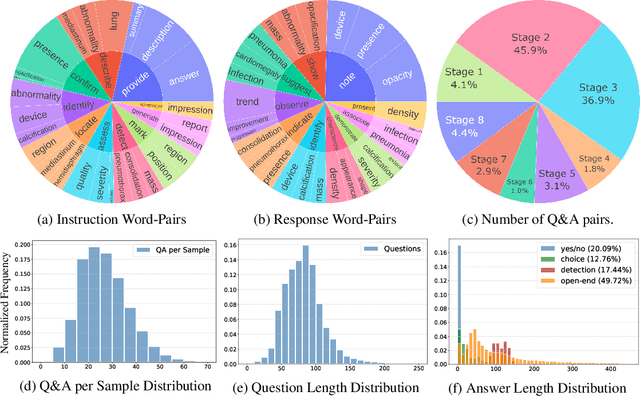
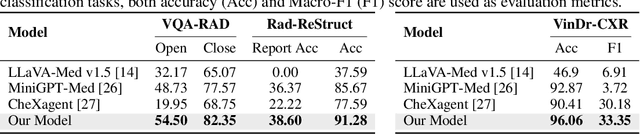
Artificial intelligence (AI)-based chest X-ray (CXR) interpretation assistants have demonstrated significant progress and are increasingly being applied in clinical settings. However, contemporary medical AI models often adhere to a simplistic input-to-output paradigm, directly processing an image and an instruction to generate a result, where the instructions may be integral to the model's architecture. This approach overlooks the modeling of the inherent diagnostic reasoning in chest X-ray interpretation. Such reasoning is typically sequential, where each interpretive stage considers the images, the current task, and the contextual information from previous stages. This oversight leads to several shortcomings, including misalignment with clinical scenarios, contextless reasoning, and untraceable errors. To fill this gap, we construct CXRTrek, a new multi-stage visual question answering (VQA) dataset for CXR interpretation. The dataset is designed to explicitly simulate the diagnostic reasoning process employed by radiologists in real-world clinical settings for the first time. CXRTrek covers 8 sequential diagnostic stages, comprising 428,966 samples and over 11 million question-answer (Q&A) pairs, with an average of 26.29 Q&A pairs per sample. Building on the CXRTrek dataset, we propose a new vision-language large model (VLLM), CXRTrekNet, specifically designed to incorporate the clinical reasoning flow into the VLLM framework. CXRTrekNet effectively models the dependencies between diagnostic stages and captures reasoning patterns within the radiological context. Trained on our dataset, the model consistently outperforms existing medical VLLMs on the CXRTrek benchmarks and demonstrates superior generalization across multiple tasks on five diverse external datasets. The dataset and model can be found in our repository (https://github.com/guanjinquan/CXRTrek).