 Add to Chrome
 Add to Firefox
 Add to Edge
CADET: Context-Conditioned Ads CTR Prediction With a Decoder-Only Transformer
Feb 11, 2026
Click-through rate (CTR) prediction is fundamental to online advertising systems. While Deep Learning Recommendation Models (DLRMs) with explicit feature interactions have long dominated this domain, recent advances in generative recommenders have shown promising results in content recommendation. However, adapting these transformer-based architectures to ads CTR prediction still presents unique challenges, including handling post-scoring contextual signals, maintaining offline-online consistency, and scaling to industrial workloads. We present CADET (Context-Conditioned Ads Decoder-Only Transformer), an end-to-end decoder-only transformer for ads CTR prediction deployed at LinkedIn. Our approach introduces several key innovations: (1) a context-conditioned decoding architecture with multi-tower prediction heads that explicitly model post-scoring signals such as ad position, resolving the chicken-and-egg problem between predicted CTR and ranking; (2) a self-gated attention mechanism that stabilizes training by adaptively regulating information flow at both representation and interaction levels; (3) a timestamp-based variant of Rotary Position Embedding (RoPE) that captures temporal relationships across timescales from seconds to months; (4) session masking strategies that prevent the model from learning dependencies on unavailable in-session events, addressing train-serve skew; and (5) production engineering techniques including tensor packing, sequence chunking, and custom Flash Attention kernels that enable efficient training and serving at scale. In online A/B testing, CADET achieves a 11.04\% CTR lift compared to the production LiRank baseline model, a hybrid ensemble of DCNv2 and sequential encoders. The system has been successfully deployed on LinkedIn's advertising platform, serving the main traffic for homefeed sponsored updates.

A Simple and Effective Self-Supervised Contrastive Learning Framework for Aspect Detection
Sep 18, 2020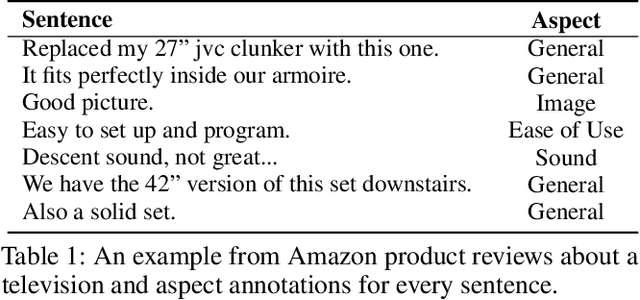
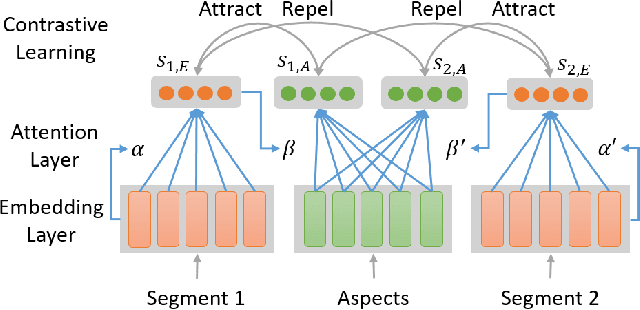
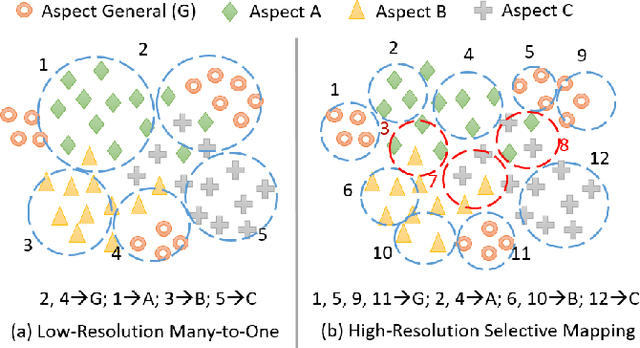
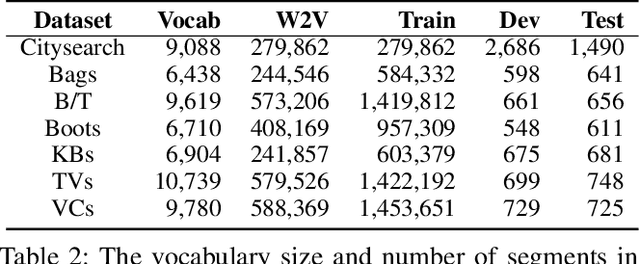
Unsupervised aspect detection (UAD) aims at automatically extracting interpretable aspects and identifying aspect-specific segments (such as sentences) from online reviews. However, recent deep learning-based topic models, specifically aspect-based autoencoder, suffer from several problems, such as extracting noisy aspects and poorly mapping aspects discovered by models to the aspects of interest. To tackle these challenges, in this paper, we first propose a self-supervised contrastive learning framework and an attention-based model equipped with a novel smooth self-attention (SSA) module for the UAD task in order to learn better representations for aspects and review segments. Secondly, we introduce a high-resolution selective mapping (HRSMap) method to efficiently assign aspects discovered by the model to aspects of interest. We also propose using a knowledge distilling technique to further improve the aspect detection performance. Our methods outperform several recent unsupervised and weakly supervised approaches on publicly available benchmark user review datasets. Aspect interpretation results show that extracted aspects are meaningful, have good coverage, and can be easily mapped to aspects of interest. Ablation studies and attention weight visualization also demonstrate the effectiveness of SSA and the knowledge distilling method.