 Add to Chrome
 Add to Firefox
 Add to Edge
Lean Learning Beyond Clouds: Efficient Discrepancy-Conditioned Optical-SAR Fusion for Semantic Segmentation
Mar 21, 2026
Cloud occlusion severely degrades the semantic integrity of optical remote sensing imagery. While incorporating Synthetic Aperture Radar (SAR) provides complementary observations, achieving efficient global modeling and reliable cross-modal fusion under cloud interference remains challenging. Existing methods rely on dense global attention to capture long-range dependencies, yet such aggregation indiscriminately propagates cloud-induced noise. Improving robustness typically entails enlarging model capacity, which further increases computational overhead. Given the large-scale and high-resolution nature of remote sensing applications, such computational demands hinder practical deployment, leading to an efficiency-reliability trade-off. To address this dilemma, we propose EDC, an efficiency-oriented and discrepancy-conditioned optical-SAR semantic segmentation framework. A tri-stream encoder with Carrier Tokens enables compact global context modeling with reduced complexity. To prevent noise contamination, we introduce a Discrepancy-Conditioned Hybrid Fusion (DCHF) mechanism that selectively suppresses unreliable regions during global aggregation. In addition, an auxiliary cloud removal branch with teacher-guided distillation enhances semantic consistency under occlusion. Extensive experiments demonstrate that EDC achieves superior accuracy and efficiency, improving mIoU by 0.56\% and 0.88\% on M3M-CR and WHU-OPT-SAR, respectively, while reducing the number of parameters by 46.7\% and accelerating inference by 1.98$\times$. Our implementation is available at https://github.com/mengcx0209/EDC.

Neural Network Based in Silico Simulation of Combustion Reactions
Nov 27, 2019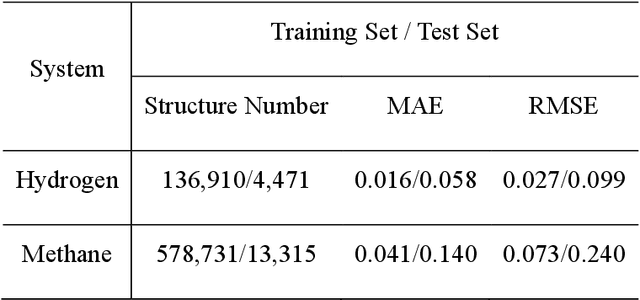
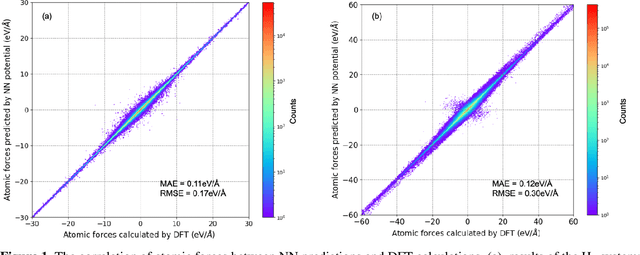
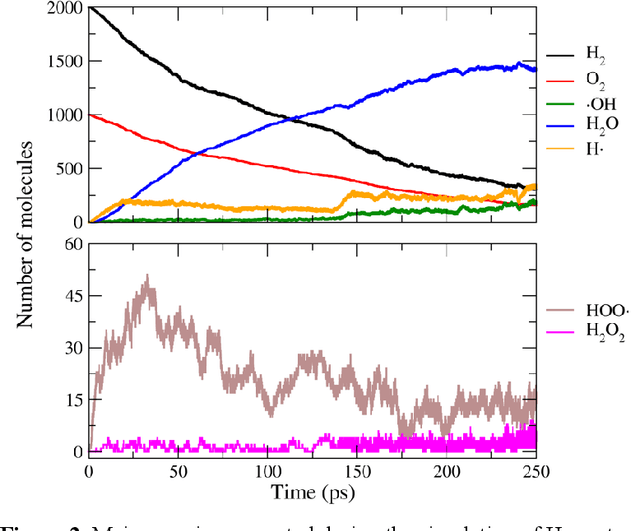
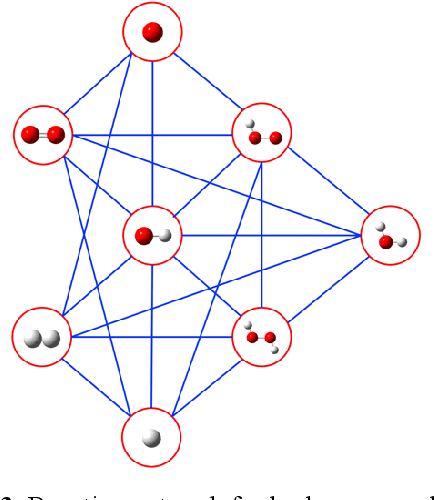
Understanding and prediction of the chemical reactions are fundamental demanding in the study of many complex chemical systems. Reactive molecular dynamics (MD) simulation has been widely used for this purpose as it can offer atomic details and can help us better interpret chemical reaction mechanisms. In this study, two reference datasets were constructed and corresponding neural network (NN) potentials were trained based on them. For given large-scale reaction systems, the NN potentials can predict the potential energy and atomic forces of DFT precision, while it is orders of magnitude faster than the conventional DFT calculation. With these two models, reactive MD simulations were performed to explore the combustion mechanisms of hydrogen and methane. Benefit from the high efficiency of the NN model, nanosecond MD trajectories for large-scale systems containing hundreds of atoms were produced and detailed combustion mechanism was obtained. Through further development, the algorithms in this study can be used to explore and discovery reaction mechanisms of many complex reaction systems, such as combustion, synthesis, and heterogeneous catalysis without any predefined reaction coordinates and elementary reaction steps.