 Add to Chrome
 Add to Firefox
 Add to Edge
SHAPE: Structure-aware Hierarchical Unsupervised Domain Adaptation with Plausibility Evaluation for Medical Image Segmentation
Mar 23, 2026
Unsupervised Domain Adaptation (UDA) is essential for deploying medical segmentation models across diverse clinical environments. Existing methods are fundamentally limited, suffering from semantically unaware feature alignment that results in poor distributional fidelity and from pseudo-label validation that disregards global anatomical constraints, thus failing to prevent the formation of globally implausible structures. To address these issues, we propose SHAPE (Structure-aware Hierarchical Unsupervised Domain Adaptation with Plausibility Evaluation), a framework that reframes adaptation towards global anatomical plausibility. Built on a DINOv3 foundation, its Hierarchical Feature Modulation (HFM) module first generates features with both high fidelity and class-awareness. This shifts the core challenge to robustly validating pseudo-labels. To augment conventional pixel-level validation, we introduce Hypergraph Plausibility Estimation (HPE), which leverages hypergraphs to assess the global anatomical plausibility that standard graphs cannot capture. This is complemented by Structural Anomaly Pruning (SAP) to purge remaining artifacts via cross-view stability. SHAPE significantly outperforms prior methods on cardiac and abdominal cross-modality benchmarks, achieving state-of-the-art average Dice scores of 90.08% (MRI->CT) and 78.51% (CT->MRI) on cardiac data, and 87.48% (MRI->CT) and 86.89% (CT->MRI) on abdominal data. The code is available at https://github.com/BioMedIA-repo/SHAPE.

ERSR: An Ellipse-constrained pseudo-label refinement and symmetric regularization framework for semi-supervised fetal head segmentation in ultrasound images
Aug 27, 2025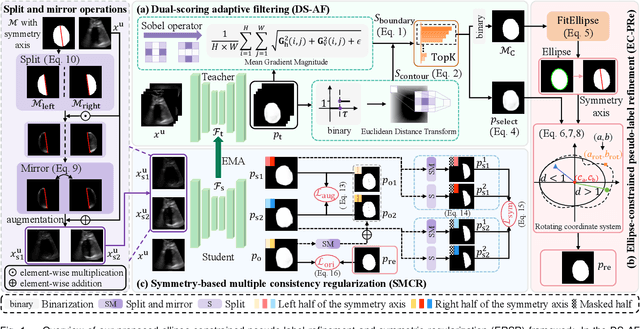
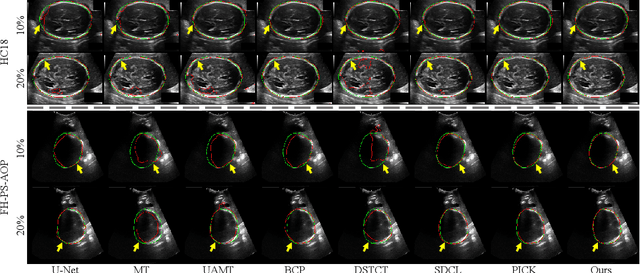
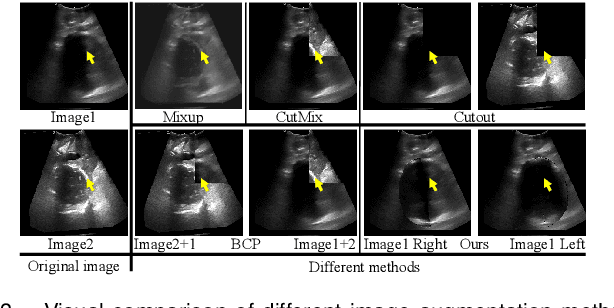
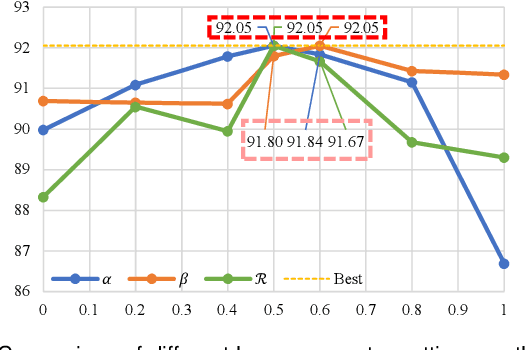
Automated segmentation of the fetal head in ultrasound images is critical for prenatal monitoring. However, achieving robust segmentation remains challenging due to the poor quality of ultrasound images and the lack of annotated data. Semi-supervised methods alleviate the lack of annotated data but struggle with the unique characteristics of fetal head ultrasound images, making it challenging to generate reliable pseudo-labels and enforce effective consistency regularization constraints. To address this issue, we propose a novel semi-supervised framework, ERSR, for fetal head ultrasound segmentation. Our framework consists of the dual-scoring adaptive filtering strategy, the ellipse-constrained pseudo-label refinement, and the symmetry-based multiple consistency regularization. The dual-scoring adaptive filtering strategy uses boundary consistency and contour regularity criteria to evaluate and filter teacher outputs. The ellipse-constrained pseudo-label refinement refines these filtered outputs by fitting least-squares ellipses, which strengthens pixels near the center of the fitted ellipse and suppresses noise simultaneously. The symmetry-based multiple consistency regularization enforces multi-level consistency across perturbed images, symmetric regions, and between original predictions and pseudo-labels, enabling the model to capture robust and stable shape representations. Our method achieves state-of-the-art performance on two benchmarks. On the HC18 dataset, it reaches Dice scores of 92.05% and 95.36% with 10% and 20% labeled data, respectively. On the PSFH dataset, the scores are 91.68% and 93.70% under the same settings.