 Add to Chrome
 Add to Firefox
 Add to Edge
Deconstructing Actor-Critic: A Large-scale Empirical Study of Design Components for Practitioners
Jul 14, 2026
Reinforcement learning is increasingly being considered for controlling real-world systems, from fusion plasma and autonomous vehicles to drug discovery and drinking water treatment, where reliability is essential and tuning budgets are limited. Actor-critic algorithms share a set of design decisions, such as how the policy is updated, how it represents the distribution over actions, how its gradient is estimated, and how often it is updated relative to the value estimator. Using a control task derived from a real water treatment plant, we analyze over 33,000 experiments to determine how these components affect variability across runs and sensitivity to hyperparameters. Common defaults, such as Gaussian action distributions with pathwise gradient estimators, are among the least reliable configurations, whereas bounded distributions with adaptive update schedules remain robust across a wide range of settings. These findings offer empirical guidance to practitioners across scientific and engineering domains for understanding and making component-level decisions when adapting actor-critic methods to new real-world control settings.

Selective Denoising Diffusion Model for Time Series Anomaly Detection
Feb 27, 2026Time series anomaly detection (TSAD) has been an important area of research for decades, with reconstruction-based methods, mostly based on generative models, gaining popularity and demonstrating success. Diffusion models have recently attracted attention due to their advanced generative capabilities. Existing diffusion-based methods for TSAD rely on a conditional strategy, which reconstructs input instances from white noise with the aid of the conditioner. However, this poses challenges in accurately reconstructing the normal parts, resulting in suboptimal detection performance. In response, we propose a novel diffusion-based method, named AnomalyFilter, which acts as a selective filter that only denoises anomaly parts in the instance while retaining normal parts. To build such a filter, we mask Gaussian noise during the training phase and conduct the denoising process without adding noise to the instances. The synergy of the two simple components greatly enhances the performance of naive diffusion models. Extensive experiments on five datasets demonstrate that AnomalyFilter achieves notably low reconstruction error on normal parts, providing empirical support for its effectiveness in anomaly detection. AnomalyFilter represents a pioneering approach that focuses on the noise design of diffusion models specifically tailored for TSAD.
RepSPD: Enhancing SPD Manifold Representation in EEGs via Dynamic Graphs
Feb 26, 2026Decoding brain activity from electroencephalography (EEG) is crucial for neuroscience and clinical applications. Among recent advances in deep learning for EEG, geometric learning stands out as its theoretical underpinnings on symmetric positive definite (SPD) allows revealing structural connectivity analysis in a physics-grounded manner. However, current SPD-based methods focus predominantly on statistical aggregation of EEGs, with frequency-specific synchronization and local topological structures of brain regions neglected. Given this, we propose RepSPD, a novel geometric deep learning (GDL)-based model. RepSPD implements a cross-attention mechanism on the Riemannian manifold to modulate the geometric attributes of SPD with graph-derived functional connectivity features. On top of this, we introduce a global bidirectional alignment strategy to reshape tangent-space embeddings, mitigating geometric distortions caused by curvature and thereby enhancing geometric consistency. Extensive experiments demonstrate that our proposed framework significantly outperforms existing EEG representation methods, exhibiting superior robustness and generalization capabilities.
ODEBrain: Continuous-Time EEG Graph for Modeling Dynamic Brain Networks
Feb 26, 2026Modeling neural population dynamics is crucial for foundational neuroscientific research and various clinical applications. Conventional latent variable methods typically model continuous brain dynamics through discretizing time with recurrent architecture, which necessarily results in compounded cumulative prediction errors and failure of capturing instantaneous, nonlinear characteristics of EEGs. We propose ODEBRAIN, a Neural ODE latent dynamic forecasting framework to overcome these challenges by integrating spatio-temporal-frequency features into spectral graph nodes, followed by a Neural ODE modeling the continuous latent dynamics. Our design ensures that latent representations can capture stochastic variations of complex brain states at any given time point. Extensive experiments verify that ODEBRAIN can improve significantly over existing methods in forecasting EEG dynamics with enhanced robustness and generalization capabilities.
TIFO: Time-Invariant Frequency Operator for Stationarity-Aware Representation Learning in Time Series
Feb 19, 2026Nonstationary time series forecasting suffers from the distribution shift issue due to the different distributions that produce the training and test data. Existing methods attempt to alleviate the dependence by, e.g., removing low-order moments from each individual sample. These solutions fail to capture the underlying time-evolving structure across samples and do not model the complex time structure. In this paper, we aim to address the distribution shift in the frequency space by considering all possible time structures. To this end, we propose a Time-Invariant Frequency Operator (TIFO), which learns stationarity-aware weights over the frequency spectrum across the entire dataset. The weight representation highlights stationary frequency components while suppressing non-stationary ones, thereby mitigating the distribution shift issue in time series. To justify our method, we show that the Fourier transform of time series data implicitly induces eigen-decomposition in the frequency space. TIFO is a plug-and-play approach that can be seamlessly integrated into various forecasting models. Experiments demonstrate our method achieves 18 top-1 and 6 top-2 results out of 28 forecasting settings. Notably, it yields 33.3% and 55.3% improvements in average MSE on the ETTm2 dataset. In addition, TIFO reduces computational costs by 60% -70% compared to baseline methods, demonstrating strong scalability across diverse forecasting models.
Symmetric Behavior Regularization via Taylor Expansion of Symmetry
Aug 06, 2025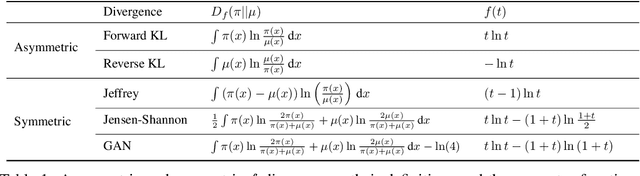
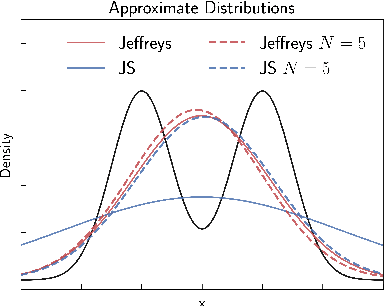

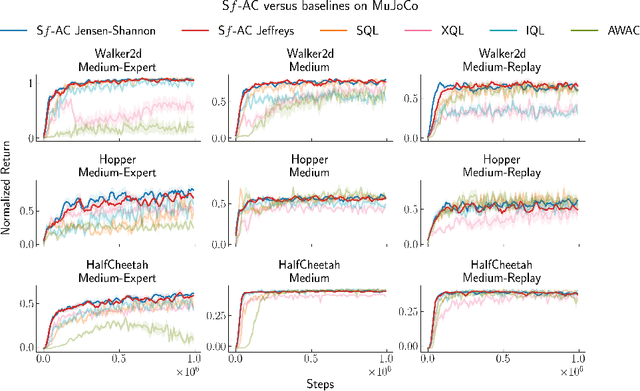
This paper introduces symmetric divergences to behavior regularization policy optimization (BRPO) to establish a novel offline RL framework. Existing methods focus on asymmetric divergences such as KL to obtain analytic regularized policies and a practical minimization objective. We show that symmetric divergences do not permit an analytic policy as regularization and can incur numerical issues as loss. We tackle these challenges by the Taylor series of $f$-divergence. Specifically, we prove that an analytic policy can be obtained with a finite series. For loss, we observe that symmetric divergences can be decomposed into an asymmetry and a conditional symmetry term, Taylor-expanding the latter alleviates numerical issues. Summing together, we propose Symmetric $f$ Actor-Critic (S$f$-AC), the first practical BRPO algorithm with symmetric divergences. Experimental results on distribution approximation and MuJoCo verify that S$f$-AC performs competitively.
Towards Physiologically Sensible Predictions via the Rule-based Reinforcement Learning Layer
Jan 31, 2025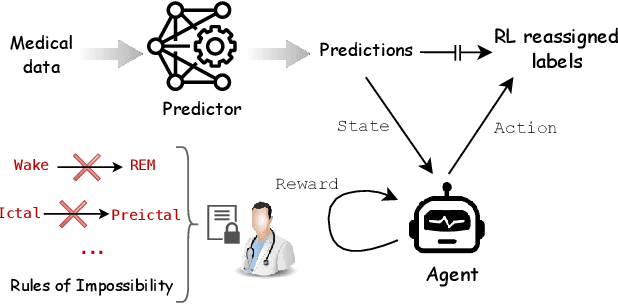
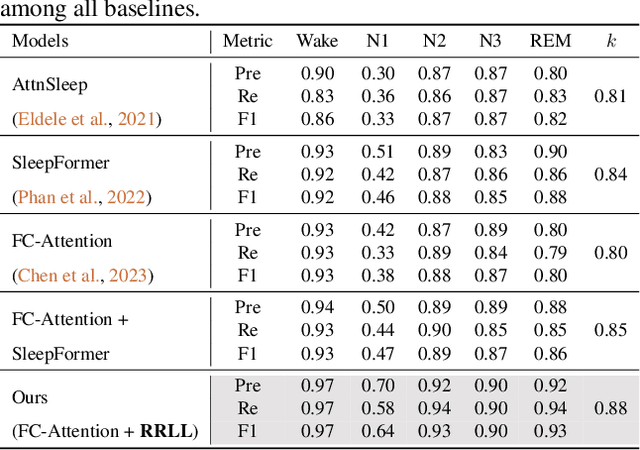
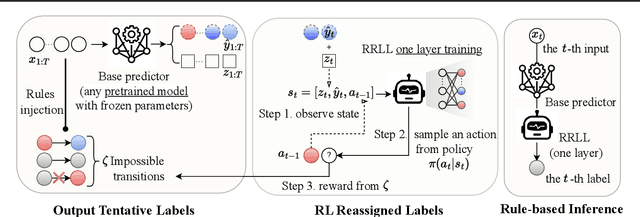
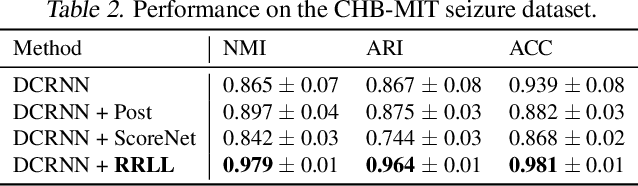
This paper adds to the growing literature of reinforcement learning (RL) for healthcare by proposing a novel paradigm: augmenting any predictor with Rule-based RL Layer (RRLL) that corrects the model's physiologically impossible predictions. Specifically, RRLL takes as input states predicted labels and outputs corrected labels as actions. The reward of the state-action pair is evaluated by a set of general rules. RRLL is efficient, general and lightweight: it does not require heavy expert knowledge like prior work but only a set of impossible transitions. This set is much smaller than all possible transitions; yet it can effectively reduce physiologically impossible mistakes made by the state-of-the-art predictor models. We verify the utility of RRLL on a variety of important healthcare classification problems and observe significant improvements using the same setup, with only the domain-specific set of impossibility changed. In-depth analysis shows that RRLL indeed improves accuracy by effectively reducing the presence of physiologically impossible predictions.
Fat-to-Thin Policy Optimization: Offline RL with Sparse Policies
Jan 24, 2025

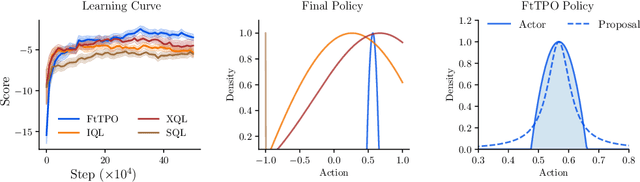
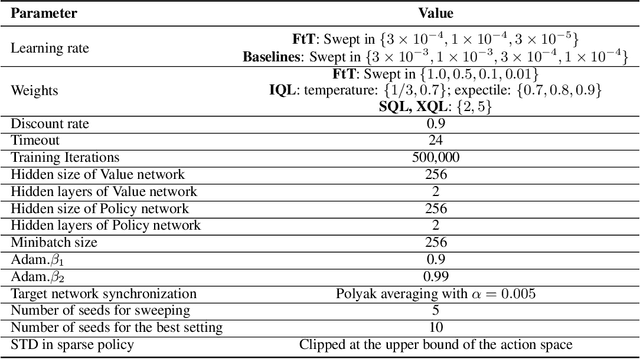
Sparse continuous policies are distributions that can choose some actions at random yet keep strictly zero probability for the other actions, which are radically different from the Gaussian. They have important real-world implications, e.g. in modeling safety-critical tasks like medicine. The combination of offline reinforcement learning and sparse policies provides a novel paradigm that enables learning completely from logged datasets a safety-aware sparse policy. However, sparse policies can cause difficulty with the existing offline algorithms which require evaluating actions that fall outside of the current support. In this paper, we propose the first offline policy optimization algorithm that tackles this challenge: Fat-to-Thin Policy Optimization (FtTPO). Specifically, we maintain a fat (heavy-tailed) proposal policy that effectively learns from the dataset and injects knowledge to a thin (sparse) policy, which is responsible for interacting with the environment. We instantiate FtTPO with the general $q$-Gaussian family that encompasses both heavy-tailed and sparse policies and verify that it performs favorably in a safety-critical treatment simulation and the standard MuJoCo suite. Our code is available at \url{https://github.com/lingweizhu/fat2thin}.
$\mathbb{BEHR}$NOULLI: A Binary EHR Data-Oriented Medication Recommendation System
Aug 18, 2024
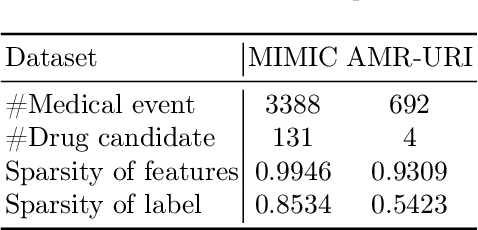
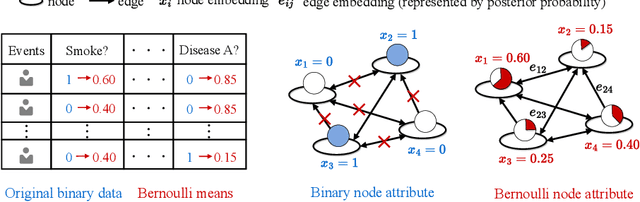

The medical community believes binary medical event outcomes in EHR data contain sufficient information for making a sensible recommendation. However, there are two challenges to effectively utilizing such data: (1) modeling the relationship between massive 0,1 event outcomes is difficult, even with expert knowledge; (2) in practice, learning can be stalled by the binary values since the equally important 0 entries propagate no learning signals. Currently, there is a large gap between the assumed sufficient information and the reality that no promising results have been shown by utilizing solely the binary data: visiting or secondary information is often necessary to reach acceptable performance. In this paper, we attempt to build the first successful binary EHR data-oriented drug recommendation system by tackling the two difficulties, making sensible drug recommendations solely using the binary EHR medical records. To this end, we take a statistical perspective to view the EHR data as a sample from its cohorts and transform them into continuous Bernoulli probabilities. The transformed entries not only model a deterministic binary event with a distribution but also allow reflecting \emph{event-event} relationship by conditional probability. A graph neural network is learned on top of the transformation. It captures event-event correlations while emphasizing \emph{event-to-patient} features. Extensive results demonstrate that the proposed method achieves state-of-the-art performance on large-scale databases, outperforming baseline methods that use secondary information by a large margin. The source code is available at \url{https://github.com/chenzRG/BEHRMecom}
q-exponential family for policy optimization
Aug 14, 2024Policy optimization methods benefit from a simple and tractable policy functional, usually the Gaussian for continuous action spaces. In this paper, we consider a broader policy family that remains tractable: the $q$-exponential family. This family of policies is flexible, allowing the specification of both heavy-tailed policies ($q>1$) and light-tailed policies ($q<1$). This paper examines the interplay between $q$-exponential policies for several actor-critic algorithms conducted on both online and offline problems. We find that heavy-tailed policies are more effective in general and can consistently improve on Gaussian. In particular, we find the Student's t-distribution to be more stable than the Gaussian across settings and that a heavy-tailed $q$-Gaussian for Tsallis Advantage Weighted Actor-Critic consistently performs well in offline benchmark problems. Our code is available at \url{https://github.com/lingweizhu/qexp}.