 Add to Chrome
 Add to Firefox
 Add to Edge
Neural Image Space Tessellation
Feb 27, 2026
We present Neural Image-Space Tessellation (NIST), a lightweight screen-space post-processing approach that produces the visual effect of tessellated geometry while rendering only the original low-polygon meshes. Inspired by our observation from Phong tessellation, NIST leverages the discrepancy between geometric normals and shading normals as a minimal, view-dependent cue for silhouette refinement. At its core, NIST performs multi-scale neural tessellation by progressively deforming image-space contours with convolutional operators, while jointly reassigning appearance information through an implicit warping mechanism to preserve texture coherence and visual fidelity. Experiments demonstrate that our approach produces smooth, visually coherent silhouettes comparable to geometric tessellation, while incurring a constant per-frame cost and fully decoupled from geometric complexity, making it well-suited for large-scale real-time rendering scenarios. To the best of our knowledge, our NIST is the first work to reformulate tessellation as a post-processing operation, shifting it from a pre-rendering geometry pipeline to a screen space neural post-processing stage.

A Bayesian Inference Framework for Procedural Material Parameter Estimation
Dec 05, 2019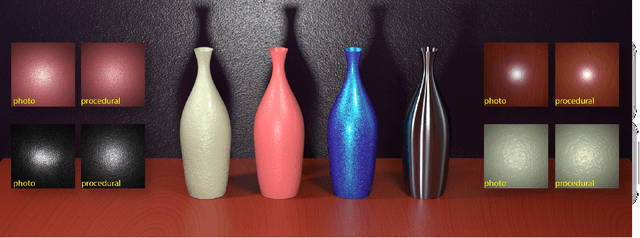
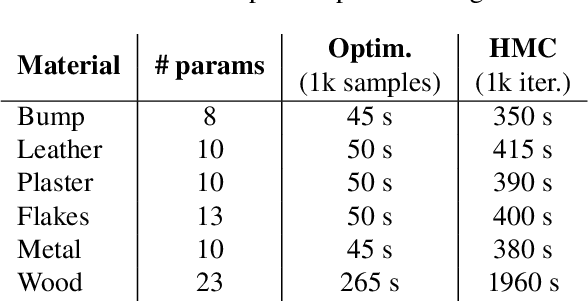
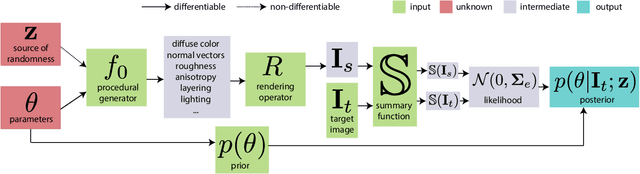
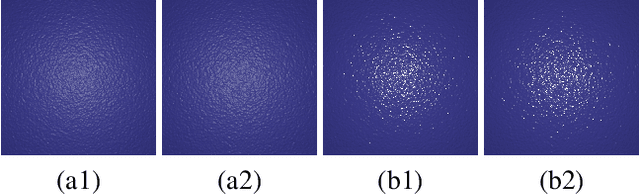
Procedural material models have been gaining traction in many applications thanks to their flexibility, compactness, and easy editability. In this paper, we explore the inverse rendering problem of procedural material parameter estimation from photographs using a Bayesian framework. We use \emph{summary functions} for comparing unregistered images of a material under known lighting, and we explore both hand-designed and neural summary functions. In addition to estimating the parameters by optimization, we introduce a Bayesian inference approach using Hamiltonian Monte Carlo to sample the space of plausible material parameters, providing additional insight into the structure of the solution space. To demonstrate the effectiveness of our techniques, we fit procedural models of a range of materials---wall plaster, leather, wood, anisotropic brushed metals and metallic paints---to both synthetic and real target images.