 Add to Chrome
 Add to Firefox
 Add to Edge
Q-Zoom: Query-Aware Adaptive Perception for Efficient Multimodal Large Language Models
Apr 08, 2026
MLLMs require high-resolution visual inputs for fine-grained tasks like document understanding and dense scene perception. However, current global resolution scaling paradigms indiscriminately flood the quadratic self-attention mechanism with visually redundant tokens, severely bottlenecking inference throughput while ignoring spatial sparsity and query intent. To overcome this, we propose Q-Zoom, a query-aware adaptive high-resolution perception framework that operates in an efficient coarse-to-fine manner. First, a lightweight Dynamic Gating Network safely bypasses high-resolution processing when coarse global features suffice. Second, for queries demanding fine-grained perception, a Self-Distilled Region Proposal Network (SD-RPN) precisely localizes the task-relevant Region-of-Interest (RoI) directly from intermediate feature spaces. To optimize these modules efficiently, the gating network uses a consistency-aware generation strategy to derive deterministic routing labels, while the SD-RPN employs a fully self-supervised distillation paradigm. A continuous spatio-temporal alignment scheme and targeted fine-tuning then seamlessly fuse the dense local RoI with the coarse global layout. Extensive experiments demonstrate that Q-Zoom establishes a dominant Pareto frontier. Using Qwen2.5-VL-7B as a primary testbed, Q-Zoom accelerates inference by 2.52 times on Document & OCR benchmarks and 4.39 times in High-Resolution scenarios while matching the baseline's peak accuracy. Furthermore, when configured for maximum perceptual fidelity, Q-Zoom surpasses the baseline's peak performance by 1.1% and 8.1% on these respective benchmarks. These robust improvements transfer seamlessly to Qwen3-VL, LLaVA, and emerging RL-based thinking-with-image models. Project page is available at https://yuhengsss.github.io/Q-Zoom/.

SoftLMs: Efficient Adaptive Low-Rank Approximation of Language Models using Soft-Thresholding Mechanism
Nov 15, 2024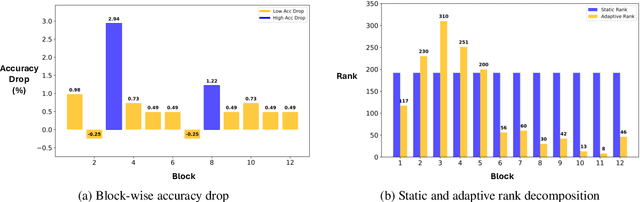
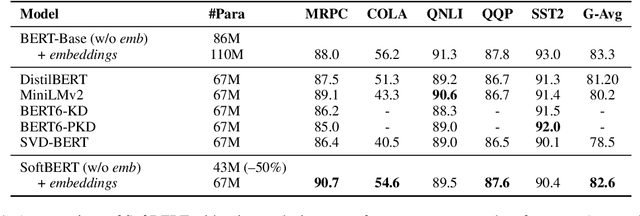

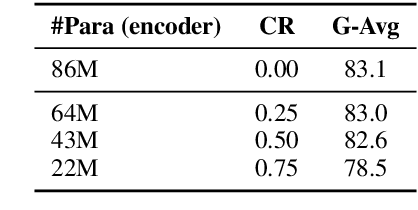
Extensive efforts have been made to boost the performance in the domain of language models by introducing various attention-based transformers. However, the inclusion of linear layers with large dimensions contributes to significant computational and memory overheads. The escalating computational demands of these models necessitate the development of various compression techniques to ensure their deployment on devices, particularly in resource-constrained environments. In this paper, we propose a novel compression methodology that dynamically determines the rank of each layer using a soft thresholding mechanism, which clips the singular values with a small magnitude in a differentiable form. This approach automates the decision-making process to identify the optimal degree of compression for each layer. We have successfully applied the proposed technique to attention-based architectures, including BERT for discriminative tasks and GPT2 and TinyLlama for generative tasks. Additionally, we have validated our method on Mamba, a recently proposed state-space model. Our experiments demonstrate that the proposed technique achieves a speed-up of 1.33X to 1.72X in the encoder/ decoder with a 50% reduction in total parameters.
CAP-VSTNet: Content Affinity Preserved Versatile Style Transfer
Mar 31, 2023Content affinity loss including feature and pixel affinity is a main problem which leads to artifacts in photorealistic and video style transfer. This paper proposes a new framework named CAP-VSTNet, which consists of a new reversible residual network and an unbiased linear transform module, for versatile style transfer. This reversible residual network can not only preserve content affinity but not introduce redundant information as traditional reversible networks, and hence facilitate better stylization. Empowered by Matting Laplacian training loss which can address the pixel affinity loss problem led by the linear transform, the proposed framework is applicable and effective on versatile style transfer. Extensive experiments show that CAP-VSTNet can produce better qualitative and quantitative results in comparison with the state-of-the-art methods.