 Add to Chrome
 Add to Firefox
 Add to Edge
STAR-KV: Low-Rank KV Cache Compression via Soft Thresholding for Adaptive Rank Control
Jun 07, 2026
Low-rank projection has emerged as a promising approach for compressing the KV cache by exploiting hidden-dimension redundancy. However, prior methods rely on fixed or heuristic rank selection and struggle to achieve aggressive compression with minimal accuracy degradation. We propose STAR-KV, an adaptive low-rank KV cache compression framework with fine-grained rank control. STAR-KV encompasses 1) a differentiable thresholding mechanism that enables optimal rank selection at both attention-head and block levels, 2) a hybrid decomposition strategy that applies different low-rank factorizations according to the sensitivity of key and value projections, and 3) a low-rank-aware mixed precision quantization that leverages data statistics for near lossless low-bit quantization. Evaluated across multiple LLMs and benchmarks, STAR-KV achieves up to 75% KV cache compression and up to 20x overall KV cache reduction when combined with quantization. Enabled by custom Triton-based GPU kernels, STAR-KV delivers up to 6.9x speedup for the attention module and 3.1x end-to-end generation throughput. Our code is publicly available at: https://github.com/PriyanshBhatnagar/STAR-KV.

Interpreting Transformers for Jet Tagging
Dec 04, 2024Machine learning (ML) algorithms, particularly attention-based transformer models, have become indispensable for analyzing the vast data generated by particle physics experiments like ATLAS and CMS at the CERN LHC. Particle Transformer (ParT), a state-of-the-art model, leverages particle-level attention to improve jet-tagging tasks, which are critical for identifying particles resulting from proton collisions. This study focuses on interpreting ParT by analyzing attention heat maps and particle-pair correlations on the $\eta$-$\phi$ plane, revealing a binary attention pattern where each particle attends to at most one other particle. At the same time, we observe that ParT shows varying focus on important particles and subjets depending on decay, indicating that the model learns traditional jet substructure observables. These insights enhance our understanding of the model's internal workings and learning process, offering potential avenues for improving the efficiency of transformer architectures in future high-energy physics applications.
SoftLMs: Efficient Adaptive Low-Rank Approximation of Language Models using Soft-Thresholding Mechanism
Nov 15, 2024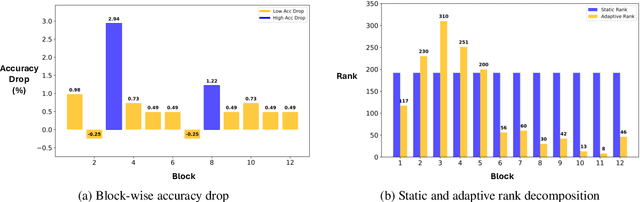
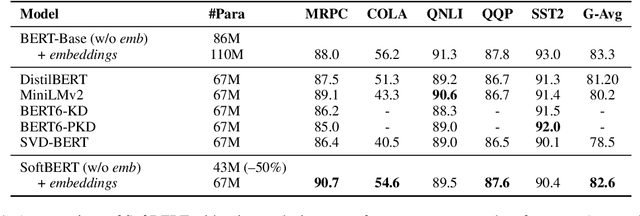

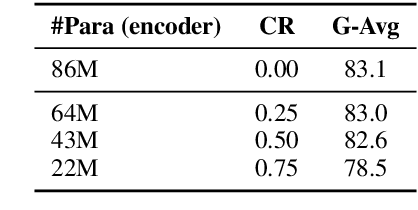
Extensive efforts have been made to boost the performance in the domain of language models by introducing various attention-based transformers. However, the inclusion of linear layers with large dimensions contributes to significant computational and memory overheads. The escalating computational demands of these models necessitate the development of various compression techniques to ensure their deployment on devices, particularly in resource-constrained environments. In this paper, we propose a novel compression methodology that dynamically determines the rank of each layer using a soft thresholding mechanism, which clips the singular values with a small magnitude in a differentiable form. This approach automates the decision-making process to identify the optimal degree of compression for each layer. We have successfully applied the proposed technique to attention-based architectures, including BERT for discriminative tasks and GPT2 and TinyLlama for generative tasks. Additionally, we have validated our method on Mamba, a recently proposed state-space model. Our experiments demonstrate that the proposed technique achieves a speed-up of 1.33X to 1.72X in the encoder/ decoder with a 50% reduction in total parameters.