 Add to Chrome
 Add to Firefox
 Add to Edge
Multi-Modal Time Series Prediction via Mixture of Modulated Experts
Jan 29, 2026
Real-world time series exhibit complex and evolving dynamics, making accurate forecasting extremely challenging. Recent multi-modal forecasting methods leverage textual information such as news reports to improve prediction, but most rely on token-level fusion that mixes temporal patches with language tokens in a shared embedding space. However, such fusion can be ill-suited when high-quality time-text pairs are scarce and when time series exhibit substantial variation in scale and characteristics, thus complicating cross-modal alignment. In parallel, Mixture-of-Experts (MoE) architectures have proven effective for both time series modeling and multi-modal learning, yet many existing MoE-based modality integration methods still depend on token-level fusion. To address this, we propose Expert Modulation, a new paradigm for multi-modal time series prediction that conditions both routing and expert computation on textual signals, enabling direct and efficient cross-modal control over expert behavior. Through comprehensive theoretical analysis and experiments, our proposed method demonstrates substantial improvements in multi-modal time series prediction. The current code is available at https://github.com/BruceZhangReve/MoME

Single Bitmap Block Truncation Coding of Color Images Using Hill Climbing Algorithm
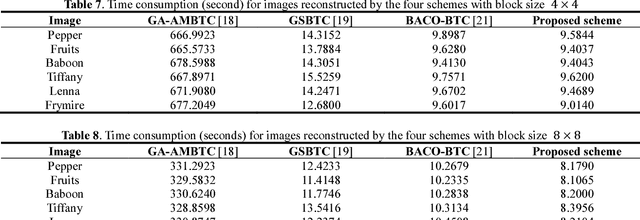
Jul 13, 2018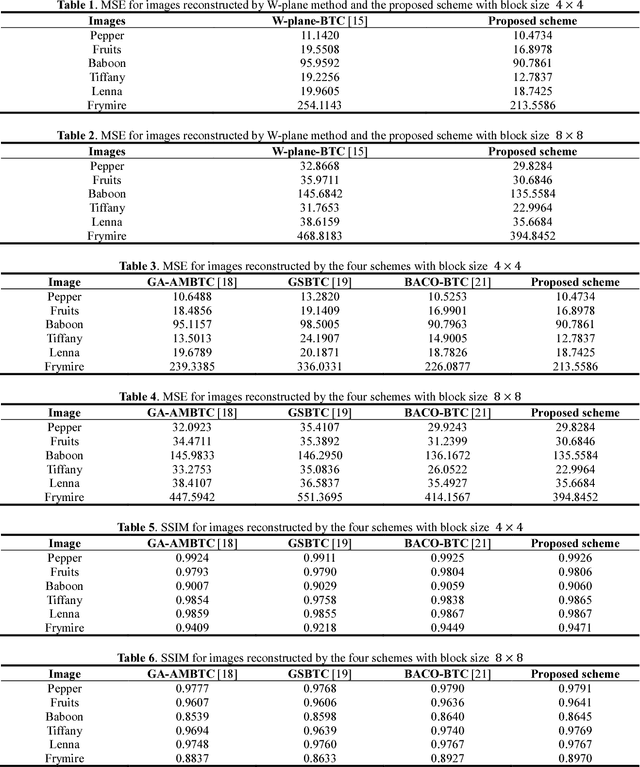
Recently, the use of digital images in various fields is increasing rapidly. To increase the number of images stored and get faster transmission of them, it is necessary to reduce the size of these images. Single bitmap block truncation coding (SBBTC) schemes are compression techniques, which are used to generate a common bitmap to quantize the R, G and B planes in color image. As one of the traditional SBBTC schemes, weighted plane (W-plane) method is famous for its simplicity and low time consumption. However, the W-plane method also has poor performance in visual quality. This paper proposes an improved SBBTC scheme based on W-plane method using parallel computing and hill climbing algorithm. Compared with various schemes, the simulation results of the proposed scheme are better than that of the reference schemes in visual quality and time consumption.