 Add to Chrome
 Add to Firefox
 Add to Edge
Improving Robotic Imitation Learning via Trajectory Standardization
Jun 22, 2026
Imitation learning for robotic manipulation relies on large sets of human demonstration trajectories, which are often noisy and temporally irregular due to variable operator speed, intermittent pauses, and inconsistent action density. A common preprocessing strategy is time-uniform downsampling to shorten sequences, but it cannot effectively remove speed-induced non-uniformity or redundant pauses. This mismatch degrades data quality and hinders policy learning. To address this issue, we propose Information-Standardized Trajectory Resampling (ISR), an offline preprocessing method for effective imitation learning. ISR resamples each trajectory by enforcing approximately equal information distance between adjacent points. Specifically, we map trajectories onto an information-modulated Riemannian manifold and perform geodesic-equidistant parameterization. We construct an information-intensity field from velocity and acceleration norms: the velocity term removes small-motion redundancy, while the acceleration term preserves high-curvature and fine-manipulation phases. We evaluate ISR on three real-world manipulation tasks with mainstream imitation learning policies. Compared with the baseline time-uniform 3x downsampling, ISR improves task success rates by about 25%, remains robust across datasets collected from different operators, and reduces both dataset size and training cost. The code and videos are publicly available at https://d-robotics-ai-lab.github.io/isr.page.

RISurConv: Rotation Invariant Surface Attention-Augmented Convolutions for 3D Point Cloud Classification and Segmentation
Aug 12, 2024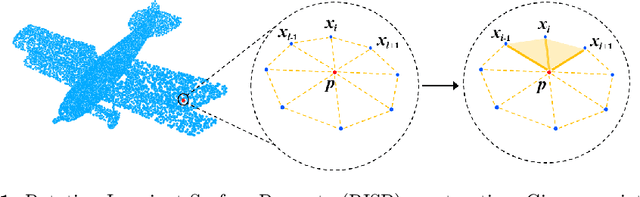
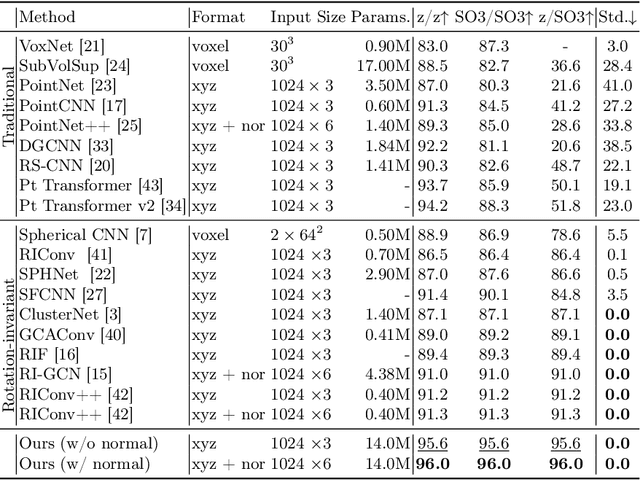
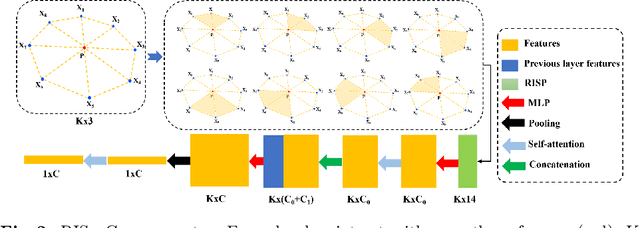

Despite the progress on 3D point cloud deep learning, most prior works focus on learning features that are invariant to translation and point permutation, and very limited efforts have been devoted for rotation invariant property. Several recent studies achieve rotation invariance at the cost of lower accuracies. In this work, we close this gap by proposing a novel yet effective rotation invariant architecture for 3D point cloud classification and segmentation. Instead of traditional pointwise operations, we construct local triangle surfaces to capture more detailed surface structure, based on which we can extract highly expressive rotation invariant surface properties which are then integrated into an attention-augmented convolution operator named RISurConv to generate refined attention features via self-attention layers. Based on RISurConv we build an effective neural network for 3D point cloud analysis that is invariant to arbitrary rotations while maintaining high accuracy. We verify the performance on various benchmarks with supreme results obtained surpassing the previous state-of-the-art by a large margin. We achieve an overall accuracy of 96.0% (+4.7%) on ModelNet40, 93.1% (+12.8%) on ScanObjectNN, and class accuracies of 91.5% (+3.6%), 82.7% (+5.1%), and 78.5% (+9.2%) on the three categories of the FG3D dataset for the fine-grained classification task. Additionally, we achieve 81.5% (+1.0%) mIoU on ShapeNet for the segmentation task. Code is available here: https://github.com/cszyzhang/RISurConv