 Add to Chrome
 Add to Firefox
 Add to Edge
EgoProx: Evaluating MLLMs on Egocentric 3D Proximity Reasoning Across a Cognitive Hierarchy
May 26, 2026
Humans constantly reason about 3D proximity, the relations between their body and surrounding objects, to guide perception and action in daily life. Whether multimodal large language models (MLLMs) can perform such embodied 3D reasoning remains unclear. To this end, we introduce EgoProx, a benchmark for egocentric 3D proximity reasoning. We organize our tasks along a cognitive chain, covering intention, exploration, exploitation, and chain-of-actions reasoning. We also design an agent based data engine that produces diverse and consistent QA pairs at scale. We benchmark prevailing MLLMs on EgoProx and conduct additional analyses with dataset specific and task specific instruction tuning. We observe large cross-domain gains, indicating that current MLLMs contain some spatial knowledge; however, they still struggle to effectively leverage it for spatial reasoning VQA.

CRPO: Character-centric Group Relative Policy Optimization for Role-aware Reasoning in Role-playing Agents
May 25, 2026Recent advancements in Reinforcement Learning (RL), particularly Group Relative Policy Optimization (GRPO), have significantly enhanced the reasoning capabilities of Large Language Models. However, applying these problem-centric optimization methods to role-playing agents often leads to a loss of character fidelity and style collapse, as they prioritize context-specific utility over persona alignment. To address this, we propose Character-Centric Group Relative Policy Optimization (CRPO), a framework designed to realign RL objectives with the role-playing task. CRPO improves character distinctiveness through three mechanisms: decoupling task logic from stylistic rewards to resolve gradient conflicts, dynamically adapting optimization constraints based on character complexity, and utilizing generic responses as negative baselines to prevent the model from reverting to a common distribution. Extensive experiments demonstrate that CRPO outperforms existing methods in consistency, emotion and others.
Position: Life-Logging Video Streams Make the Privacy-Utility Trade-off Inevitable
May 11, 2026With the growing prevalence of always-on hardware such as smart glasses, body cameras, and home security systems, life-logging visual sensing is becoming inevitable, forming the backbone of persistent, always-on AI systems. Meanwhile, recent advances in proactive agents and world models signal a fundamental shift from episodic, prompt-driven tools to next-generation AI systems that continuously perceive and react to the physical world. Although life-logging video streams can substantially improve utility of these promising systems, they also introduce significant privacy risks by revealing sensitive information, such as behavioral patterns, emotional states, and social interactions, beyond what isolated images expose. If unresolved, these risks may undermine public trust and hinder the sustainable development of always-on AI technologies. Existing privacy protections are either attack-specific or incur substantial utility loss, and fail to consider the entire data exploitation pipeline. We therefore posit that the privacy-utility trade-off in life-logging video streams is a foundational challenge for next-generation AI systems that demands further investigation. We call for novel pipeline-aware privacy-preserving designs that jointly optimize utility and privacy for long-horizon life-logging visual data. In parallel, formal privacy leakage metrics and standardized benchmarks remain important open directions for future research.
A Three-phase Augmented Classifiers Chain Approach Based on Co-occurrence Analysis for Multi-Label Classification
Apr 13, 2022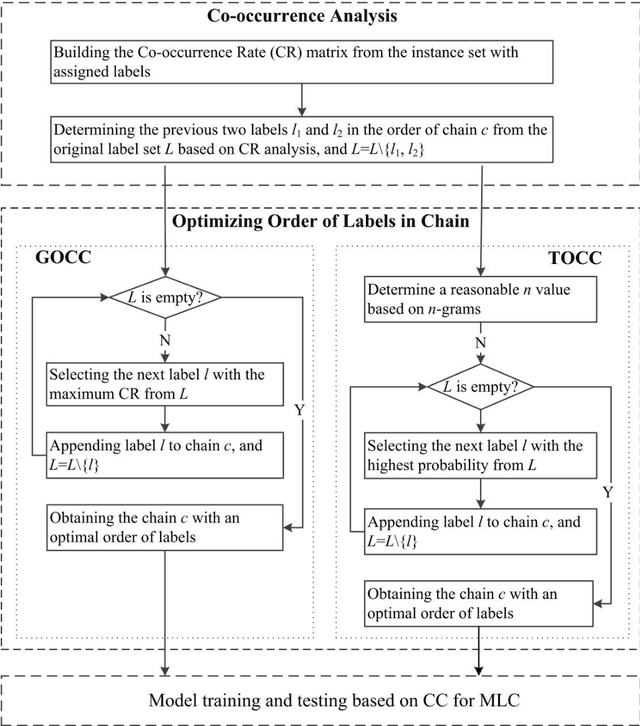
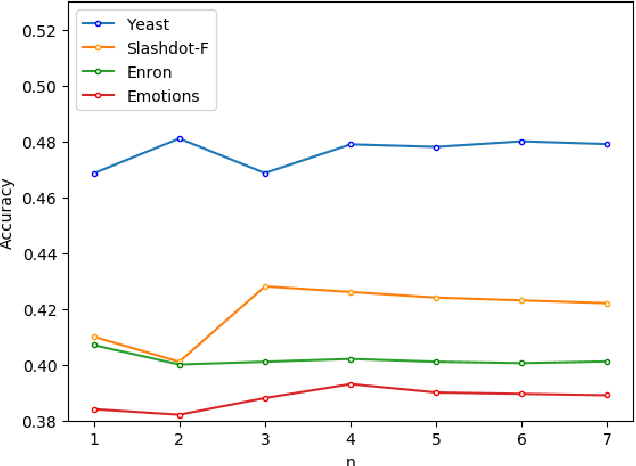
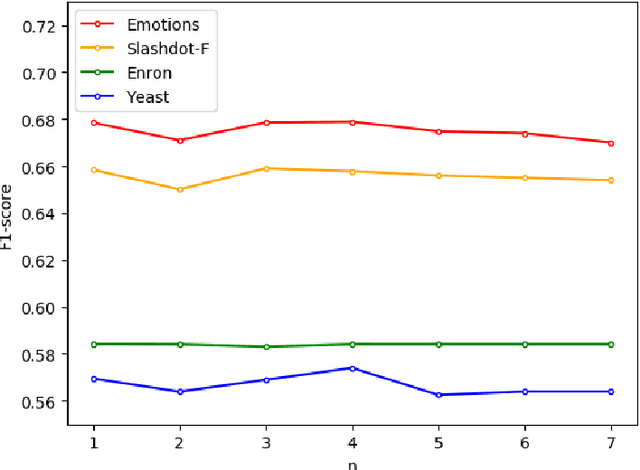
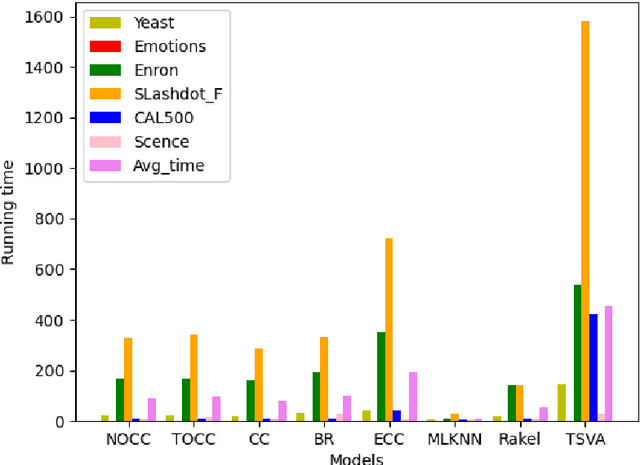
As a very popular multi-label classification method, Classifiers Chain has recently been widely applied to many multi-label classification tasks. However, existing Classifier Chains methods are difficult to model and exploit the underlying dependency in the label space, and often suffer from the problems of poorly ordered chain and error propagation. In this paper, we present a three-phase augmented Classifier Chains approach based on co-occurrence analysis for multi-label classification. First, we propose a co-occurrence matrix method to model the underlying correlations between a label and its precedents and further determine the head labels of a chain. Second, we propose two augmented strategies of optimizing the order of labels of a chain to approximate the underlying label correlations in label space, including Greedy Order Classifier Chain and Trigram Order Classifier Chain. Extensive experiments were made over six benchmark datasets, and the experimental results show that the proposed augmented CC approaches can significantly improve the performance of multi-label classification in comparison with CC and its popular variants of Classifier Chains, in particular maintaining lower computational costs while achieving superior performance.