 Add to Chrome
 Add to Firefox
 Add to Edge
Cert-LAS: Toward Certified Model Ownership Verification for Text-to-Image Diffusion Models via Layer-Adaptive Smoothing
May 28, 2026
Large-scale text-to-image (T2I) diffusion models have enabled unprecedented creative applications, but their unauthorized use has raised serious intellectual property concerns, making model ownership verification (MOV) increasingly critical. We find that existing backdoor-based diffusion watermarking methods often (implicitly) assume a "faithful" verification process, namely, that the verifier can query a suspicious model and obtain the faithful watermark response to complete MOV. However, in practice, adversaries may intentionally or unintentionally damage potential watermark signals, significantly degrading verification reliability. To address this issue, we propose Cert-LAS, the first certified MOV method for T2I models based on layer-adaptive smoothing. In general, Cert-LAS embeds specified watermarks using diffusion classifiers and an LFS-guided layer-adaptive noise, and verifies ownership by examining whether the suspected model exhibits significantly stronger watermark responses compared to unwatermarked references through hypothesis testing. We further prove that, under certain conditions, our Cert-LAS can still achieve reliable verification even in the presence of malicious removal attacks. Extensive experiments validate the effectiveness of Cert-LAS and its resistance to adaptive attacks. Our code is available at https://github.com/Leyi-Qi/Cert-LAS.

CertDW: Towards Certified Dataset Ownership Verification via Conformal Prediction
Jun 16, 2025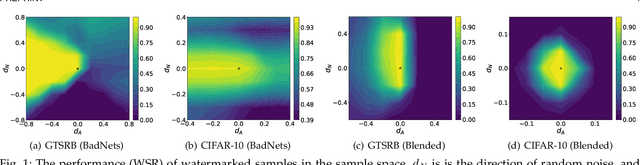
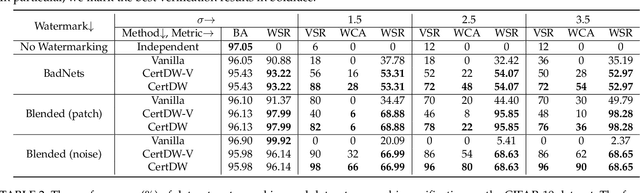
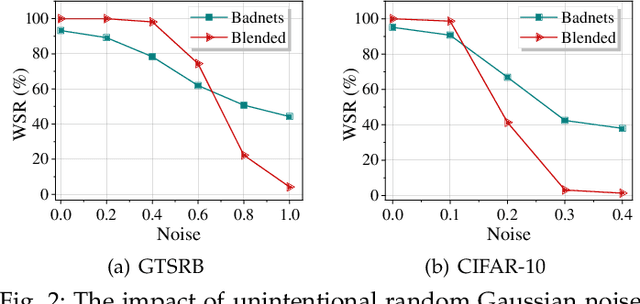
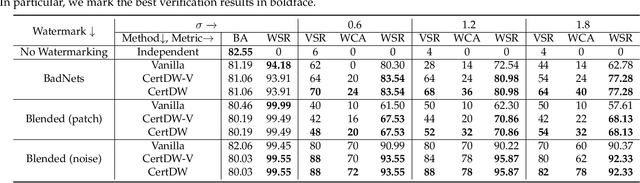
Deep neural networks (DNNs) rely heavily on high-quality open-source datasets (e.g., ImageNet) for their success, making dataset ownership verification (DOV) crucial for protecting public dataset copyrights. In this paper, we find existing DOV methods (implicitly) assume that the verification process is faithful, where the suspicious model will directly verify ownership by using the verification samples as input and returning their results. However, this assumption may not necessarily hold in practice and their performance may degrade sharply when subjected to intentional or unintentional perturbations. To address this limitation, we propose the first certified dataset watermark (i.e., CertDW) and CertDW-based certified dataset ownership verification method that ensures reliable verification even under malicious attacks, under certain conditions (e.g., constrained pixel-level perturbation). Specifically, inspired by conformal prediction, we introduce two statistical measures, including principal probability (PP) and watermark robustness (WR), to assess model prediction stability on benign and watermarked samples under noise perturbations. We prove there exists a provable lower bound between PP and WR, enabling ownership verification when a suspicious model's WR value significantly exceeds the PP values of multiple benign models trained on watermark-free datasets. If the number of PP values smaller than WR exceeds a threshold, the suspicious model is regarded as having been trained on the protected dataset. Extensive experiments on benchmark datasets verify the effectiveness of our CertDW method and its resistance to potential adaptive attacks. Our codes are at \href{https://github.com/NcepuQiaoTing/CertDW}{GitHub}.