 Add to Chrome
 Add to Firefox
 Add to Edge
Projecting Latent RL Actions: Towards Generalizable and Scalable Graph Combinatorial Optimization
May 19, 2026
Graph combinatorial optimization (GCO) has attracted growing interest, as many NP-hard problems naturally admit graph formulations, yet their combinatorial explosion renders exact methods computationally intractable. Recent advances in Reinforcement Learning (RL) combined with Graph Neural Networks (GNNs) have significantly improved learning-based GCO solvers. However, existing approaches face limitations in both generalization across diverse graph instances and computational scalability as action spaces grow. To address both challenges, we introduce projection agents, a novel RL-GCO approach that operates directly in a continuous GNN-based action embedding space, predicting a desired latent action in a single forward pass and subsequently decoding it into a valid discrete action. Additionally, we enable fair comparison across RL methods through a shared embedding space for both observations and actions. Across diverse benchmarks, our approach achieves up to 16.2x faster inference and up to 40% better generalization than existing solutions using only simple nearest-neighbor decoding, while opening the door to strong RL performance in super-linear decision spaces with multiple interdependent variables. Finally, we release LaGCO-RL, a Python library that automates latent action-space construction and supports existing RL-GCO solutions, promoting reproducibility and adaptation to new GCO benchmarks.

HOPSE: Scalable Higher-Order Positional and Structural Encoder for Combinatorial Representations
May 21, 2025While Graph Neural Networks (GNNs) have proven highly effective at modeling relational data, pairwise connections cannot fully capture multi-way relationships naturally present in complex real-world systems. In response to this, Topological Deep Learning (TDL) leverages more general combinatorial representations -- such as simplicial or cellular complexes -- to accommodate higher-order interactions. Existing TDL methods often extend GNNs through Higher-Order Message Passing (HOMP), but face critical \emph{scalability challenges} due to \textit{(i)} a combinatorial explosion of message-passing routes, and \textit{(ii)} significant complexity overhead from the propagation mechanism. To overcome these limitations, we propose HOPSE (Higher-Order Positional and Structural Encoder) -- a \emph{message passing-free} framework that uses Hasse graph decompositions to derive efficient and expressive encodings over \emph{arbitrary higher-order domains}. Notably, HOPSE scales linearly with dataset size while preserving expressive power and permutation equivariance. Experiments on molecular, expressivity and topological benchmarks show that HOPSE matches or surpasses state-of-the-art performance while achieving up to 7 $times$ speedups over HOMP-based models, opening a new path for scalable TDL.
TopoBenchmarkX: A Framework for Benchmarking Topological Deep Learning
Jun 09, 2024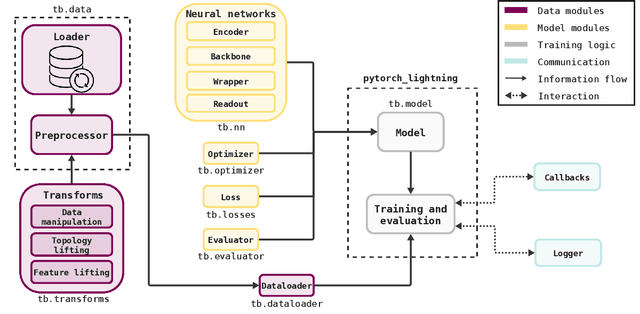
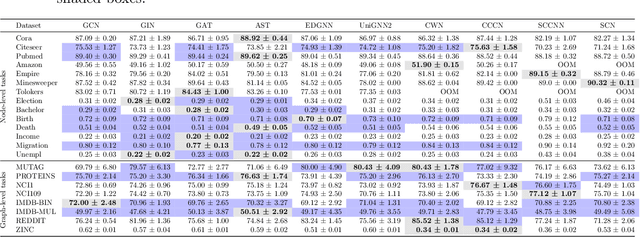
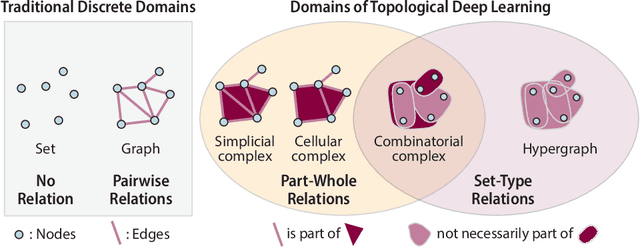
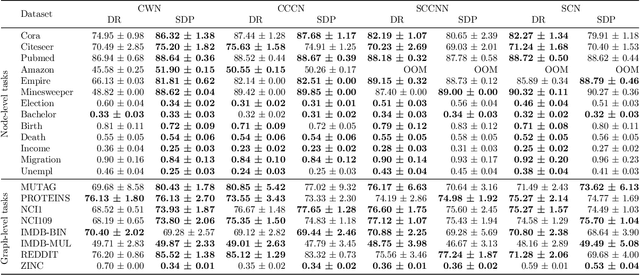
This work introduces TopoBenchmarkX, a modular open-source library designed to standardize benchmarking and accelerate research in Topological Deep Learning (TDL). TopoBenchmarkX maps the TDL pipeline into a sequence of independent and modular components for data loading and processing, as well as model training, optimization, and evaluation. This modular organization provides flexibility for modifications and facilitates the adaptation and optimization of various TDL pipelines. A key feature of TopoBenchmarkX is that it allows for the transformation and lifting between topological domains. This enables, for example, to obtain richer data representations and more fine-grained analyses by mapping the topology and features of a graph to higher-order topological domains such as simplicial and cell complexes. The range of applicability of TopoBenchmarkX is demonstrated by benchmarking several TDL architectures for various tasks and datasets.
Hypergraph Neural Networks through the Lens of Message Passing: A Common Perspective to Homophily and Architecture Design
Oct 11, 2023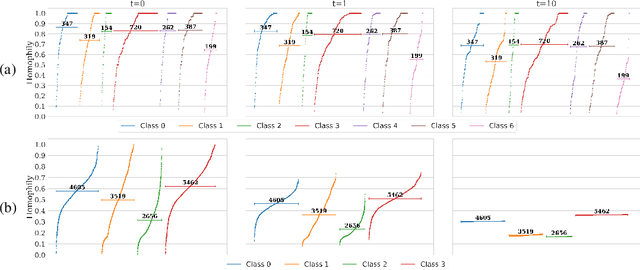
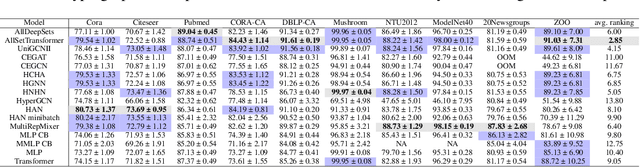

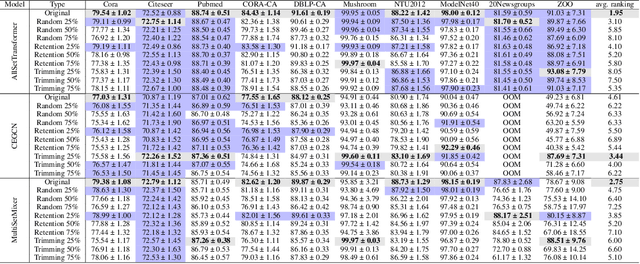
Most of the current hypergraph learning methodologies and benchmarking datasets in the hypergraph realm are obtained by lifting procedures from their graph analogs, simultaneously leading to overshadowing hypergraph network foundations. This paper attempts to confront some pending questions in that regard: Can the concept of homophily play a crucial role in Hypergraph Neural Networks (HGNNs), similar to its significance in graph-based research? Is there room for improving current hypergraph architectures and methodologies? (e.g. by carefully addressing the specific characteristics of higher-order networks) Do existing datasets provide a meaningful benchmark for HGNNs? Diving into the details, this paper proposes a novel conceptualization of homophily in higher-order networks based on a message passing scheme; this approach harmonizes the analytical frameworks of datasets and architectures, offering a unified perspective for exploring and interpreting complex, higher-order network structures and dynamics. Further, we propose MultiSet, a novel message passing framework that redefines HGNNs by allowing hyperedge-dependent node representations, as well as introduce a novel architecture MultiSetMixer that leverages a new hyperedge sampling strategy. Finally, we provide an extensive set of experiments that contextualize our proposals and lead to valuable insights in hypergraph representation learning.
ICML 2023 Topological Deep Learning Challenge : Design and Results
Oct 02, 2023

This paper presents the computational challenge on topological deep learning that was hosted within the ICML 2023 Workshop on Topology and Geometry in Machine Learning. The competition asked participants to provide open-source implementations of topological neural networks from the literature by contributing to the python packages TopoNetX (data processing) and TopoModelX (deep learning). The challenge attracted twenty-eight qualifying submissions in its two-month duration. This paper describes the design of the challenge and summarizes its main findings.