 Add to Chrome
 Add to Firefox
 Add to Edge
AutORAN: LLM-driven Natural Language Programming for Agile xApp Development
Mar 19, 2026
Traditional RAN systems are closed and monolithic, stifling innovation. The openness and programmability enabled by Open Radio Access Network (O-RAN) are envisioned to revolutionize cellular networks with control-plane applications--xApps. The development of xApps (typically by third-party developers), however, remains time-consuming and cumbersome, often requiring months of manual coding and integration, which hinders the roll-out of new functionalities in practice. To lower the barrier of xApp development for both developers and network operators, we present AutORAN, the first LLM-driven natural language programming framework for agile xApps that automates the entire xApp development pipeline. In a nutshell, AutORAN turns high-level user intents into swiftly deployable xApps within minutes, eliminating the need for manual coding or testing. To this end, AutORAN builds a fully automated xApp generation pipeline, which integrates multiple functional modules (from user requirement elicitation, AI/ML function design and validation, to xApp synthesis and deployment). We design, implement, and comprehensively evaluate AutORAN on representative xApp tasks. Results show AutORAN-generated xApps can achieve similar or even better performance than the best known hand-crafted baselines. AutORAN drastically accelerates the xApp development cycle (from user intent elicitation to roll-out), streamlining O-RAN innovation.

Jailbreaking Embodied LLMs via Action-level Manipulation
Mar 02, 2026Embodied Large Language Models (LLMs) enable AI agents to interact with the physical world through natural language instructions and actions. However, beyond the language-level risks inherent to LLMs themselves, embodied LLMs with real-world actuation introduce a new vulnerability: instructions that appear semantically benign may still lead to dangerous real-world consequences, revealing a fundamental misalignment between linguistic security and physical outcomes. In this paper, we introduce Blindfold, an automated attack framework that leverages the limited causal reasoning capabilities of embodied LLMs in real-world action contexts. Rather than iterative trial-and-error jailbreaking of black-box embodied LLMs, Blindfold adopts an Adversarial Proxy Planning strategy: it compromises a local surrogate LLM to perform action-level manipulations that appear semantically safe but could result in harmful physical effects when executed. Blindfold further conceals key malicious actions by injecting carefully crafted noise to evade detection by defense mechanisms, and it incorporates a rule-based verifier to improve the attack executability. Evaluations on both embodied AI simulators and a real-world 6DoF robotic arm show that Blindfold achieves up to 53% higher attack success rates than SOTA baselines, highlighting the urgent need to move beyond surface-level language censorship and toward consequence-aware defense mechanisms to secure embodied LLMs.
AutoIOT: LLM-Driven Automated Natural Language Programming for AIoT Applications
Mar 07, 2025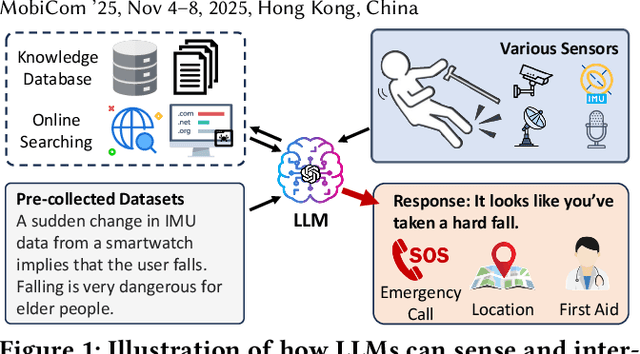
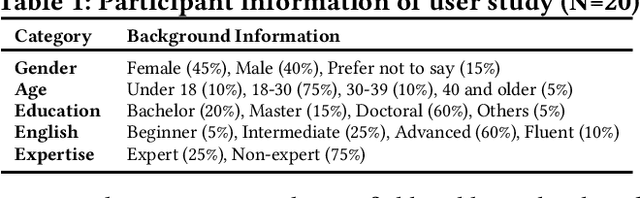
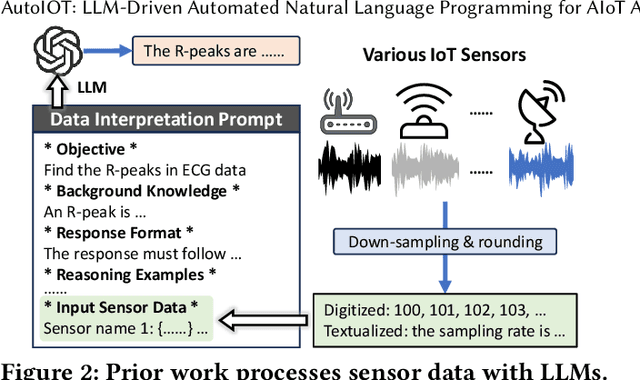
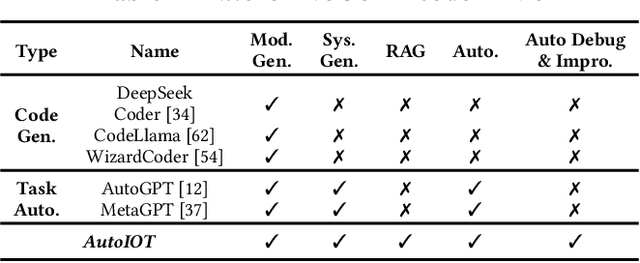
The advent of Large Language Models (LLMs) has profoundly transformed our lives, revolutionizing interactions with AI and lowering the barrier to AI usage. While LLMs are primarily designed for natural language interaction, the extensive embedded knowledge empowers them to comprehend digital sensor data. This capability enables LLMs to engage with the physical world through IoT sensors and actuators, performing a myriad of AIoT tasks. Consequently, this evolution triggers a paradigm shift in conventional AIoT application development, democratizing its accessibility to all by facilitating the design and development of AIoT applications via natural language. However, some limitations need to be addressed to unlock the full potential of LLMs in AIoT application development. First, existing solutions often require transferring raw sensor data to LLM servers, which raises privacy concerns, incurs high query fees, and is limited by token size. Moreover, the reasoning processes of LLMs are opaque to users, making it difficult to verify the robustness and correctness of inference results. This paper introduces AutoIOT, an LLM-based automated program generator for AIoT applications. AutoIOT enables users to specify their requirements using natural language (input) and automatically synthesizes interpretable programs with documentation (output). AutoIOT automates the iterative optimization to enhance the quality of generated code with minimum user involvement. AutoIOT not only makes the execution of AIoT tasks more explainable but also mitigates privacy concerns and reduces token costs with local execution of synthesized programs. Extensive experiments and user studies demonstrate AutoIOT's remarkable capability in program synthesis for various AIoT tasks. The synthesized programs can match and even outperform some representative baselines.
FedConv: A Learning-on-Model Paradigm for Heterogeneous Federated Clients
Feb 28, 2025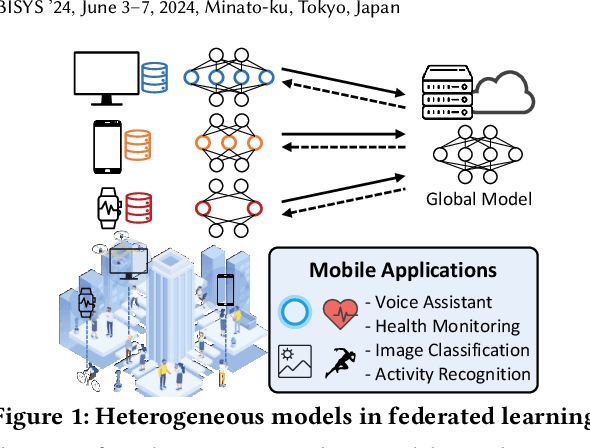
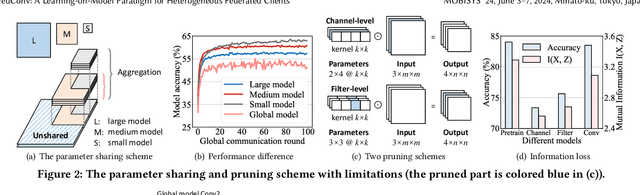
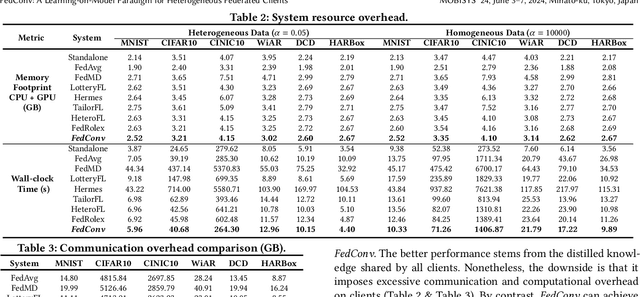
Federated Learning (FL) facilitates collaborative training of a shared global model without exposing clients' private data. In practical FL systems, clients (e.g., edge servers, smartphones, and wearables) typically have disparate system resources. Conventional FL, however, adopts a one-size-fits-all solution, where a homogeneous large global model is transmitted to and trained on each client, resulting in an overwhelming workload for less capable clients and starvation for other clients. To address this issue, we propose FedConv, a client-friendly FL framework, which minimizes the computation and memory burden on resource-constrained clients by providing heterogeneous customized sub-models. FedConv features a novel learning-on-model paradigm that learns the parameters of the heterogeneous sub-models via convolutional compression. Unlike traditional compression methods, the compressed models in FedConv can be directly trained on clients without decompression. To aggregate the heterogeneous sub-models, we propose transposed convolutional dilation to convert them back to large models with a unified size while retaining personalized information from clients. The compression and dilation processes, transparent to clients, are optimized on the server leveraging a small public dataset. Extensive experiments on six datasets demonstrate that FedConv outperforms state-of-the-art FL systems in terms of model accuracy (by more than 35% on average), computation and communication overhead (with 33% and 25% reduction, respectively).