 Add to Chrome
 Add to Firefox
 Add to Edge
Deep Learning-Empowered Movable-Antenna Position Optimization with Partial CSI
Jun 16, 2026
Movable antennas (MAs) are a promising technology to improve wireless data rates by dynamically adjusting their positions to avoid deep fading. However, finding the optimal MA positions requires full channel state information (CSI) for all possible locations within the movement region, creating massive channel estimation overhead. This paper proposes a deep neural network (DNN)-based learning framework to predict the optimal positions of multiple transmit MAs in a multi-user multiple-input single-output (MISO) system, entirely bypassing explicit channel estimation.First, we analyze a single-user MISO case, revealing a complex, highly nonlinear mapping between the optimal MA positions and the channel power gains from a specific subset of locations in the transmit region to the user. Because this mapping cannot be mathematically characterized for practical channel models, we train a DNN via supervised learning to capture it. The pre-trained DNN can then determine optimized MA positions in real-time relying only on partial power measurements from the transmit region.Extending this to multi-user scenarios is challenging due to complex rate expressions and the lack of globally optimal position solutions to use as training labels. To overcome this, we develop an unsupervised training framework that directly maximizes the multi-user sum-rate. This framework utilizes an attention-based architecture to extract latent features from the partial channel measurements and effectively manage inter-user interference. Simulation results show that our proposed approach achieves near-optimal performance in single-user systems and surpasses conventional CSI-based alternating optimization algorithms in multi-user environments.

Performance Optimization for Movable Antenna Enhanced MISO-OFDM Systems
Oct 02, 2025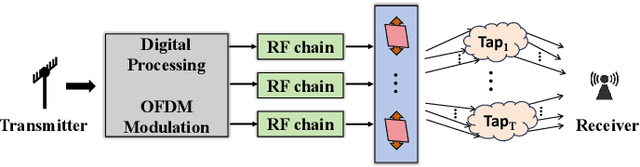
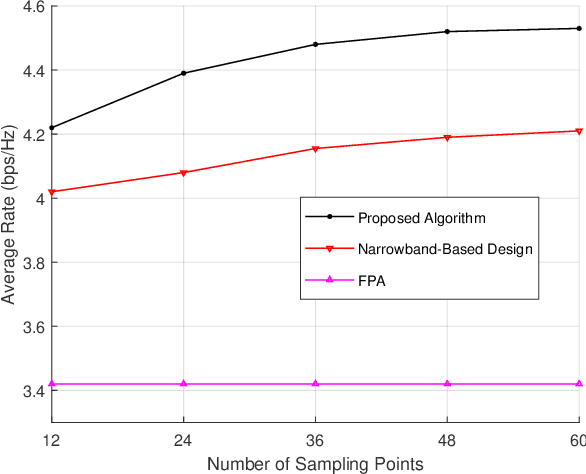
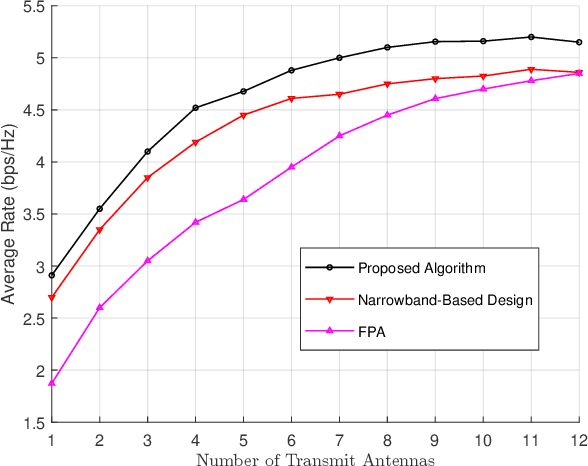
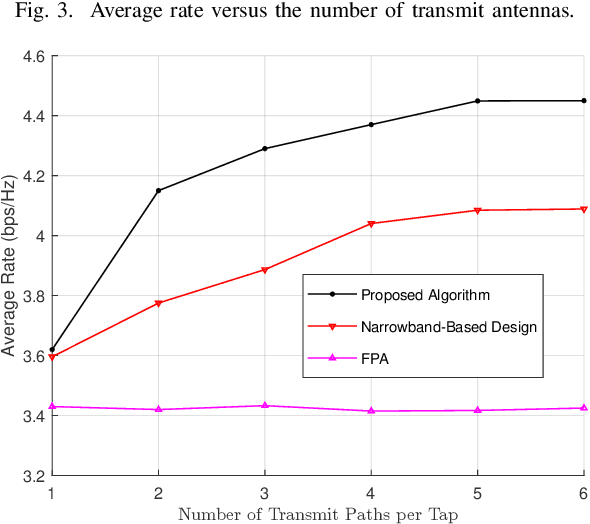
Movable antenna (MA) technology offers a flexible approach to enhancing wireless channel conditions by adjusting antenna positions within a designated region. While most existing works focus on narrowband MA systems, this paper investigates MA position optimization for an MA-enhanced multiple-input single-output (MISO) orthogonal frequency-division multiplexing (OFDM) system. This problem appears to be particularly challenging due to the frequency-flat nature of MA positioning, which should accommodate the channel conditions across different subcarriers. To overcome this challenge, we discretize the movement region into a multitude of sampling points, thereby converting the continuous position optimization problem into a discrete point selection problem. Although this problem is combinatorial, we develop an efficient partial enumeration algorithm to find the optimal solution using a branch-and-bound framework, where a graph-theoretic method is incorporated to effectively prune suboptimal solutions. In the low signal-to-noise ratio (SNR) regime, a simplified graph-based algorithm is also proposed to obtain the optimal MA positions without the need for enumeration. Simulation results reveal that the proposed algorithm outperforms conventional fixed-position antennas (FPAs), while narrowband-based antenna position optimization can achieve near-optimal performance.