 Add to Chrome
 Add to Firefox
 Add to Edge
Transcription Policy as a Latent Variable: Activating Controllable Verbatim ASR with Word-Level Timing
Jul 21, 2026
Modern ASR models trained on heterogeneously annotated data treat transcription style (verbatim vs. intended) as an uncontrolled latent variable, causing measurable decoding instability, evaluation confounding (up to 60% of reported WER attributable to style mismatch), and unreliable word-level timing. We show that models already encode both styles; the challenge is controlled activation. Using coverage-aware decoder task tokens trained on parallel verbatim/intended transcript pairs, we raise German disfluency F1 from 10% to 79% zero-shot, despite English-only training. Full English-only fine-tuning surpasses all baselines in verbatim accuracy, disfluency detection, and intended-mode quality across both languages. We further introduce supervised cross-attention fine-tuning that improves word-level timestamps on disfluent speech beyond forced-alignment baselines. Finally, we propose verbatimize, a new task enabling scalable creation and enrichment of speech corpora with high-quality canonical verbatim transcriptions.

Content is What Remains: Invariant Speech Tokenization from Parallel Utterances
Jul 21, 2026Discrete speech tokenizers aim to disentangle semantic from acoustic information, yet targets from self-supervised learning (SSL) models like HuBERT retain non-linguistic variation: speaker identity, prosody, and channel conditions leak into the tokens, inflating entropy. Our key insight is that when enough speakers utter the same words under varying conditions, linguistic content is the only shared factor. We propose PINT (Parallel INvariant Tokenization), which fine-tunes an SSL encoder with alignment losses across parallel utterances and augmentations to distill this shared residual. PINT collapses identical words onto consistent token sequences, drastically reducing conditional entropy. Unlike ASR text, PINT tokens preserve frame-level temporal grounding and serve as drop-in semantic targets for audio codecs. Experiments show a 98.7% relative reduction in speaker probe accuracy (93.1% to 1.2%), a 42% lower ABX error rate, and 27-30% lower LM perplexity versus baselines, confirming that the right invariance is key to efficient learning.
CrisperWhisper: Accurate Timestamps on Verbatim Speech Transcriptions
Aug 29, 2024We demonstrate that carefully adjusting the tokenizer of the Whisper speech recognition model significantly improves the precision of word-level timestamps when applying dynamic time warping to the decoder's cross-attention scores. We fine-tune the model to produce more verbatim speech transcriptions and employ several techniques to increase robustness against multiple speakers and background noise. These adjustments achieve state-of-the-art performance on benchmarks for verbatim speech transcription, word segmentation, and the timed detection of filler events, and can further mitigate transcription hallucinations. The code is available open https://github.com/nyrahealth/CrisperWhisper.
Careful Whisper -- leveraging advances in automatic speech recognition for robust and interpretable aphasia subtype classification
Aug 02, 2023This paper presents a fully automated approach for identifying speech anomalies from voice recordings to aid in the assessment of speech impairments. By combining Connectionist Temporal Classification (CTC) and encoder-decoder-based automatic speech recognition models, we generate rich acoustic and clean transcripts. We then apply several natural language processing methods to extract features from these transcripts to produce prototypes of healthy speech. Basic distance measures from these prototypes serve as input features for standard machine learning classifiers, yielding human-level accuracy for the distinction between recordings of people with aphasia and a healthy control group. Furthermore, the most frequently occurring aphasia types can be distinguished with 90% accuracy. The pipeline is directly applicable to other diseases and languages, showing promise for robustly extracting diagnostic speech biomarkers.
The Group Loss++: A deeper look into group loss for deep metric learning
Apr 04, 2022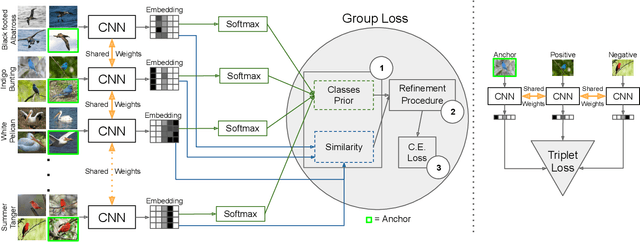
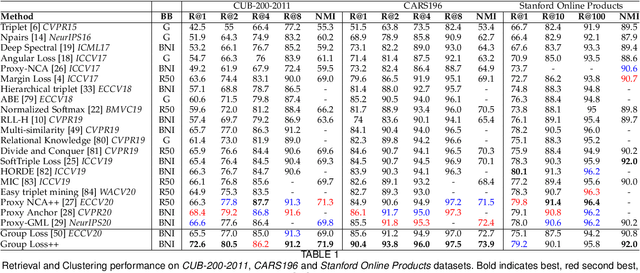
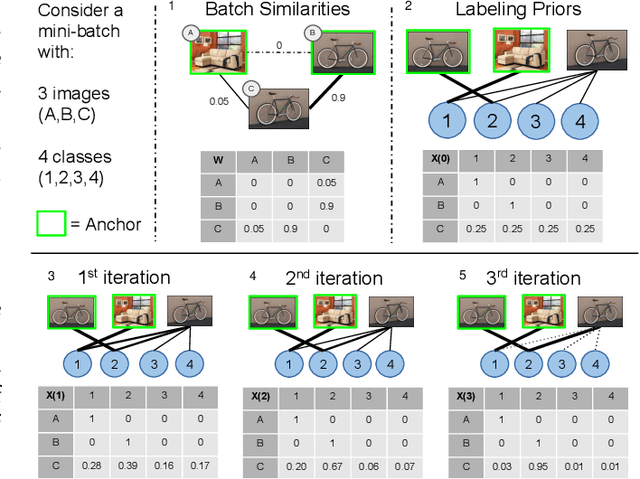
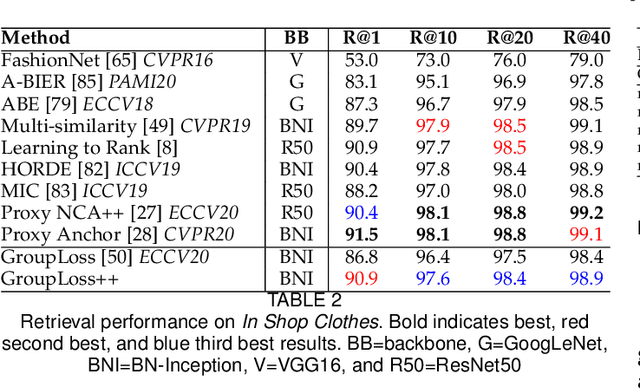
Deep metric learning has yielded impressive results in tasks such as clustering and image retrieval by leveraging neural networks to obtain highly discriminative feature embeddings, which can be used to group samples into different classes. Much research has been devoted to the design of smart loss functions or data mining strategies for training such networks. Most methods consider only pairs or triplets of samples within a mini-batch to compute the loss function, which is commonly based on the distance between embeddings. We propose Group Loss, a loss function based on a differentiable label-propagation method that enforces embedding similarity across all samples of a group while promoting, at the same time, low-density regions amongst data points belonging to different groups. Guided by the smoothness assumption that "similar objects should belong to the same group", the proposed loss trains the neural network for a classification task, enforcing a consistent labelling amongst samples within a class. We design a set of inference strategies tailored towards our algorithm, named Group Loss++ that further improve the results of our model. We show state-of-the-art results on clustering and image retrieval on four retrieval datasets, and present competitive results on two person re-identification datasets, providing a unified framework for retrieval and re-identification.