 Add to Chrome
 Add to Firefox
 Add to Edge
On the Identifiability of Semi-Blind Estimation in Cell-Free Massive MIMO Networks
May 20, 2026
Semi-blind joint channel estimation and data detection (JCD) is a promising approach to mitigate pilot contamination in cell-free massive multiple-input multiple-output (CF-MaMIMO) networks. The effectiveness of such methods fundamentally depends on identifiability, i.e., the ability to unambiguously recover the unknown channel coefficients and transmitted data signals from the received uplink observations. In this work, we investigate the identifiability of semi-blind JCD from a large-scale system design perspective. We consider a CF-MaMIMO network in which access points (APs) and user equipments (UEs) are spatially distributed according to Poisson point processes (PPPs). The resulting network topology is modeled as bipartite random geometric graph (BRGG) that captures local connectivity induced by wireless propagation. To enable a tractable analysis, the spatially dependent graph model is approximated by a surrogate independent-edge random graph with matched degree distributions. Building on this model, we develop a recursive probabilistic analysis that characterizes the conditions under which semi-blind recovery succeeds with high probability. The proposed analysis reveals an identifiability region as a function of key system parameters, including AP and UE densities and the connectivity radius beyond which channel coefficients are assumed negligible. Monte Carlo simulations validate the predicted identifiability region and assess the accuracy of the proposed graph approximation. The proposed framework provides system level insights into how network density and connectivity affect identifiability in large-scale CF-MaMIMO systems and offers guidelines for selecting deployment parameters and pilot sequence lengths that enable reliable semi-blind recovery.

Expectation Propagation for Distributed Inference in Grant-Free Cell-Free Massive MIMO
Jan 07, 2026Grant-free cell-free massive multiple-input multiple-output (GF-CF-MaMIMO) systems are anticipated to be a key enabling technology for next-generation Internet-of-Things (IoT) networks, as they support massive connectivity without explicit scheduling. However, the large amount of connected devices prevents the use of orthogonal pilot sequences, resulting in severe pilot contamination (PC) that degrades channel estimation and data detection performance. Furthermore, scalable GF-CF-MaMIMO networks inherently rely on distributed signal processing. In this work, we consider the uplink of a GF-CF-MaMIMO system and propose two novel distributed algorithms for joint activity detection, channel estimation, and data detection (JACD) based on expectation propagation (EP). The first algorithm, denoted as JACD-EP, uses Gaussian approximations for the channel variables, whereas the second, referred to as JACD-EP-BG, models them as Bernoulli-Gaussian (BG) random variables. To integrate the BG distribution into the EP framework, we derive its exponential family representation and develop the two algorithms as efficient message passing over a factor graph constructed from the a posteriori probability (APP) distribution. The proposed framework is inherently scalable with respect to both the number of access points (APs) and user equipments (UEs). Simulation results show the efficient mitigation of PC by the proposed distributed algorithms and their superior detection accuracy compared to (genie-aided) centralized linear detectors.
Distributed Joint User Activity Detection, Channel Estimation, and Data Detection via Expectation Propagation in Cell-Free Massive MIMO
May 16, 2024
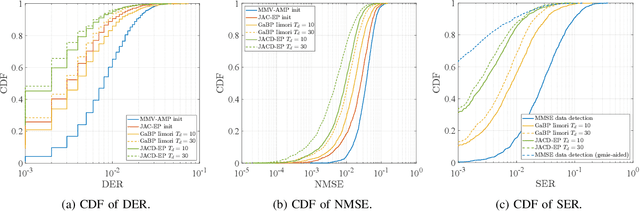


We consider the uplink of a grant-free cell-free massive multiple-input multiple-output (GF-CF-MaMIMO) system. We propose an algorithm for distributed joint activity detection, channel estimation, and data detection (JACD) based on expectation propagation (EP) called JACD-EP. We develop the algorithm by factorizing the a posteriori probability (APP) of activities, channels, and transmitted data, then, mapping functions and variables onto a factor graph, and finally, performing a message passing on the resulting factor graph. If users with the same pilot sequence are sufficiently distant from each other, the JACD-EP algorithm is able to mitigate the effects of pilot contamination which naturally occurs in grant-free systems due to the large number of potential users and limited signaling resources. Furthermore, it outperforms state-of-the-art algorithms for JACD in GF-CF-MaMIMO systems.
Detection Schemes with Low-Resolution ADCs and Spatial Oversampling for Transmission with Higher-Order Constellations in the Terahertz Band
Feb 07, 2024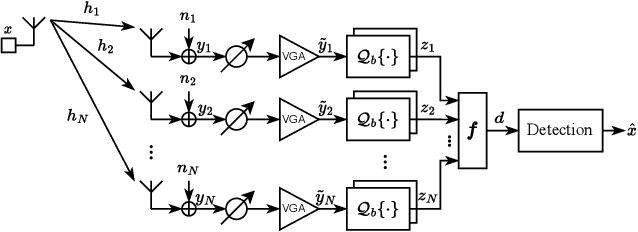
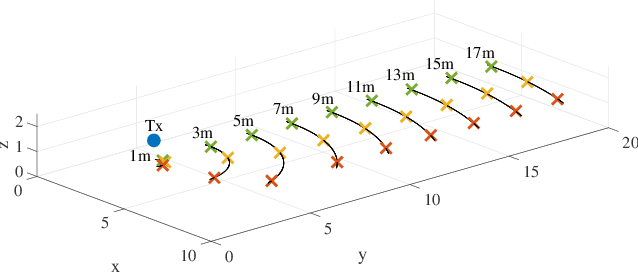
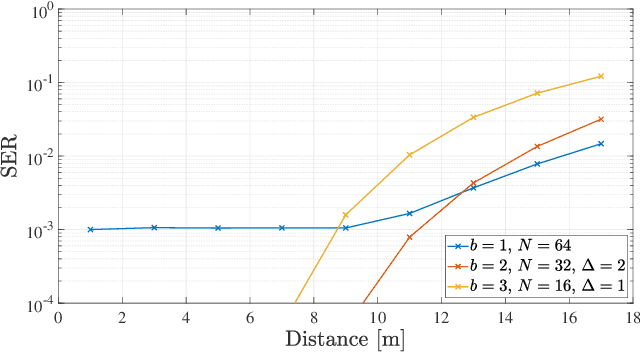
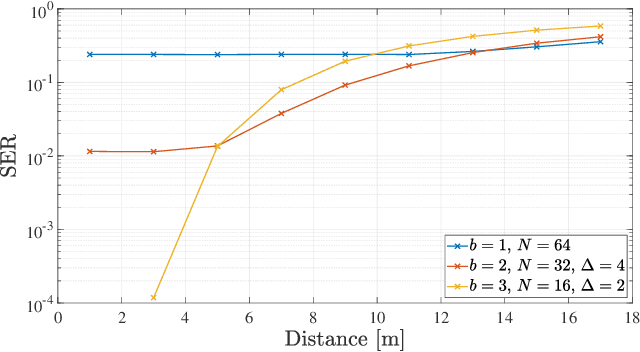
In this work, we consider Terahertz (THz) communications with low-resolution uniform quantization and spatial oversampling at the receiver side. We compare different analog-to-digital converter (ADC) parametrizations in a fair manner by keeping the ADC power consumption constant. Here, 1-, 2-, and 3-bit quantization is investigated with different oversampling factors. We analytically compute the statistics of the detection variable, and we propose the optimal as well as several suboptimal detection schemes for arbitrary quantization resolutions. Then, we evaluate the symbol error rate (SER) of the different detectors for a 16- and a 64-ary quadrature amplitude modulation (QAM) constellation. The results indicate that there is a noticeable performance degradation of the suboptimal detection schemes compared to the optimal scheme when the constellation size is larger than the number of quantization levels. Furthermore, at low signal-to-noise ratios (SNRs), 1-bit quantization outperforms 2- and 3-bit quantization, respectively, even when employing higher-order constellations. We confirm our analytical results by Monte Carlo simulations. Both a pure line-of-sight (LoS) and a more realistically modeled indoor THz channel are considered. Then, we optimize the input signal constellation with respect to SER for 1-bit quantization. The results show that the minimum SER can be lowered significantly for 16-QAM by increasing the distance between the inner and outer points of the input constellation. For larger constellations, however, the achievable reduction of the minimum SER is much smaller compared to 16-QAM.
Bilinear Expectation Propagation for Distributed Semi-Blind Joint Channel Estimation and Data Detection in Cell-Free Massive MIMO
Dec 18, 2023We consider a cell-free massive multiple-input multiple-output (CF-MaMIMO) communication system in the uplink transmission and propose a novel algorithm for blind or semi-blind joint channel estimation and data detection (JCD). We formulate the problem in the framework of bilinear inference and develop a solution based on the expectation propagation (EP) method for both channel estimation and data detection. We propose a new approximation of the joint a posteriori distribution of the channel and data whose representation as a factor graph enables the application of the EP approach using the message-passing technique, local low-complexity computations at the nodes, and an effective modeling of channel-data interplay. The derived algorithm, called bilinear-EP JCD, allows for a distributed implementation among access points (APs) and the central processing unit (CPU) and has polynomial complexity. Our simulation results show that it outperforms other EP-based state-of-the-art polynomial time algorithms.
Analysis of Neural Image Compression Networks for Machine-to-Machine Communication
May 13, 2022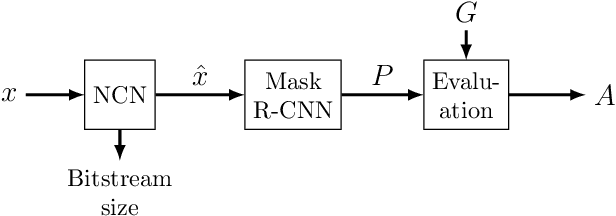

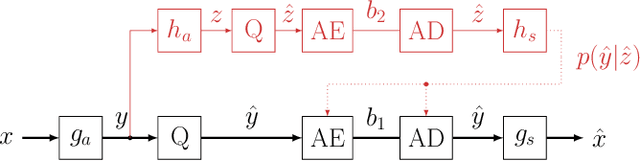
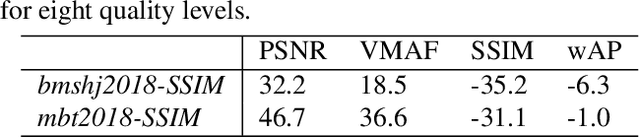
Video and image coding for machines (VCM) is an emerging field that aims to develop compression methods resulting in optimal bitstreams when the decoded frames are analyzed by a neural network. Several approaches already exist improving classic hybrid codecs for this task. However, neural compression networks (NCNs) have made an enormous progress in coding images over the last years. Thus, it is reasonable to consider such NCNs, when the information sink at the decoder side is a neural network as well. Therefore, we build-up an evaluation framework analyzing the performance of four state-of-the-art NCNs, when a Mask R-CNN is segmenting objects from the decoded image. The compression performance is measured by the weighted average precision for the Cityscapes dataset. Based on that analysis, we find that networks with leaky ReLU as non-linearity and training with SSIM as distortion criteria results in the highest coding gains for the VCM task. Furthermore, it is shown that the GAN-based NCN architecture achieves the best coding performance and even out-performs the recently standardized Versatile Video Coding (VVC) for the given scenario.
* Originally submitted at IEEE ICIP 2021