 Add to Chrome
 Add to Firefox
 Add to Edge
Sensor-Placement-Agnostic Sonomyography: Toward Continuous High-Dimensional Control by Users with Tetraplegia
Jul 29, 2026
Sonomyography (SMG) enables continuous device control via ultrasound-measured muscle deformation signals, but existing SMG interfaces generally require substantial user- and sensor-location-specific training data and provide only one proportional signal or task-specific classification. We present a real-time, sensor-placement-agnostic SMG control system based on sparse optical flow tracking that enables continuous 1-DOF control after minimal calibration (3 pose definitions). We also present a preliminary expansion of this method that augments this algorithm with a short computer-aided calibration to enable 2-DOF control. We evaluate both 1- and 2-DOF systems' performance for a preliminary cohort of 3 cervical spinal cord injury survivors and 6 uninjured individuals across 6 sensor placements spanning the arm, neck, and upper torso. As assessed by a cursor trajectory tracking task, all participants achieved continuous 1-DOF control at all tested sensor locations (even those that relied on passive tissue motions), with all participants achieving <5.5% tracking error using at least one placement (and many <4% across many). All participants were also able to modulate 2D cursor position via the 2-DOF system, with varying levels of control authority, and several were able to complete a 2D drawing task, constituting the first (to our knowledge) demonstration of location-agnostic multi-DOF continuous SMG-based control. These results highlight the promise of SMG to enable rapidly calibratable, high-dimensional, sensor-placement-agnostic device control by users with tetraplegia, and also illuminate key challenges in both signal processing and practical system deployment. To enable further development by scientific and user communities, developed algorithms have been open-sourced as part of the OpenMyoControl project on SimTK (simtk.org/projects/openmyocontrol).

Characterizing Healthy & Post-Stroke Neuromotor Behavior During 6D Upper-Limb Isometric Gaming: Implications for Design of End-Effector Rehabilitation Robot Interfaces
Mar 10, 2026Successful robot-mediated rehabilitation requires designing games and robot interventions that promote healthy motor practice. However, the interplay between a given user's neuromotor behavior, the gaming interface, and the physical robot makes designing system elements -- and even characterizing what behaviors are "healthy" or pathological -- challenging. We leverage our OpenRobotRehab 1.0 open access data set to assess the characteristics of 13 healthy and 2 post-stroke users' force output, muscle activations, and game performance while executing isometric trajectory tracking tasks using an end-effector rehabilitation robot. We present an assessment of how subtle aspects of interface design impact user behavior; an analysis of how pathological neuromotor behaviors are reflected in end-effector force dynamics; and a novel hidden Markov model (HMM)-based neuromotor behavior classification method based on surface electromyography (sEMG) signals during cyclic motions. We demonstrate that task specification (including which axes are constrained and how users interpret tracking instructions) shapes user behavior; that pathology-related features are detectable in 6D end-effector force data during isometric task execution (with significant differences between healthy and post-stroke profiles in force error and average force production at $p=0.05$); and that healthy neuromotor strategies are heterogeneous and inherently difficult to characterize. We also show that our HMM-based models discriminate healthy and post-stroke neuromotor dynamics where synergy-based decompositions reflect no such differentiation. Lastly, we discuss these results' implications for the design of adaptive end-effector rehabilitation robots capable of promoting healthier movement strategies across diverse user populations.
A Computer Vision Pipeline for Automated Determination of Cardiac Structure and Function and Detection of Disease by Two-Dimensional Echocardiography
Jan 12, 2018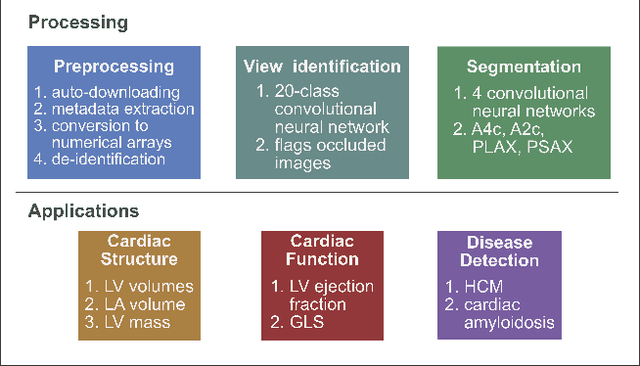
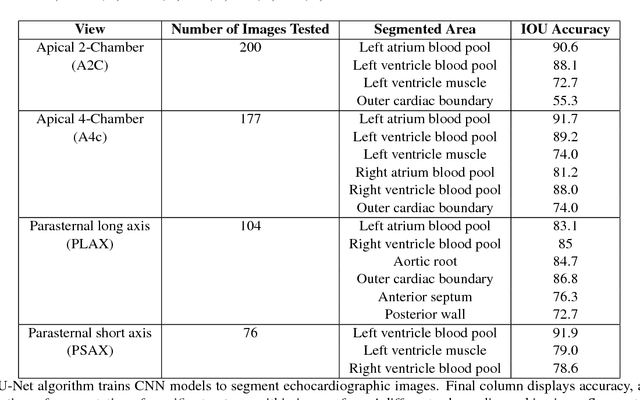
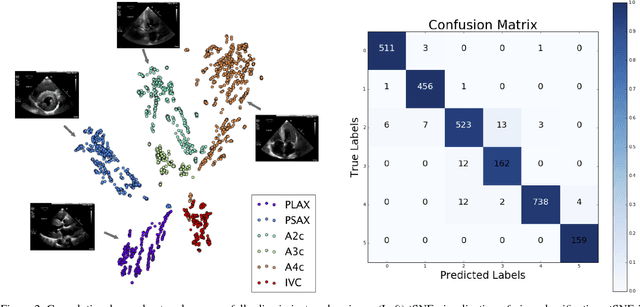
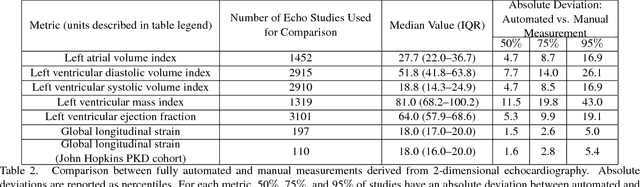
Automated cardiac image interpretation has the potential to transform clinical practice in multiple ways including enabling low-cost serial assessment of cardiac function in the primary care and rural setting. We hypothesized that advances in computer vision could enable building a fully automated, scalable analysis pipeline for echocardiogram (echo) interpretation. Our approach entailed: 1) preprocessing; 2) convolutional neural networks (CNN) for view identification, image segmentation, and phasing of the cardiac cycle; 3) quantification of chamber volumes and left ventricular mass; 4) particle tracking to compute longitudinal strain; and 5) targeted disease detection. CNNs accurately identified views (e.g. 99% for apical 4-chamber) and segmented individual cardiac chambers. Cardiac structure measurements agreed with study report values (e.g. mean absolute deviations (MAD) of 7.7 mL/kg/m2 for left ventricular diastolic volume index, 2918 studies). We computed automated ejection fraction and longitudinal strain measurements (within 2 cohorts), which agreed with commercial software-derived values [for ejection fraction, MAD=5.3%, N=3101 studies; for strain, MAD=1.5% (n=197) and 1.6% (n=110)], and demonstrated applicability to serial monitoring of breast cancer patients for trastuzumab cardiotoxicity. Overall, we found that, compared to manual measurements, automated measurements had superior performance across seven internal consistency metrics with an average increase in the Spearman correlation coefficient of 0.05 (p=0.02). Finally, we developed disease detection algorithms for hypertrophic cardiomyopathy and cardiac amyloidosis, with C-statistics of 0.93 and 0.84, respectively. Our pipeline lays the groundwork for using automated interpretation to support point-of-care handheld cardiac ultrasound and large-scale analysis of the millions of echos archived within healthcare systems.