 Add to Chrome
 Add to Firefox
 Add to Edge
Characterizing Healthy & Post-Stroke Neuromotor Behavior During 6D Upper-Limb Isometric Gaming: Implications for Design of End-Effector Rehabilitation Robot Interfaces
Mar 10, 2026
Successful robot-mediated rehabilitation requires designing games and robot interventions that promote healthy motor practice. However, the interplay between a given user's neuromotor behavior, the gaming interface, and the physical robot makes designing system elements -- and even characterizing what behaviors are "healthy" or pathological -- challenging. We leverage our OpenRobotRehab 1.0 open access data set to assess the characteristics of 13 healthy and 2 post-stroke users' force output, muscle activations, and game performance while executing isometric trajectory tracking tasks using an end-effector rehabilitation robot. We present an assessment of how subtle aspects of interface design impact user behavior; an analysis of how pathological neuromotor behaviors are reflected in end-effector force dynamics; and a novel hidden Markov model (HMM)-based neuromotor behavior classification method based on surface electromyography (sEMG) signals during cyclic motions. We demonstrate that task specification (including which axes are constrained and how users interpret tracking instructions) shapes user behavior; that pathology-related features are detectable in 6D end-effector force data during isometric task execution (with significant differences between healthy and post-stroke profiles in force error and average force production at $p=0.05$); and that healthy neuromotor strategies are heterogeneous and inherently difficult to characterize. We also show that our HMM-based models discriminate healthy and post-stroke neuromotor dynamics where synergy-based decompositions reflect no such differentiation. Lastly, we discuss these results' implications for the design of adaptive end-effector rehabilitation robots capable of promoting healthier movement strategies across diverse user populations.

Automated ultrasound doppler angle estimation using deep learning
Aug 06, 2025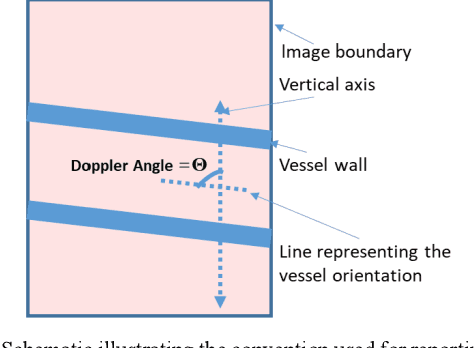

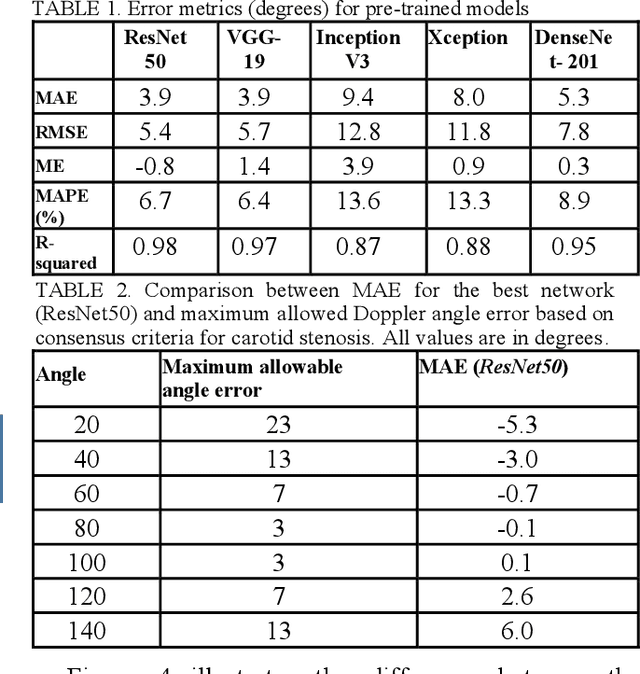
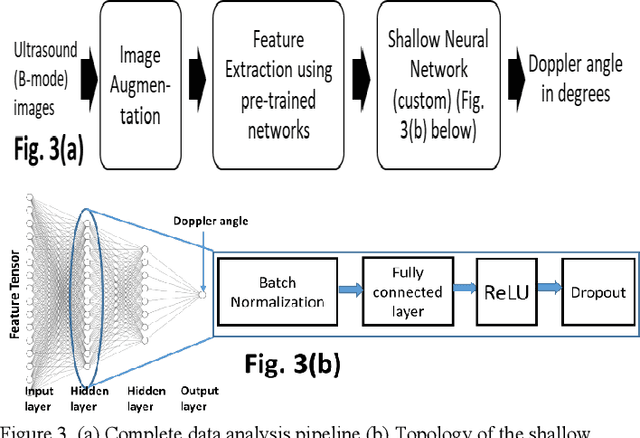
Angle estimation is an important step in the Doppler ultrasound clinical workflow to measure blood velocity. It is widely recognized that incorrect angle estimation is a leading cause of error in Doppler-based blood velocity measurements. In this paper, we propose a deep learning-based approach for automated Doppler angle estimation. The approach was developed using 2100 human carotid ultrasound images including image augmentation. Five pre-trained models were used to extract images features, and these features were passed to a custom shallow network for Doppler angle estimation. Independently, measurements were obtained by a human observer reviewing the images for comparison. The mean absolute error (MAE) between the automated and manual angle estimates ranged from 3.9{\deg} to 9.4{\deg} for the models evaluated. Furthermore, the MAE for the best performing model was less than the acceptable clinical Doppler angle error threshold thus avoiding misclassification of normal velocity values as a stenosis. The results demonstrate potential for applying a deep-learning based technique for automated ultrasound Doppler angle estimation. Such a technique could potentially be implemented within the imaging software on commercial ultrasound scanners.